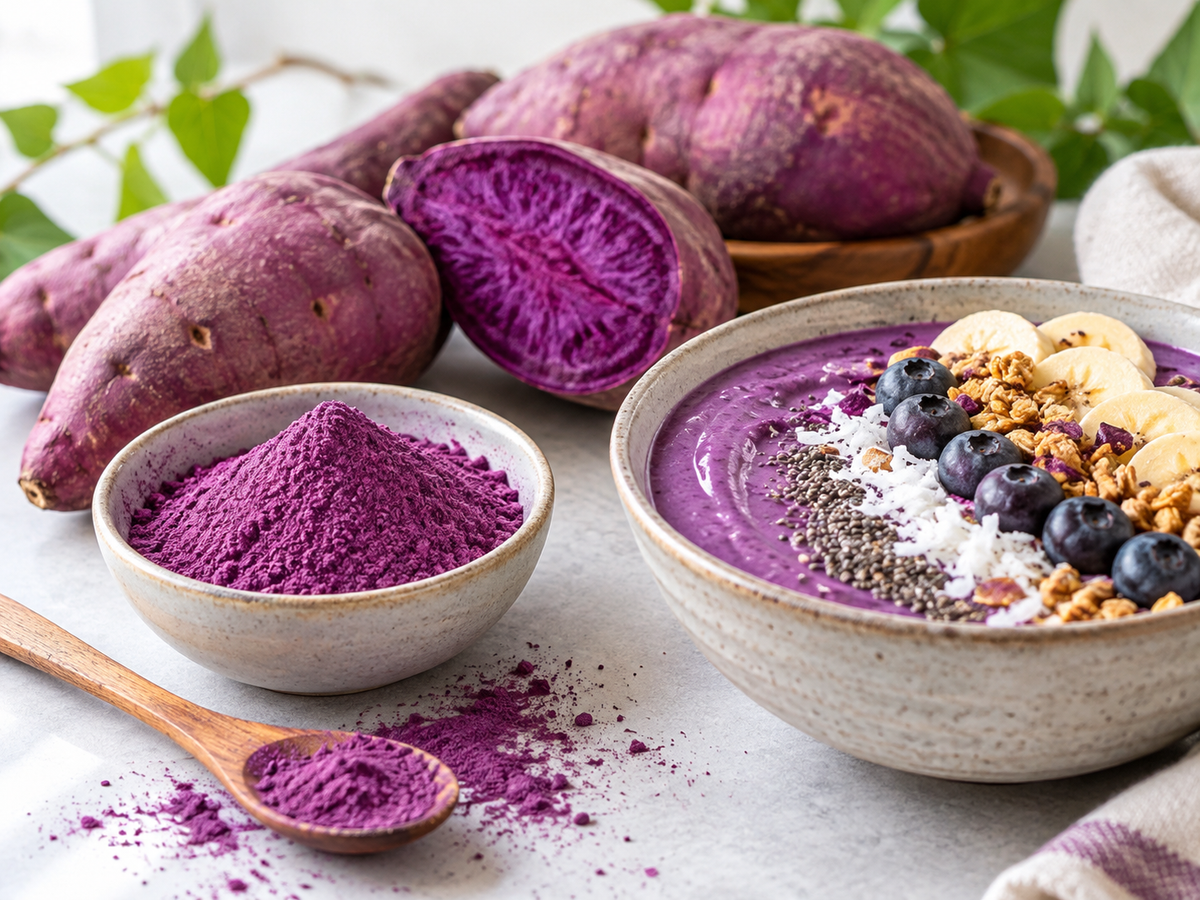
If you're interested in including more anthocyanin-containing foods in your diet, purple sweet potato is a plant worth getting to know. Although blueberries and other berries may be more familiar sources, purple-fleshed sweet potatoes offer a different botanical source of these naturally occurring plant compounds.
Purple sweet potato powder provides another way to incorporate this ingredient into everyday food. Rather than purchasing a fresh purple sweet potato and preparing it from scratch, you can use a powder derived from the plant in foods you already enjoy.
But what makes purple sweet potato interesting as an anthocyanin-containing food? How does it compare with berries? And what should you understand about the composition of a finished powder before choosing one?
The answers begin with the plant itself.
What Are Anthocyanins, and Why Are People Interested in Them?
Anthocyanins are naturally occurring plant pigments belonging to the flavonoid family of polyphenolic compounds. They contribute to the red, purple, and blue colors of many plant foods, including blueberries, blackberries, red cabbage, black rice, and purple sweet potatoes.
These compounds are more than a visual characteristic of plants. They are part of the plants' natural chemical composition and have become an active subject of food and nutrition research.
Scientists have investigated anthocyanins and anthocyanin-containing foods in connection with various aspects of human health. However, findings from laboratory studies, observational research, and clinical trials do not all establish the same conclusions. Research involving an isolated compound also cannot automatically be applied to a particular food or finished plant powder.
Anthocyanins are not essential nutrients with an established daily intake requirement. There is no specific amount that everyone must consume.
For someone interested in a varied, plant-rich diet, the more practical question is straightforward: which foods naturally contain anthocyanins, and how can different plant sources fit into everyday eating?
Purple sweet potato offers one answer.
Why Is Purple Sweet Potato a Natural Anthocyanin Source?
Purple sweet potato is a purple-fleshed form of Ipomoea batatas, the same botanical species that includes familiar orange- and white-fleshed sweet potatoes.
Its distinctive flesh color is associated with naturally occurring anthocyanins. Unlike a food that receives its color from an added ingredient, the purple pigments in purple sweet potato are part of the plant itself.
The anthocyanins identified in purple-fleshed sweet potatoes commonly include derivatives of cyanidin and peonidin. Many occur in acylated forms, meaning their molecular structures contain additional chemical groups that influence properties such as pigment color and stability.
These details help explain why purple sweet potato has attracted interest in food science. Its pigment composition is not identical to that of blueberries or other familiar anthocyanin-containing foods.
That difference does not establish that purple sweet potato is a better source or offers greater health benefits. It means the two plants have different botanical identities and naturally occurring compound profiles.
For consumers interested in dietary variety, this distinction is useful. Choosing foods from different plant sources can introduce a broader range of plant ingredients into the diet, rather than relying on one familiar food alone.
If you'd like a deeper explanation of the plant itself, its pigments, and its ingredient characteristics, read our Purple Sweet Potato Powder — Anthocyanins, Color & Uses.
Purple Sweet Potato vs. Blueberries: How Are Their Anthocyanins Different?
Purple sweet potatoes and blueberries both naturally contain anthocyanins, but they represent different types of plant foods.
Blueberries are familiar berry fruits, while purple sweet potato is a root vegetable. Their characteristic anthocyanin profiles also differ.
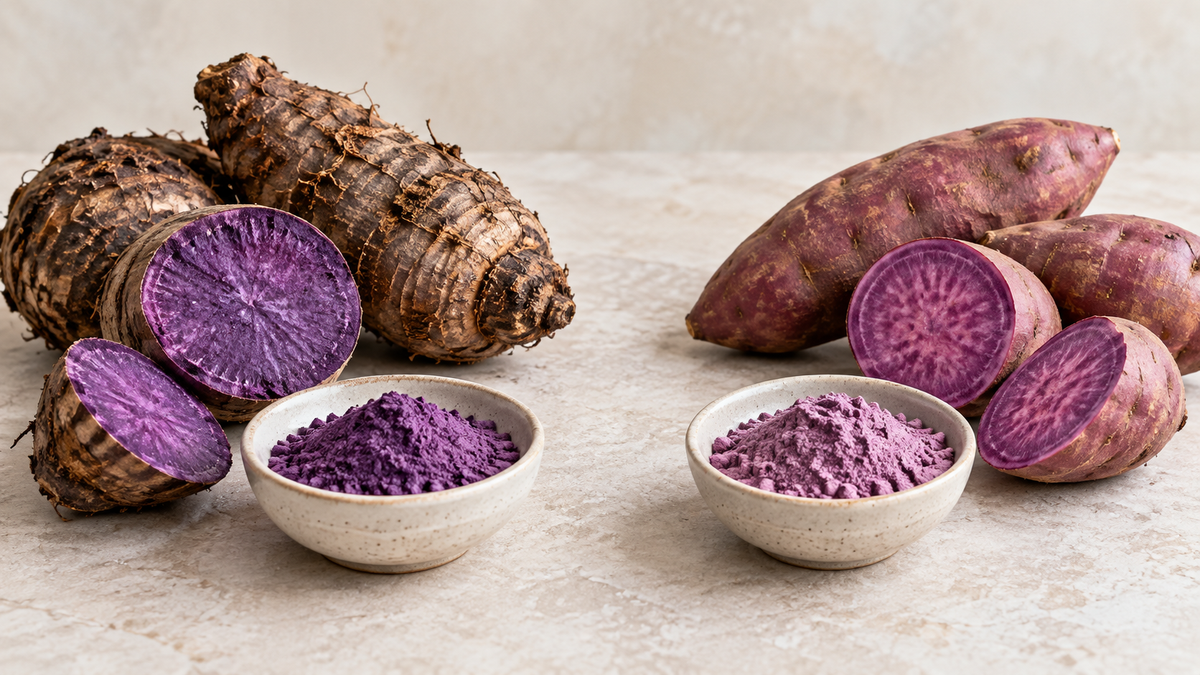
For example, purple-fleshed sweet potatoes are known for cyanidin- and peonidin-related compounds, frequently including acylated forms. Blueberries contain several anthocyanin groups, commonly including derivatives of delphinidin, cyanidin, petunidin, peonidin, and malvidin.
The comparison below highlights these differences without ranking either food as nutritionally superior.
| Feature | Purple Sweet Potato | Blueberries |
|---|---|---|
| Botanical identity | Ipomoea batatas | Vaccinium species |
| Plant type | Root vegetable | Berry fruit |
| Common food forms | Cooked sweet potato and plant-derived powder | Fresh, frozen, dried, juice-derived, and powdered ingredients |
| Characteristic anthocyanins | Cyanidin- and peonidin-related anthocyanins, often in acylated forms | Several anthocyanin groups, including delphinidin, cyanidin, petunidin, peonidin, and malvidin derivatives |
| Pigment characteristics | Acylated forms can influence color and stability under certain conditions | Pigment composition and behavior vary with the specific compounds and food environment |
| What consumers should understand | A different botanical source with its own natural plant composition | A familiar fruit source with a distinct anthocyanin profile |
The exact amount and composition of anthocyanins in either food can vary by cultivar, growing conditions, processing, and other factors. The table describes general characteristics of the plants, not the measured composition of a particular finished product.
The useful takeaway is not that one should replace the other. Both are examples of anthocyanin-containing foods, and each brings its own characteristics to a varied diet.
To learn more about berry-derived ingredients, see our Existing Blueberry / Anthocyanins Article.
Why Might Someone Choose Purple Sweet Potato Powder?
Fresh purple sweet potato is a food in its own right. It can be cooked and incorporated into meals much like other sweet potatoes.
A powder offers a different format for someone who wants to include purple sweet potato in foods they already prepare.
The main reason to consider purple sweet potato powder is its plant origin—not simply its color. It is a food ingredient derived from purple sweet potato, a plant naturally known for its anthocyanins and broader botanical composition.
That makes it different from purchasing an isolated anthocyanin extract or an artificial purple coloring ingredient.
An extract is produced to obtain particular components from a source material. A food powder derived from purple sweet potato represents a different ingredient format. The two should not be assumed to have the same composition or nutritional characteristics.
The distinction is particularly relevant to consumers who prefer to explore naturally occurring plant compounds through foods and food ingredients rather than through isolated preparations.
Purple sweet potato powder also offers an alternative to relying exclusively on familiar berry ingredients. Someone who regularly eats blueberries, for example, may be interested in incorporating a purple-fleshed root vegetable into their diet as another plant source.
Its powdered format provides practical flexibility. It can be incorporated into a range of everyday foods without requiring someone to prepare a fresh root each time.
For readers interested in this ingredient, Unleash’d Organic Purple Sweet Potato Powder is a food powder derived from purple sweet potato.
The important distinction is that a plant-derived powder is not a standardized anthocyanin preparation. Its actual composition depends on the finished ingredient, which leads to another useful question.
Does Purple Sweet Potato Powder Retain Anthocyanins?
Purple sweet potato naturally contains anthocyanins, but the amount present in a finished powder cannot be determined from the original plant alone.
Different purple sweet potato varieties can have different pigment profiles. Processing and storage conditions may also influence the anthocyanins present in a finished ingredient.
Factors such as temperature, oxygen exposure, light, and pH can affect anthocyanins. The extent of these effects depends on the specific compounds and conditions involved.
Research has shown that some acylated anthocyanins can exhibit different stability characteristics from non-acylated forms under certain conditions. That does not mean they are unaffected by drying, heating, storage, or other processing steps.
For this reason, it would be inaccurate to assume that every purple sweet potato powder retains the same anthocyanin composition as fresh purple sweet potato.
It is also important not to use color intensity as a substitute for compositional data. A darker purple powder does not automatically contain more anthocyanins than a lighter one.
For a particular finished product, verified compositional information is the appropriate basis for making a specific anthocyanin-content claim. Without that information, the exact amount should not be assumed.
This does not change purple sweet potato's identity as a naturally anthocyanin-containing plant. It simply distinguishes what is known about the original food from what can be established about an individual finished powder.
How Can Purple Sweet Potato Powder Fit Into Everyday Foods?
Purple sweet potato powder offers a practical way to introduce this plant ingredient into foods you already enjoy.
It can be incorporated into:
Smoothies: Blend it with fruit and a liquid base. The other ingredients and the amount of powder used will influence the finished texture and color.
Oatmeal: Stir or whisk it into prepared oats, adjusting the consistency as needed.
Yogurt bowls: Mix it into plain yogurt before adding fruit, seeds, or other toppings.
Pancakes and waffles: Incorporate it into a suitable batter, adjusting the recipe to account for the additional dry ingredient.
Other food preparations: Depending on the recipe, it may also be used in drinks, baked goods, or selected savory foods.
As with many plant powders, purple sweet potato powder generally disperses through a mixture rather than necessarily dissolving completely in water. A whisk or blender may help distribute it more evenly.
Its natural purple color and mild sweet-potato character can be useful in food preparation, but they are supporting characteristics. The broader reason to consider the ingredient is that it provides another way to include purple sweet potato in a varied diet.
You can explore this and other vegetable-derived ingredients in our Vegetable Powders collection.
The Bottom Line: Is Purple Sweet Potato Powder Worth Considering?
If you're interested in including more anthocyanin-containing plant foods in your diet, purple sweet potato is a source worth knowing about.
Its naturally occurring anthocyanins differ in composition from those found in familiar berries, offering another botanical source to explore as part of a varied eating pattern.
Purple sweet potato powder provides a convenient food format for incorporating this plant ingredient into everyday meals. It should not be confused with an isolated anthocyanin extract, nor should its exact anthocyanin content be assumed without product-specific information.
For consumers who want to explore purple sweet potato as a real plant-derived food ingredient, Unleash’d Organic Purple Sweet Potato Powder offers another option.
The central idea is simple: a varied diet can include many different plant foods, and purple sweet potato is one of them.

Leave a comment
This site is protected by hCaptcha and the hCaptcha Privacy Policy and Terms of Service apply.