Most people could name a few vegetables they would like to eat more often. Broccoli is usually somewhere on that list.
But knowing that and actually including it consistently in weekly meals are two different things. Busy schedules, repetitive meals, shopping, and preparation can all make it easy for vegetables to fall out of the routine.
Broccoli powder offers another option: a broccoli-derived food ingredient that can be incorporated into foods you already prepare, without requiring you to cook a fresh vegetable every time.
It is not a replacement for eating whole broccoli or other vegetables. Instead, it can complement a varied diet by giving you another way to keep a broccoli-derived ingredient in regular rotation.
That makes the more useful question not whether broccoli powder can replace a plate of vegetables—it cannot—but whether it can play a practical supporting role in a diet that could use more vegetable variety.
For some people, it can.
Why Vegetable Variety Matters, Too
Conversations about vegetables often focus on how much we eat. Quantity matters, but so does variety.
Different vegetables contain different combinations of naturally occurring nutrients, fiber, and plant compounds. No single vegetable represents the full nutritional range found across the vegetable category.
That is one reason dietary variety matters. Rotating among different vegetables exposes the diet to a broader range of plant foods instead of relying on the same few choices repeatedly.
Broccoli is especially interesting because it belongs to the cruciferous vegetable family, a botanical group that includes cauliflower, kale, cabbage, Brussels sprouts, and arugula.
These vegetables share certain naturally occurring plant compounds that distinguish them from many other vegetable groups.
Broccoli’s Nutritional Identity: More Than Just a Green Vegetable
Broccoli is commonly classified as Brassica oleracea var. italica, a member of the Brassicaceae family.
Like other whole vegetables, broccoli naturally contains a range of nutrients and plant compounds. These include dietary fiber, vitamins, minerals, and a class of compounds called glucosinolates.
Glucosinolates: Characteristic Compounds in Cruciferous Vegetables
Glucosinolates are sulfur-containing compounds naturally found in cruciferous vegetables.
Broccoli contains several glucosinolates, including glucoraphanin, one of the most widely discussed in broccoli research.
Glucoraphanin is related to another compound that many consumers may have heard of: sulforaphane.
They are not the same substance.
Glucoraphanin can be converted into sulforaphane under appropriate conditions through the activity of an enzyme called myrosinase. In the intact broccoli plant, these components are kept largely separate within the plant tissue. When that tissue is disrupted, such as through chopping or chewing, they can come into contact.
This relationship is important because preparation and processing can influence what ultimately remains in a food ingredient.
It also explains why information about glucoraphanin or sulforaphane in fresh broccoli should not automatically be applied to a finished broccoli powder.
Fiber, Vitamins, and Minerals
Fresh broccoli also naturally provides dietary fiber and a variety of vitamins and minerals.
These are part of the nutritional identity of broccoli as a whole vegetable.
However, the composition of a finished powder should be evaluated separately. Drying and processing can affect different nutrients and plant compounds in different ways, so product-specific information is more appropriate than simply applying fresh-broccoli values to a powdered ingredient.
If you are interested in another member of the same plant family, you can also read our Existing Cauliflower Powder Article.
What Broccoli Powder Actually Is
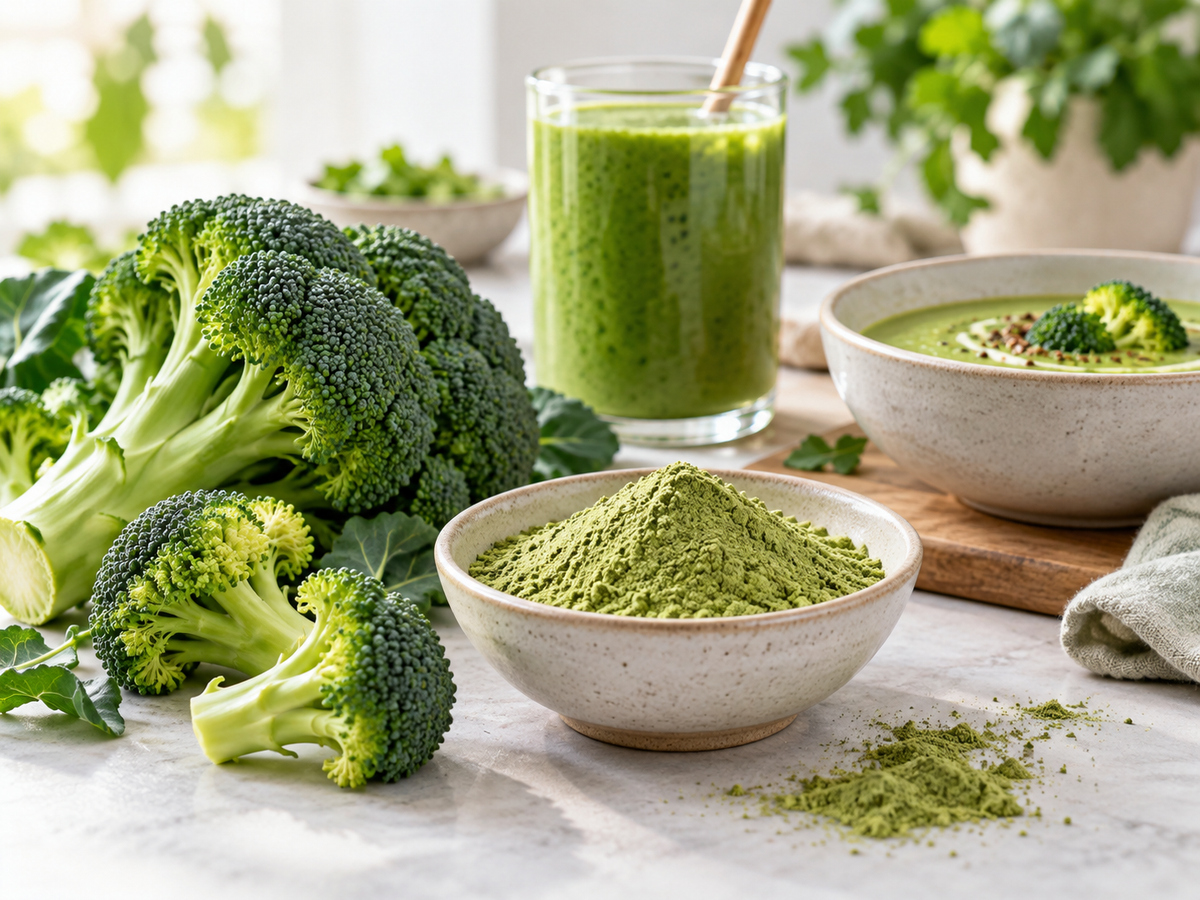
Broccoli powder is a food ingredient derived from broccoli that has been dried and ground into a powdered form.
Removing much of the water changes the physical format of the vegetable and makes the ingredient easier to store and incorporate into certain foods.
But broccoli powder should not be assumed to be nutritionally identical to fresh broccoli.
The source material, drying method, processing conditions, and storage can all influence the composition of the finished ingredient.
For that reason, specific claims about glucoraphanin levels, sulforaphane formation, myrosinase activity, fiber content, or other nutrients should come from verified information about the finished product—not from extrapolation based on research involving fresh broccoli.
What can be said more generally is that broccoli powder provides another food format derived from broccoli.
That is where its practical value comes in.
For readers interested in this type of ingredient, Unleash’d Organic Broccoli Powder provides a broccoli-derived food powder designed for everyday food use.
Fresh Broccoli and Broccoli Powder: Different Roles, Not a Trade-Off
Fresh broccoli and broccoli powder are better viewed as two different food formats rather than as direct substitutes.
| Feature | Fresh Broccoli | Broccoli Powder |
|---|---|---|
| Form | Whole florets and stalks | Fine dried powder |
| Preparation | Usually washed, chopped, and eaten raw or cooked | Mixed into suitable foods or beverages |
| Storage | Requires refrigeration and is relatively perishable | Follow package storage directions; typically designed for pantry storage when properly sealed |
| Fiber | Contains the dietary fiber of the whole vegetable | Actual fiber content should be checked on the finished product’s Nutrition Facts |
| Glucosinolates | Naturally present; levels can vary with variety and preparation | Finished levels depend on the source material and processing |
| Myrosinase | Naturally present in raw broccoli; activity may change with processing or cooking | Activity in the finished powder should not be assumed without product-specific information |
| Flavor | Familiar cruciferous vegetable flavor that changes with preparation | Concentrated broccoli-derived flavor |
| Dietary role | Whole vegetable that contributes to overall vegetable intake | Additional broccoli-derived ingredient that can complement whole vegetables |
Fresh broccoli provides the texture, volume, and eating experience of the whole vegetable.
Broccoli powder serves a different purpose.
It may be useful in situations where fresh broccoli does not naturally fit into the meal you are preparing, or when you want another way to include a broccoli-derived ingredient without adding a whole vegetable to the dish.
The two formats can coexist in the same diet.
What Does Processing Mean for Broccoli’s Natural Compounds?
This is an important question, especially for people interested in broccoli because of its glucosinolates.
The simplest answer is that processing matters.
Heat, drying, storage, and other processing conditions can influence different components of broccoli in different ways.
It would be inaccurate to assume that every broccoli powder retains the same glucosinolate profile, enzyme activity, or nutrient composition as fresh raw broccoli.
It would also be inaccurate to assume that all processing has the same effect.
A finished broccoli powder may retain some naturally occurring compounds from the original plant, but the amount and form present in a particular product depend on its source material and processing.
That is why product-specific information matters.
For Unleash’d Organic Broccoli Powder, any specific statement about glucosinolate content, glucoraphanin levels, myrosinase activity, or related compounds should be based on verified product data, such as manufacturer information or compositional testing.
Without that information, exact amounts should not be assumed.
This distinction allows us to talk accurately about broccoli as a plant while being careful not to overstate what has been established about a specific finished powder.
How to Actually Use Broccoli Powder
Broccoli powder has a noticeable green vegetable character, so it tends to work most naturally in foods where that flavor fits.
Savory Applications
Soups and broths: Stir it into vegetable soups, lentil soups, or other savory preparations where a broccoli-derived flavor makes sense.
Sauces and dips: Incorporate it into hummus, tahini-based sauces, blended vegetable sauces, or other savory mixtures.
Grains and bowls: Mix it into suitable sauces or liquid components used with rice, quinoa, or other grain-based dishes.
Blended Applications
Green smoothies: Broccoli powder can be blended with fruits, greens, and a liquid base. Other ingredients will influence the finished flavor and texture.
Savory breakfast preparations: It can also be incorporated into suitable savory oatmeal, egg dishes, or other foods where a vegetable flavor fits.
The amount used should depend on the recipe and any product-specific directions provided on the package.
As with many plant powders, broccoli powder generally disperses through a mixture rather than dissolving completely in water. A whisk or blender can help distribute it more evenly.
For other vegetable-derived ingredients, explore our Vegetable Powders collection.
Does Broccoli Powder Count as a Vegetable Serving?
Not in the same way as eating a portion of fresh or cooked broccoli.
A powdered ingredient differs from a whole vegetable in volume, texture, fiber profile, and potentially other aspects of its composition.
It is more useful to think of broccoli powder as an additional broccoli-derived ingredient rather than as a direct way to measure or replace a serving of vegetables.
Whole vegetables and dietary variety remain important.
Is Broccoli Powder Useful If You Already Eat Fresh Broccoli?
It can be.
If broccoli is already part of your regular meals, a powder does not need to replace it.
Instead, it may simply offer another format for situations where fresh broccoli is not especially convenient or does not suit the food you are preparing.
That is the practical distinction between the two.
The Practical Answer to the Original Question
If you do not always manage to include as many vegetables or as much vegetable variety as you would like, broccoli powder can offer another way to keep a broccoli-derived ingredient in your routine.
Its usefulness comes from a combination of plant identity and convenience.
Broccoli is a cruciferous vegetable with its own naturally occurring nutrients and characteristic plant compounds. The powder format makes that ingredient easier to incorporate into foods where fresh broccoli may not fit as naturally.
The appropriate expectation is not that broccoli powder will replace vegetables or correct an otherwise unbalanced diet.
It is simply another food format derived from a recognizable vegetable.
For people who value real plant ingredients and want more flexibility in how they use them, Unleash’d Organic Broccoli Powder can be one option to consider alongside fresh and cooked vegetables.


Leave a comment
This site is protected by hCaptcha and the hCaptcha Privacy Policy and Terms of Service apply.