Walk through the ingredient section of a natural food store, or browse plant-based ingredients online, and you may come across both cauliflower powder and cauliflower extract.
The names sound similar. Both begin with the same vegetable. But they are not the same kind of ingredient.
The difference is not about deciding that one is universally better than the other. It comes down to how each ingredient is made, how much of the original vegetable remains part of the finished product, and what the ingredient is designed to be used for.
A whole cauliflower powder begins with the vegetable itself and turns it into a convenient dried food ingredient.
An extract takes a different approach: selected components are separated from the plant material through an extraction process.
Understanding that distinction matters, especially when comparing a whole-food plant powder with an ingredient designed around selected plant compounds.
This article explains what whole cauliflower powder is, what cauliflower extract is, what naturally occurs in cauliflower, and why processing makes a meaningful difference.
Quick Answer: What's the Difference Between Cauliflower Powder and Cauliflower Extract?
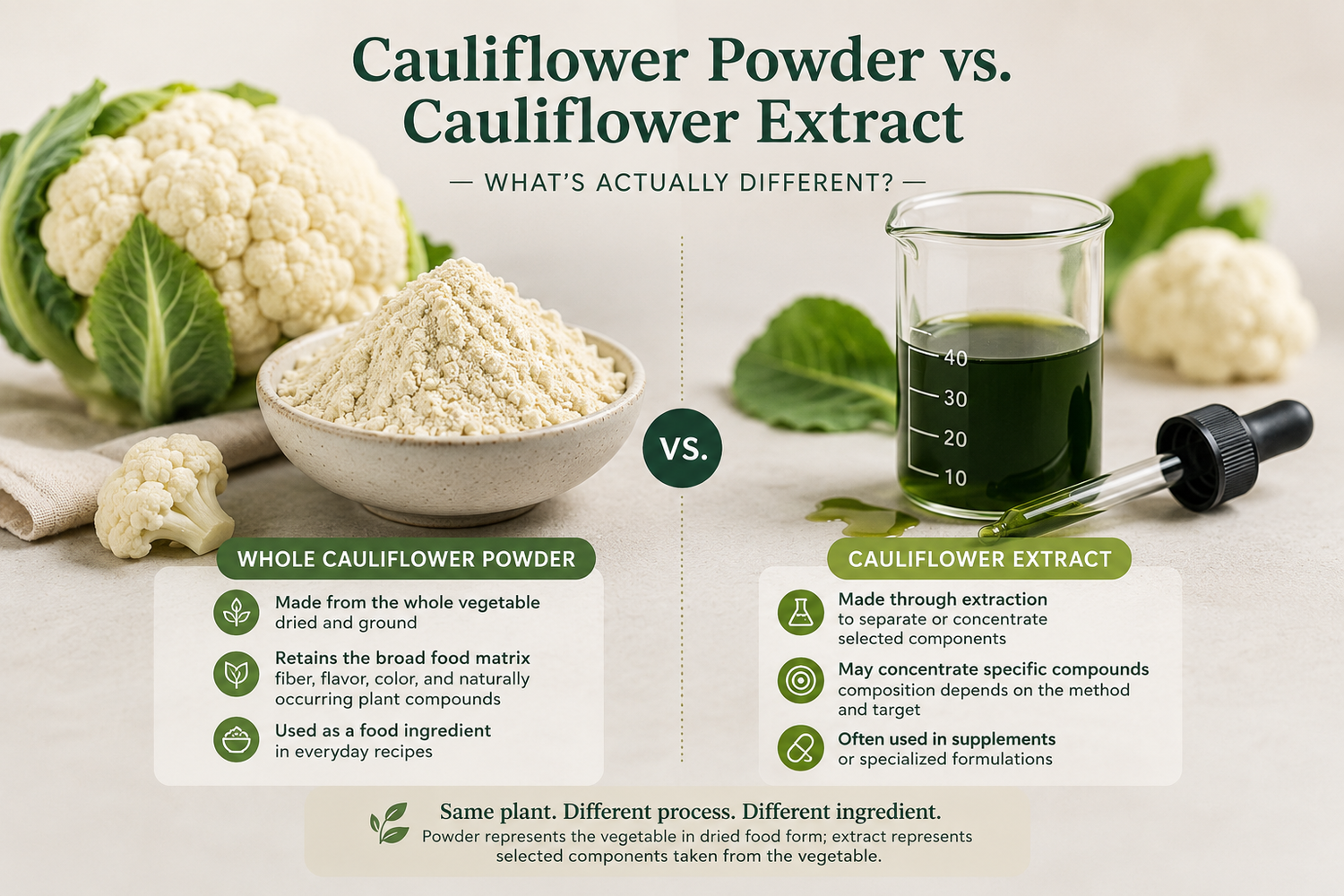
Whole cauliflower powder is made by drying cauliflower and grinding the dried vegetable into a fine powder.
It represents cauliflower in a shelf-stable food form, with the broader vegetable material remaining part of the ingredient — including fiber, natural color, mild flavor, and naturally occurring plant compounds that remain after processing.
Cauliflower extract belongs to a different category.
Extraction is designed to separate or concentrate selected components from plant material. The resulting ingredient may contain less of the broader vegetable matrix and more emphasis on particular compounds, depending on how the extract is made.
The simplest way to understand the difference is:
Powder represents the vegetable in dried food form; extract represents selected components taken from the vegetable.
Whole cauliflower powder is therefore best understood as a food ingredient.
Cauliflower extract is better understood as a specialized plant ingredient whose composition depends on the extraction method, the plant material used, and whether particular components are being targeted or standardized.
What Is Whole Cauliflower Powder?
Whole cauliflower powder begins with cauliflower itself.
The vegetable is dried to reduce its moisture content and then ground into a fine powder. Instead of isolating one particular compound, the process turns the vegetable into a format that is easier to store, measure, and incorporate into everyday foods.
Because the process is based on drying and grinding rather than selective extraction, the finished powder remains a broader whole-food-style ingredient.
Depending on the raw material and processing conditions, that broader composition can include:
- Vegetable fiber naturally present in cauliflower
- Natural pale or off-white color
- Mild vegetable flavor
- Naturally occurring glucosinolates
- Naturally occurring phenolic compounds
- Other plant constituents that remain after processing
This does not mean dried cauliflower is chemically identical to fresh cauliflower.
Drying temperature, moisture, processing time, storage conditions, and other factors can influence nutrients and plant compounds in any dried plant ingredient.
That distinction is important.
The purpose of whole cauliflower powder is not to guarantee or standardize one specific compound.
It is to provide the broader character of the vegetable in a convenient food form.
What Is Cauliflower Extract?
“Cauliflower extract” does not describe one single standardized ingredient.
It describes a category of ingredients produced by applying an extraction process to cauliflower plant material.
The purpose of extraction is generally to separate or concentrate selected components rather than preserve the entire vegetable matrix.
Different extracts can therefore be very different from one another.
Their composition may depend on:
- The extraction method
- The liquid, solvent, or process used
- Which part of the plant is used
- Which plant compounds are being targeted
- Whether the finished ingredient is standardized
- Additional concentration or drying steps
Some cruciferous-vegetable extracts are formulated around particular glucosinolates, their precursors, or related plant compounds.
Others may be produced for specialized food, research, formulation, or other ingredient applications.
So seeing the word “extract” alone does not tell you exactly what the ingredient contains.
You need to know what was extracted and how the finished ingredient was produced.
That is fundamentally different from taking the vegetable itself, drying it, and grinding it into powder.
Whole Cauliflower Powder vs. Cauliflower Extract
Here is a simple way to compare the two.
| Feature | Whole Cauliflower Powder | Cauliflower Extract |
|---|---|---|
| Starting material | Cauliflower vegetable | Cauliflower plant material |
| Processing | Drying and grinding | Extraction, separation and sometimes concentration |
| Whole-food matrix | Broader vegetable material remains | May be reduced or selectively separated |
| Dietary fiber | Naturally present as part of the vegetable | May be reduced or absent depending on extraction |
| Plant compounds | Naturally occurring mixture within the vegetable | Selected compounds may be concentrated or isolated |
| Standardization | Generally not standardized to one plant compound | Some extracts may be standardized |
| Flavor | Mild, vegetal, slightly cruciferous | Depends heavily on the extract |
| Color | Natural pale cauliflower color | Depends on the extraction process |
| Typical use | Everyday food ingredient | Specialized ingredient or formulation use |
| Best understood as | Dried vegetable ingredient | Extracted plant ingredient |
These differences matter because the two products are intended to represent different things.
If someone wants a real vegetable ingredient that still carries the broader character of cauliflower, whole powder is the more relevant category.
If the goal is to work with a particular extracted or standardized plant component, an extract may be more appropriate.
They begin with the same plant, but they do not represent the plant in the same way.
What Naturally Occurs in Cauliflower?
Cauliflower is a cruciferous vegetable, part of the same botanical family that includes broccoli, cabbage, kale, and Brussels sprouts.
Like other cruciferous vegetables, cauliflower has its own natural plant composition.
That composition is what makes the vegetable interesting before it is ever turned into either a powder or an extract.
Rather than thinking about cauliflower only as a source of one isolated compound, it is more useful to think of it as a whole vegetable containing a combination of:
- Naturally occurring glucosinolates
- Naturally occurring phenolic compounds
- Vegetable fiber and plant material
- Natural flavor
- Natural color
- Other plant constituents
The exact composition is not identical in every cauliflower.
Variety, growing conditions, soil, plant part, harvest timing, processing, and storage can all influence what is present in the vegetable and what remains in a finished ingredient.
That natural variability is part of working with real plants.
Glucosinolates
Cauliflower naturally contains glucosinolates.
Glucosinolates are sulfur-containing plant compounds characteristic of cruciferous vegetables.
They are not ingredients added during manufacturing.
They are part of the plant's natural chemistry.
Different cruciferous vegetables naturally contain different glucosinolate profiles, and even within cauliflower, the types and amounts present can vary according to cultivar, growing conditions, harvest timing, plant part, and processing.
Glucosinolates are especially interesting from an ingredient-science perspective because they can interact with enzymes naturally present in plant tissue.
One of those enzymes is myrosinase.
When plant cells are disrupted — for example through cutting, grinding, chewing, or other processing — glucosinolates and myrosinase can come into contact.
What happens next depends on several factors, including:
- Which glucosinolate is present
- Temperature
- Moisture
- pH
- Enzyme activity
- Processing conditions
This is one reason it is important not to treat whole cauliflower powder, glucosinolate extracts, and specific glucosinolate breakdown products as if they were identical ingredients.
They are not.
Phenolic Compounds
Cauliflower also naturally contains phenolic compounds, another broad group of plant constituents found throughout the plant kingdom.
Phenolic compounds form part of the vegetable's natural biochemical composition.
As with glucosinolates, the exact phenolic profile can vary.
Different cauliflower varieties can have different natural compositions, and colored cauliflower varieties such as purple or orange cauliflower may have noticeably different pigment and phenolic profiles from traditional white cauliflower.
The important point is not that cauliflower contains one single defining compound.
It is that the vegetable has a broader natural plant composition.
Fiber and Vegetable Material
Dietary fiber is part of the physical structure of cauliflower.
When the vegetable is dried and ground rather than selectively extracted, that broader vegetable material remains part of the powder.
This creates one of the most practical differences between whole powder and many extracts.
A whole-food-style powder still represents the vegetable itself.
An extraction process may intentionally separate selected components from much of that original plant matrix.
Again, neither approach is automatically better.
They simply create different types of ingredients.
Natural Flavor and Color
Cauliflower has a naturally mild vegetable flavor with a subtle cruciferous character.
Its familiar pale cream-to-off-white color also comes from the vegetable itself.
Whole cauliflower powder generally retains some of that sensory identity because it begins with the vegetable rather than an isolated target compound.
That is why whole cauliflower powder behaves more like a food ingredient than a standardized botanical extract.
What Are Glucosinolates?
Glucosinolates are naturally occurring compounds found primarily in cruciferous vegetables.
Their chemical structure contains sulfur and nitrogen, and they are produced by the plant as part of its natural biology.
They contribute to some of the characteristic flavors and aromas associated with vegetables such as cauliflower, broccoli, cabbage, kale, mustard greens, and Brussels sprouts.
In intact plant tissue, glucosinolates and the enzyme myrosinase are largely kept apart.
When plant cells are disrupted, myrosinase can interact with glucosinolates and contribute to the formation of different breakdown products.
The specific compounds that form can depend on:
- The type of glucosinolate
- Enzyme activity
- Temperature
- pH
- Moisture
- Processing conditions
This is why the terms glucosinolate and glucosinolate breakdown product should not automatically be treated as interchangeable.
It is also why a whole vegetable powder should not automatically be assumed to have the same composition as an ingredient standardized around one selected compound.
Glucosinolates are interesting here because they help illustrate a larger point:
The plant already has its own natural chemistry before anyone extracts or concentrates anything from it.
Is Cauliflower Powder the Same as a Sulforaphane Supplement?
No.
Whole cauliflower powder and a sulforaphane-focused supplement are different categories of products.
Sulforaphane belongs to the broader chemistry associated with certain glucosinolates and their enzymatic breakdown.
It is especially associated with glucoraphanin and is often discussed in connection with broccoli and other cruciferous vegetables.
Sulforaphane-focused products may be formulated around:
- Sulforaphane itself
- Glucoraphanin
- Myrosinase
- Combinations designed to create a more predictable amount of a target compound or precursor
Whole cauliflower powder works differently.
It is not standardized to a specific level of sulforaphane or a particular glucosinolate unless product-specific analytical testing establishes that information.
Instead, cauliflower powder contains the broader vegetable material and naturally occurring plant compounds that remain after processing.
So the key distinction is:
Whole cauliflower powder is a food ingredient made from the vegetable. A sulforaphane-focused product is formulated around specific cruciferous-plant chemistry.
The two should not be treated as interchangeable.
Does Processing Matter?
Yes.
Processing matters for almost every plant ingredient.
Plants are chemically complex, and their natural compounds do not necessarily remain completely unchanged through drying, heating, grinding, extraction, storage, or other forms of processing.
For cauliflower ingredients, relevant factors can include:
- Drying temperature
- Drying method
- Moisture
- Processing duration
- Particle size
- Storage temperature
- Light exposure
- Humidity
- Extraction method
- Enzyme activity
For glucosinolates in particular, processing can influence how those compounds interact with myrosinase and what breakdown products may form.
Heating can reduce enzyme activity.
Grinding disrupts plant cells.
Moisture and storage conditions can also influence the finished ingredient over time.
But this does not mean that one processing method automatically preserves everything while another automatically destroys it.
It means something more useful:
Processing conditions matter, and specific claims about the amount of a plant compound in a finished product should be based on product-specific analytical data rather than assumptions about the fresh vegetable.
That is an important distinction for any real plant powder.
Which Is Better: Cauliflower Powder or Cauliflower Extract?
Neither is universally better.
The right choice depends on what someone is looking for.
Whole Cauliflower Powder
Whole cauliflower powder makes sense when the goal is a real-food vegetable ingredient.
It provides the broader character of cauliflower in dried form, including vegetable material, mild flavor, fiber, and naturally occurring plant compounds that remain after processing.
It can fit naturally into everyday foods.
Cauliflower Extract
An extract makes more sense when the purpose is centered on selected plant components.
Depending on how it is produced, an extract may be used when a specific compound, concentration, or standardized ingredient profile is the primary objective.
These are simply different ingredient formats.
The better question is not:
Which one is stronger?
It is:
Which kind of ingredient fits the intended use?
What Does Cauliflower Powder Taste Like?
Cauliflower powder has a mild, vegetal flavor with a subtle cruciferous note.
It is not naturally sweet or strongly flavor-forward.
The powder still carries some of the familiar vegetable character of cauliflower, but its relatively mild profile makes it easier to incorporate into foods alongside other ingredients.
It should not be thought of in the same way as garlic powder, onion powder, or a strongly flavored seasoning.
Cauliflower powder is better understood as a vegetable ingredient.
Its purpose is to bring real cauliflower material into a convenient powdered format, not to dominate the flavor of a dish.
How to Use Cauliflower Powder in Everyday Food
Because cauliflower powder has a relatively mild vegetable flavor, it can fit into a range of savory foods and plant-based recipes.
Possible uses include:
Soups
Stir a small amount into vegetable soups, creamy soups, or broths.
Sauces
Blend it into pasta sauces, tomato-based sauces, or vegetable purées.
Batters
Mix it into savory batters, pancakes, flatbreads, crackers, or other recipes where a mild vegetable ingredient fits naturally.
Vegetable Blends
Combine it with other vegetable or greens powders to create broader plant-food blends.
Savory Smoothies
It can also be incorporated into vegetable-forward smoothies where cauliflower's mild flavor complements greens and other plant ingredients.
Dips and Spreads
Mix into savory dips or spreads where the vegetable character can become part of the overall recipe.
Start with a small amount and adjust according to the recipe, flavor, and texture you prefer.
The point is not to turn cauliflower powder into a seasoning.
These are simply practical ways to bring the real vegetable — and the broader plant material naturally present in it — into foods you already make.
Where Unleash’d Organic Cauliflower Powder Fits In
Unleash’d Organic Cauliflower Powder is a USDA certified organic plant powder made from real cauliflower.
It is designed as an everyday food ingredient rather than a standardized extract.
Its value begins with the vegetable itself — its natural plant material, fiber, mild flavor, and the broader plant composition that comes with real cauliflower.
Rather than isolating one target compound, cauliflower powder offers the vegetable in a convenient dried form that can fit into everyday foods and plant-based routines.
For us, that distinction matters.
The interesting part of cauliflower is not something that needs to be added afterward.
It begins with what the real plant naturally contains.
Final Thoughts
The difference between cauliflower powder and cauliflower extract is not simply a difference in quality.
It is a difference in ingredient category, processing, composition, and purpose.
Whole cauliflower powder represents the vegetable in dried food form.
Cauliflower extract represents selected components separated from the vegetable through an extraction process.
Neither should be mistaken for the other.
Whole cauliflower powder should not be presented as a standardized or guaranteed source of sulforaphane or another specific plant compound without product-specific analytical testing.
At the same time, an extract should not be evaluated as if it were simply dried cauliflower.
The more interesting story behind whole cauliflower powder is simpler.
Cauliflower is already a real plant with its own:
- Natural plant compounds
- Vegetable fiber
- Flavor
- Color
- Botanical character
Drying and grinding make that vegetable easier to store and incorporate into everyday foods.
Nothing about that requires turning cauliflower into a supplement story.
The starting point is the plant itself.
Frequently Asked Questions
What is cauliflower powder?
Cauliflower powder is made by drying cauliflower and grinding the dried vegetable into a fine powder.
It is used as a food ingredient and retains the broader character of the vegetable, including vegetable material, fiber, mild natural flavor, color, and naturally occurring plant compounds that remain after processing.
What is cauliflower extract?
Cauliflower extract is an ingredient produced by applying an extraction process to cauliflower plant material in order to separate or concentrate selected components.
Its composition depends on the extraction method, the plant material used, the target compounds, and whether the finished extract is standardized.
Is cauliflower powder the same as cauliflower extract?
No.
Cauliflower powder is the dried and ground vegetable.
Cauliflower extract is produced through an extraction process focused on selected components from the plant.
They may begin with cauliflower, but they differ in processing, composition, and intended use.
Does cauliflower naturally contain glucosinolates?
Yes.
Cauliflower is a cruciferous vegetable and naturally contains glucosinolates, a family of sulfur-containing plant compounds found throughout the cruciferous vegetable family.
The exact types and amounts can vary depending on the cauliflower variety, growing conditions, plant part, processing, and other factors.
Does cauliflower powder contain sulforaphane?
Whole cauliflower powder should not be assumed to contain a standardized or guaranteed amount of sulforaphane.
Cauliflower naturally contains glucosinolates as part of its broader plant composition, but the formation and amount of specific glucosinolate breakdown products depend on the plant material and processing conditions.
Products specifically formulated around sulforaphane or its precursors belong to a different ingredient category.
Is cauliflower powder a supplement?
Unleash’d Organic Cauliflower Powder is sold as a food ingredient.
It is made from real cauliflower in dried powder form and is intended for everyday food use rather than as a standardized extract.
What does cauliflower powder taste like?
Cauliflower powder has a mild, vegetal flavor with a subtle cruciferous note.
It is relatively neutral compared with strongly flavored seasonings and can blend into soups, sauces, batters, vegetable blends, and other savory foods.
How do you use cauliflower powder?
Cauliflower powder can be stirred into soups, blended into sauces, mixed into savory batters, added to vegetable blends, incorporated into flatbreads or crackers, or used in other recipes where a mild vegetable ingredient fits naturally.
Start with a small amount and adjust according to taste and recipe.
Is cauliflower powder made from real cauliflower?
Yes.
Whole cauliflower powder begins with real cauliflower vegetable material that is dried and ground into powder.
It is a vegetable ingredient in powdered form rather than an isolated cauliflower compound.

Leave a comment
This site is protected by hCaptcha and the hCaptcha Privacy Policy and Terms of Service apply.