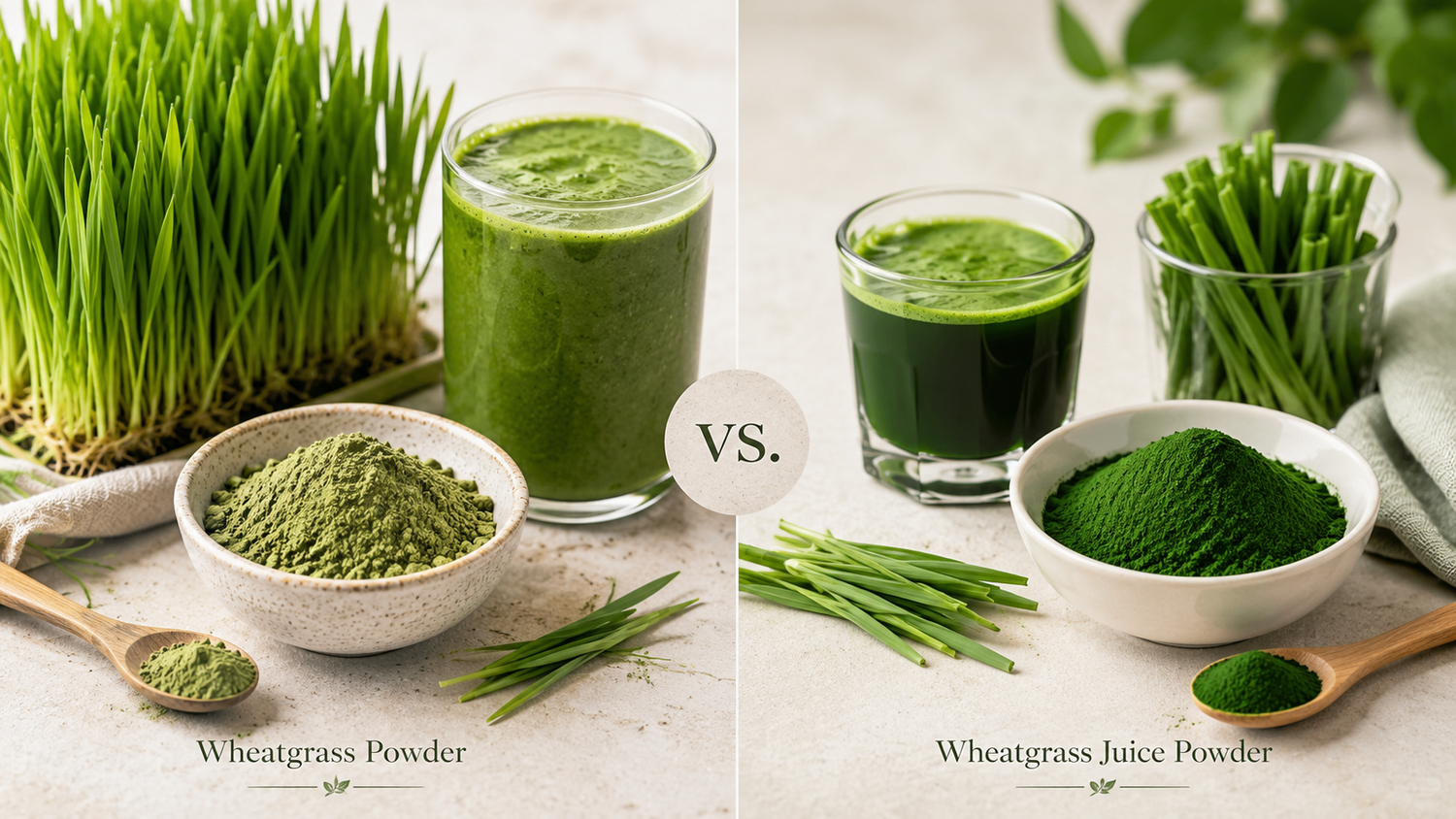
Two packages on the same shelf. Both say “wheatgrass.” Both are green. Both come from the same plant. And yet they are not the same ingredient.
One is made from wheatgrass plant material that has been dried and ground into powder. The other is made from juice separated from that grass before the liquid is dried into powder.
Same source plant, different processing path, different finished ingredient.
The distinction matters — not because one is automatically better, but because understanding what each product actually represents can help you choose the format that fits what you are looking for.
This article explains both in plain terms: what they are, how their plant composition differs, how fiber and processing fit into the picture, what they taste like, and where each one fits into an everyday food routine.
Quick Answer: What’s the Difference?
Wheatgrass powder represents the dried grass itself — young wheatgrass plant material that has been dried and ground.
Wheatgrass juice powder represents the juice separated from that grass before drying.
They come from the same plant, but they are different ingredient formats with different plant compositions, textures, and potentially different flavor characteristics.
Wheatgrass Powder
Wheatgrass powder is made from wheatgrass plant material — the young grass itself — that is dried and ground into a fine powder.
Because more of the physical plant material remains part of the ingredient, whole wheatgrass powder includes more of the grass’s natural fiber matrix and broader plant structure.
Wheatgrass Juice Powder
Wheatgrass juice powder is generally produced by separating liquid juice from fresh wheatgrass and then drying that juice into powder.
Because much of the fibrous grass material is separated before drying, the finished ingredient represents a different portion of the original plant — the juice-derived portion rather than the broader whole-grass matrix.
Exact processing methods can vary by manufacturer, and the composition of any finished product depends on the raw material, growing conditions, processing approach, and storage.
Wheatgrass powder represents the dried grass itself; wheatgrass juice powder represents the juice separated from that grass before drying.
Organic Wheatgrass Powder
Organic Wheatgrass Juice Powder
What Is Wheatgrass Powder?
Wheatgrass is the young green grass of the wheat plant, Triticum aestivum.
To make wheatgrass powder, the plant material is dried to reduce moisture and then ground into a fine powder.
The result is a dried form of the young grass itself, with its broader plant material, natural green pigments, fiber, and naturally occurring plant compounds forming part of the finished ingredient.
Because the plant material itself is the starting point, wheatgrass powder represents more of the physical grass, including the naturally occurring fiber matrix found throughout the grass blades.
Its flavor generally reflects that whole-plant character: grassy, vegetal, and distinctly green.
Processing still matters.
Drying temperature, moisture, processing method, storage, and other conditions can influence the final composition of any plant powder.
Wheatgrass powder should therefore not be assumed to be chemically identical to fresh wheatgrass, and claims about specific nutrient or plant-compound levels in a finished product should be based on product-specific information.
What Is Wheatgrass Juice Powder?
Wheatgrass juice powder starts with the same plant but follows a different processing path.
Instead of drying the broader grass material first, liquid juice is separated from the wheatgrass and that juice is then dried into powder.
The juicing step is what creates the main distinction.
When liquid is separated from wheatgrass, much of the insoluble fibrous plant structure remains behind. The juice-derived portion then becomes the starting material for the finished powder.
Because the juice is separated from much of the fibrous plant material before drying, wheatgrass juice powder generally contains less of the whole-grass fiber matrix than whole wheatgrass powder.
Its broader plant-compound profile may also differ because it reflects what is present in the separated juice rather than the entire grass material.
Wheatgrass juice powder and a standardized botanical extract should not automatically be treated as the same type of ingredient.
Juicing separates the liquid portion of the grass from much of the fibrous plant material.
Botanical extraction, by contrast, generally focuses on selectively removing or concentrating particular constituents through a targeted extraction process.
These are different processing concepts.
As with whole wheatgrass powder, the exact composition of a finished wheatgrass juice powder depends on the raw material, processing method, growing conditions, and storage.
Wheatgrass Powder vs. Wheatgrass Juice Powder: Side by Side
| Feature | Wheatgrass Powder | Wheatgrass Juice Powder |
|---|---|---|
| Starting material | Young wheatgrass plant material | Juice separated from wheatgrass |
| Main processing | Drying + grinding | Juicing/separation + drying |
| Plant matrix | Broader whole-grass material | Primarily juice-derived material |
| Fiber | More of the natural grass fiber matrix remains | Generally less fibrous plant material |
| Texture | More whole-plant character | Often less fibrous, depending on processing |
| Flavor | Grassy, vegetal, earthy-green | May differ depending on processing |
| Color | Naturally green | Naturally green; exact shade may vary |
| Plant compounds | Broader whole-grass composition | Composition reflects compounds present in the separated juice |
| Typical use | Smoothies, blends, everyday foods | Drinks, smoothies, everyday foods |
| Best understood as | Dried grass ingredient | Dried wheatgrass juice ingredient |
These comparisons describe general tendencies rather than absolute rules.
The exact characteristics of any wheatgrass powder depend on the raw material, processing conditions, and finished product.
What Naturally Occurs in Wheatgrass?
To understand why the difference between wheatgrass powder and wheatgrass juice powder matters, it helps to start with the plant itself.
Wheatgrass has its own natural composition before it is turned into either type of powder.
Like other green plants, it naturally contains plant pigments, fiber, phenolic compounds, nutrients, and other plant constituents that are part of the grass itself.
That broader plant composition is more useful to understand than reducing wheatgrass to one single “active” ingredient.
Natural Green Pigments — Chlorophyll
Chlorophyll is the natural green pigment responsible for the characteristic color of wheatgrass and other green plants.
It is part of the plant’s photosynthetic system and one of wheatgrass’s most recognizable natural components.
Wheatgrass naturally contains chlorophyll.
However, the amount and form present in any finished powder can be influenced by processing, drying conditions, storage, and the original plant material.
So the green color of wheatgrass begins with the plant, while the exact appearance of a finished powder can vary.
Carotenoids and Other Plant Pigments
Wheatgrass also naturally contains carotenoids and other plant pigments.
These compounds are part of the grass’s broader natural composition and exist alongside chlorophyll in young green plant tissue.
They are another example of how the natural composition of wheatgrass includes more than a single pigment or compound.
Phenolic Compounds
Wheatgrass naturally contains various phenolic compounds.
Phenolic compounds are a broad group of naturally occurring plant constituents found throughout many fruits, vegetables, grains, herbs, and other plant foods.
Their presence in wheatgrass reflects the natural chemistry of the plant itself rather than something added during processing.
As with other naturally occurring plant compounds, the exact profile in a finished powder can vary.
Plant Fiber
The blades of wheatgrass contain structural plant fiber.
This is one of the most practically meaningful differences between whole wheatgrass powder and wheatgrass juice powder.
Whole wheatgrass powder contains more of the physical grass material, including more of its natural fiber matrix.
Wheatgrass juice powder, because it begins with separated juice, generally contains less of that whole-grass fiber structure.
Naturally Occurring Vitamins and Minerals
Wheatgrass also naturally contains vitamins and minerals as part of its plant composition.
However, the amount of any specific nutrient in a finished powder depends on many factors, including:
- Raw material
- Growing conditions
- Harvest timing
- Processing
- Drying
- Storage
For that reason, specific nutrient amounts in a finished product should be taken from that product’s own Nutrition Facts or analytical data rather than assumed from fresh wheatgrass.
The central point is simple:
Wheatgrass has its own natural plant composition before it is turned into any kind of powder.
That composition is broader than one single compound, and both wheatgrass powder and wheatgrass juice powder begin with that same plant before processing takes them in different directions.
Why Does Fiber Differ Between the Two Products?
Fiber is one of the clearest practical differences between wheatgrass powder and wheatgrass juice powder.
The reason comes down to processing.
In whole wheatgrass powder, more of the physical grass material is dried and ground together.
The plant structure — including naturally occurring insoluble fiber — becomes part of the finished powder.
In wheatgrass juice powder, liquid is separated from much of that physical plant structure before drying.
Because much of the fibrous material remains behind during the juicing process, wheatgrass juice powder generally contains less of the whole-grass fiber matrix.
This does not make one product better than the other.
It simply means they represent different portions of the same plant.
Someone who prefers more of the physical whole-grass material may prefer wheatgrass powder.
Someone who prefers a less fibrous, juice-derived format may prefer wheatgrass juice powder.
Exact fiber content should always be determined from the finished product’s own Nutrition Facts rather than from general assumptions about the ingredient category.
Does Processing Change Wheatgrass?
Yes.
Processing affects plant ingredients, and wheatgrass is no exception.
When wheatgrass becomes either whole powder or juice powder, several factors can influence the finished ingredient, including drying method, temperature, moisture, plant age, grinding, juicing, filtration, storage, heat, light, humidity, and time.
For example, grinding changes the physical structure of plant material, while juicing separates liquid from much of the fibrous solid material.
Drying removes moisture, but the conditions used during drying may also influence heat-sensitive plant components.
Storage can continue to affect product quality after manufacturing.
The important point is:
Processing creates different ingredient formats, and claims about specific nutrients or plant compounds in a finished product should be based on product-specific information rather than assumptions about fresh wheatgrass.
This applies to both products.
Neither format is simply “fresh wheatgrass in a pouch.”
They are processed food ingredients whose finished composition reflects the entire path from plant to powder.
Why Can Wheatgrass Powder and Wheatgrass Juice Powder Look Different?
Both products are naturally green because wheatgrass itself contains chlorophyll and other naturally occurring plant pigments.
But the exact shade and intensity of green can vary.
Several factors may influence appearance, including the raw wheatgrass, growing conditions, harvest timing, processing method, temperature, drying conditions, and storage.
The fact that one batch or product looks slightly lighter, darker, brighter, or more muted does not automatically indicate a quality problem.
Natural plant ingredients can vary.
Neither wheatgrass powder nor wheatgrass juice powder should be expected to always look darker or greener than the other in every situation.
Do Wheatgrass Powder and Wheatgrass Juice Powder Taste the Same?
Not necessarily.
Whole wheatgrass powder tends to have a more noticeable whole-grass character.
It can taste grassy, vegetal, and earthy-green because more of the physical grass material is part of the ingredient.
Its texture can also reflect that broader plant matrix.
Wheatgrass juice powder begins with separated liquid rather than the full grass material, so its flavor and mouthfeel may be somewhat different.
Because it contains less of the whole-grass fiber matrix, the texture may feel less fibrous.
However, whether wheatgrass juice powder tastes milder, sweeter, stronger, or simply different depends on the specific product and processing conditions.
Those characteristics should not be treated as universal.
Both formats still have the naturally green, plant-forward character associated with wheatgrass.
Which Is Better: Wheatgrass Powder or Wheatgrass Juice Powder?
Neither is universally better.
They represent different formats of the same plant, and the better choice depends on what kind of ingredient you prefer.
Wheatgrass Powder May Be a Better Fit If:
You prefer a whole-grass-style ingredient that contains more physical plant material and more of the naturally occurring fiber matrix.
You may also prefer the broader grassy, vegetal character associated with dried whole plant material.
Wheatgrass Juice Powder May Be a Better Fit If:
You prefer a juice-derived ingredient with less emphasis on the physical grass structure.
Its less fibrous format may also be preferable in certain drinks or foods, depending on the product and how you use it.
Neither product should be described as automatically “more nutritious,” “healthier,” or “better.”
The more useful question is:
Which ingredient format, texture, flavor, and plant composition do you prefer?
How to Use Wheatgrass Powder and Wheatgrass Juice Powder
Both products can fit into everyday foods and drinks.
Start with a small amount and adjust according to taste and the type of food or drink you are preparing.
Wheatgrass Powder
Wheatgrass powder can be blended into smoothies, mixed into green blends, stirred into yogurt or thicker foods, or incorporated into recipes where a broader whole-grass character works well.
Blending is especially useful when working with the more fibrous plant material.
Wheatgrass Juice Powder
Wheatgrass juice powder can be stirred, whisked, or blended into water, juice, smoothies, yogurt bowls, smoothie bowls, and other everyday foods and drinks.
Its less fibrous, juice-derived format may disperse more readily in liquids, depending on the specific powder and how it is mixed.
Neither product should be expected to dissolve completely like sugar in water.
They are plant-derived powders and are better described as mixing, blending, whisking, or dispersing into liquids and foods.
Where Unleash’d Organic Wheatgrass Products Fit In
Unleash’d Organic offers both wheatgrass ingredient formats as USDA certified organic plant powders for everyday food use.
Organic Wheatgrass Powder
Unleash’d Organic Wheatgrass Powder is a USDA certified organic whole-grass-style plant powder made from wheatgrass.
It brings more of the physical plant material, including the naturally occurring fiber matrix and broader grass character, into a convenient dried food format.
Organic Wheatgrass Powder
Organic Wheatgrass Juice Powder
Unleash’d Organic Wheatgrass Juice Powder is a USDA certified organic juice-derived wheatgrass powder.
It represents the juice portion separated from wheatgrass before drying, giving it a different plant composition and physical character from whole wheatgrass powder.
Organic Wheatgrass Juice Powder
Both begin with wheatgrass.
Both are USDA organic.
The main difference is which portion of the plant becomes the finished ingredient and how the two formats are processed.
Understanding that difference helps you choose the version that better fits your preferences.
Final Thoughts
Wheatgrass powder and wheatgrass juice powder begin with the same young green plant.
What separates them is what happens next.
One represents more of the dried grass itself.
The other represents juice separated from that grass before drying.
That difference influences the plant matrix, fiber, texture, flavor, and overall character of the finished ingredient.
Neither should automatically be treated as a superior version of the other.
They are simply different ways of turning the same plant into a usable food ingredient.
And that brings the story back to where Unleash’d Organic starts:
the plant itself.
Wheatgrass naturally has its own green pigments, fiber, plant compounds, flavor, and botanical character.
Processing determines which part of that plant ultimately becomes the powder you use.
Understanding that difference is more useful than assuming one format is automatically better.
Frequently Asked Questions
What is wheatgrass powder?
Wheatgrass powder is made from young wheatgrass plant material that has been dried and ground into a fine powder.
It represents more of the dried grass itself and contains more of the physical plant material, including naturally occurring plant fiber.
What is wheatgrass juice powder?
Wheatgrass juice powder is generally made by separating liquid juice from wheatgrass and then drying that juice into powder.
Because much of the fibrous plant structure is separated before drying, the finished ingredient represents the juice-derived portion of the plant rather than the broader whole-grass matrix.
Exact processing methods can vary by manufacturer.
What is the difference between wheatgrass powder and wheatgrass juice powder?
Wheatgrass powder is made from dried, ground wheatgrass plant material.
Wheatgrass juice powder is made from juice separated from wheatgrass before drying.
Whole wheatgrass powder therefore contains more of the physical grass and its natural fiber matrix, while wheatgrass juice powder represents more of the juice-derived portion of the plant.
They come from the same plant but are different ingredient formats.
Is wheatgrass juice powder made from whole wheatgrass?
It begins with wheatgrass, but the finished ingredient does not represent the whole grass in the same way whole wheatgrass powder does.
The juice is separated from much of the fibrous plant structure before drying.
Whole wheatgrass powder, by comparison, includes more of the physical grass material.
Which has more fiber: wheatgrass powder or wheatgrass juice powder?
Wheatgrass powder generally retains more of the whole-grass fiber matrix because more of the physical plant material becomes part of the finished powder.
Wheatgrass juice powder generally contains less of that physical fiber because the juice is separated from much of the fibrous grass structure before drying.
Exact fiber content should be confirmed using the specific product’s Nutrition Facts.
Does wheatgrass naturally contain chlorophyll?
Yes.
Chlorophyll is a naturally occurring green plant pigment and part of wheatgrass’s natural composition.
It contributes to wheatgrass’s characteristic green color.
The exact amount and form retained in a finished powder can depend on processing, drying conditions, raw material, and storage.
Is wheatgrass juice powder more concentrated than wheatgrass powder?
The word “concentrated” can mean different things and should be used carefully.
Water is removed when wheatgrass juice is dried into powder, but removing water is not the same thing as selectively concentrating a particular plant compound.
Wheatgrass juice powder reflects the plant components present in the separated juice portion, while whole wheatgrass powder represents more of the physical grass material.
One should not automatically be interpreted as nutritionally superior or more potent than the other.
Is wheatgrass juice powder an extract?
Not necessarily.
“Juice powder” and “botanical extract” describe different processing concepts and should not automatically be used interchangeably.
Juicing separates the liquid portion of the grass from much of the fibrous plant material.
Botanical extraction generally refers to a process designed to selectively remove or concentrate particular constituents.
Wheatgrass juice powder is therefore better understood as a juice-derived wheatgrass powder unless a specific product is explicitly manufactured and described as an extract.
Do wheatgrass powder and wheatgrass juice powder taste the same?
Not necessarily.
Whole wheatgrass powder generally has a grassy, vegetal, whole-plant character.
Wheatgrass juice powder may have a somewhat different flavor and mouthfeel because it begins with separated juice rather than the broader physical grass material.
Whether one tastes milder or stronger depends on the specific product and processing.
How do you use wheatgrass powder?
Wheatgrass powder can be blended into smoothies, mixed into green plant blends, stirred into yogurt, or incorporated into other everyday foods.
Because it includes more physical plant material, blending can help create a more even texture.
Start with a small amount and adjust according to taste.
How do you use wheatgrass juice powder?
Wheatgrass juice powder can be stirred, whisked, or blended into water, juice, smoothies, yogurt bowls, and other everyday foods and drinks.
Its juice-derived format may disperse more readily in liquids depending on the specific product and mixing method.
Start with a small amount and adjust to taste.
Which wheatgrass powder should I choose?
The better choice depends on the ingredient format you prefer.
Choose wheatgrass powder if you are looking for more of the physical whole-grass material and naturally occurring fiber matrix.
Choose wheatgrass juice powder if you prefer a juice-derived format with less emphasis on the fibrous grass structure.
Neither is universally better.
They are different formats of the same plant.

Leave a comment
This site is protected by hCaptcha and the hCaptcha Privacy Policy and Terms of Service apply.