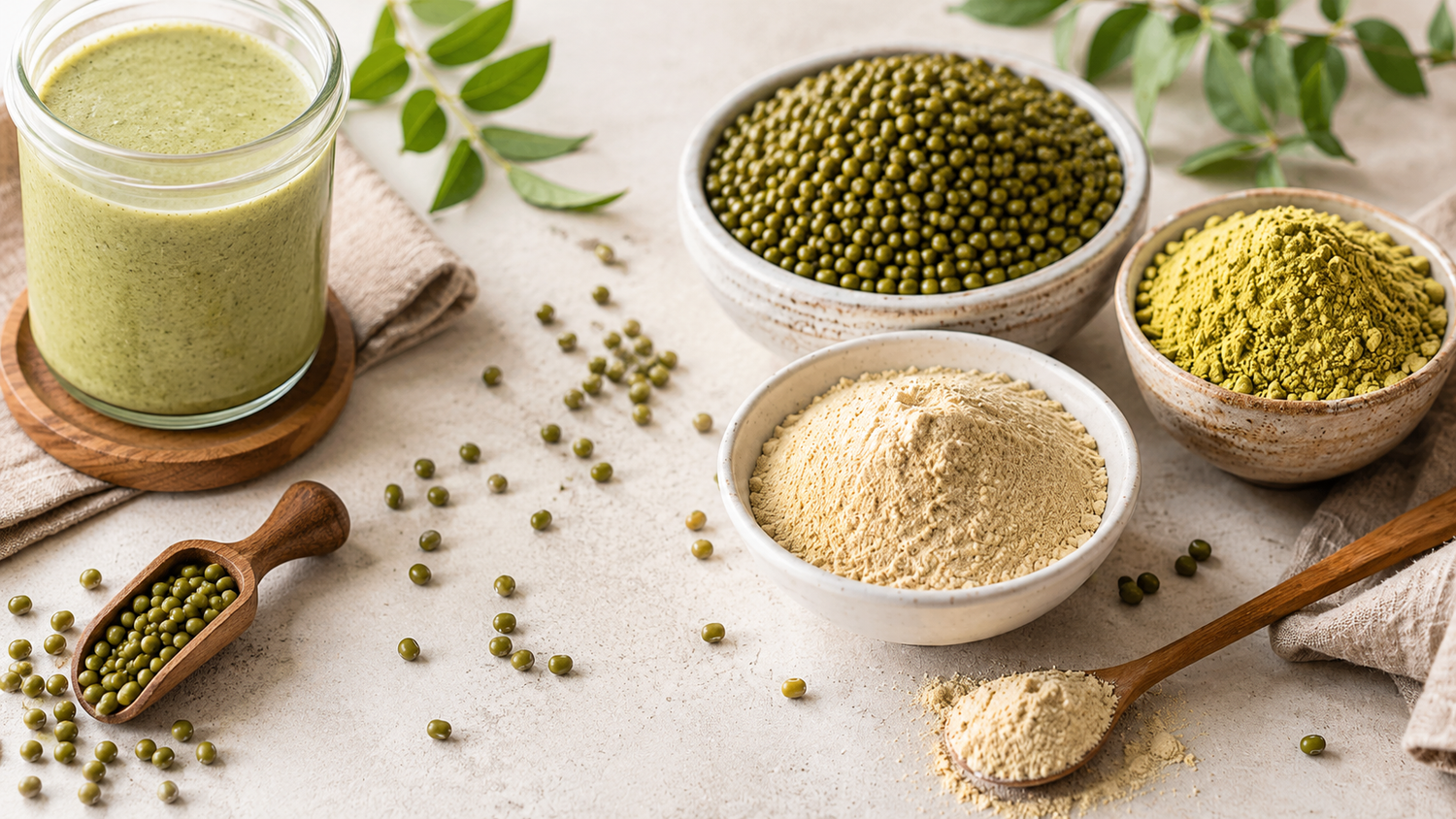
A pouch labeled “mung bean protein” may sound as if someone simply ground mung beans into powder and called it done.
That is not what the ingredient actually is.
Whole mung bean powder and mung bean protein may begin with the same bean, but processing turns them into meaningfully different food ingredients.
One represents more of the bean in its broader whole-bean proportions. The other goes through additional processing designed to separate a protein-rich portion from the broader bean matrix.
The result is an ingredient with a different nutritional composition, physical character, color, and role in everyday food.
Understanding that distinction is the point of this article.
What is mung bean protein? How is it made at a high level? And how does it differ from simply grinding the whole bean into powder?
Quick Answer: What Is Mung Bean Protein?
Mung bean protein is a plant-derived protein ingredient made from mung beans, but it is not simply the whole bean ground into powder.
It goes through additional processing so that a protein-rich portion can be separated from other components of the bean, creating an ingredient that is more protein-focused than whole mung bean powder.
Mung bean protein begins with a real mung bean, but the finished ingredient represents a different portion of that bean than whole mung bean powder does.
Whole mung bean powder represents more of the bean in powdered form; mung bean protein represents a protein-rich portion separated from the broader bean matrix.
Organic Mung Bean Protein Powder
What Is a Mung Bean?
Mung beans, botanically known as Vigna radiata, are small legumes in the same broad plant family as lentils, chickpeas, and other pulses.
Like other legumes, mung beans are complex whole seeds.
By their nature, they contain:
- Naturally occurring plant protein
- Carbohydrates and starch
- Dietary fiber
- Naturally occurring vitamins and minerals
- Other naturally occurring plant compounds
This matters because the protein in mung bean protein is not something added later.
It was already present in the bean.
Processing does not create protein from nothing.
It changes which portion of the bean becomes the finished ingredient and in what proportions.
What Is Mung Bean Protein Powder?
Mung bean protein powder is a plant-derived protein ingredient produced from mung beans through processing that separates a protein-rich portion from some of the bean’s other components.
The result is an ingredient in which protein makes up a larger share of the finished composition than it does in whole mung bean powder.
That distinction is central.
In the whole bean, protein, carbohydrate, fiber, and other plant components exist together in broader natural proportions.
In mung bean protein, processing changes those proportions in order to create a more protein-focused ingredient.
The exact protein content of any finished product should be determined from that product’s own Nutrition Facts panel rather than from general assumptions about mung beans as a food.
Composition can vary depending on the raw material and processing approach.
Mung bean protein is best understood as a protein-rich plant-derived food ingredient made from a real legume.
How Is Mung Bean Protein Made?
Mung bean protein is not made by simply grinding whole beans.
The production process is more involved than that, and this is what separates it from whole mung bean powder.
At a high level, the process can be understood like this:
- Mung beans are sourced and cleaned
- The beans are prepared through soaking and other initial conditioning steps
- The beans are mechanically processed so that a protein-rich portion can be separated from other components of the bean
- That protein-rich portion goes through further refinement
- The ingredient is dried into powder form using spray drying
- Quality-control testing and packaging complete the process
The exact technical conditions used during separation and refinement — including specific equipment settings, temperatures, times, ratios, and processing parameters — are part of the manufacturing process and are not necessary for understanding the finished ingredient.
What matters from an ingredient-education perspective is the principle:
Mung bean protein production involves more than grinding. It involves separating and refining a protein-rich portion of a complex whole food.
That is what makes the finished ingredient compositionally and physically different from whole mung bean powder.
The article deliberately keeps this process at a high level; the detailed manufacturing sequence is not needed to understand the ingredient. The original draft likewise framed the public explanation around cleaning, preparation, separation, refinement, spray drying, and quality control without disclosing operating parameters.
Why Does Processing Matter?
Processing creates the distinction between a broader whole-bean ingredient and a protein-focused bean ingredient.
That difference affects not only nutrition, but also the physical behavior and food-use profile of the powder.
Protein Proportion
Because a protein-rich portion is separated and refined, protein makes up a greater proportion of the finished ingredient than it does in the broader whole bean.
Carbohydrate and Starch Proportion
The processing changes the proportion of starch and other carbohydrates in the finished ingredient as the protein-rich portion is separated and refined.
Fiber Composition
Whole mung bean powder generally retains more of the bean’s broader fiber matrix.
Mung bean protein has a different fiber profile because processing changes which portions of the bean remain in the finished ingredient.
The exact fiber content depends on the specific product and should be checked on its Nutrition Facts panel.
Physical Character
Mung bean protein has a different physical character from whole mung bean powder because it has gone through separation, refinement, and drying.
That can affect texture and how the ingredient behaves in foods and drinks.
Color
Processing can influence the appearance of the finished powder.
Mung bean protein may therefore look different from the original green mung bean or from a broader whole mung bean powder.
Mixing Behavior
Mung bean protein and whole mung bean powder may behave differently in liquids and recipes because they represent different ingredient formats.
Both are better described as blending and dispersing rather than dissolving completely.
None of these differences means one format is universally better than the other.
They are simply different ingredients created for different purposes.
Mung Bean Protein vs. Whole Mung Bean Powder
| Feature | Mung Bean Protein | Whole Mung Bean Powder |
|---|---|---|
| Starting material | Mung beans | Mung beans |
| Processing | Preparation, separation, refinement, spray drying | Whole-bean milling or broader whole-bean processing |
| Protein | Protein-rich, more protein-focused ingredient | Protein naturally present within the broader whole-bean matrix |
| Fiber | Proportion changes depending on processing | More of the whole-bean fiber generally remains |
| Carbohydrate / starch | Proportions change after separation and refinement | Broader whole-bean carbohydrate matrix remains |
| Plant matrix | More protein-focused fraction | Broader whole-bean composition |
| Texture | Refined plant protein powder | More whole-bean physical character |
| Flavor | Mild plant-protein / legume character | More whole-bean / legume character |
| Typical use | Smoothies, drinks, baking, everyday recipes | Whole-bean food and cooking applications |
| Best understood as | Plant protein ingredient | Whole-bean powder |
These comparisons describe general tendencies.
Exact composition, texture, color, and behavior depend on the specific product and processing approach.
Consumers should use the Nutrition Facts panel of the individual product for accurate composition information.
Is Mung Bean Protein the Same as Mung Bean Flour?
Not necessarily.
Mung bean flour or whole mung bean powder generally represents more of the bean itself — including a broader combination of protein, carbohydrate, fiber, and other naturally occurring bean components.
Mung bean protein is produced through additional processing designed to create a more protein-focused ingredient.
The two may begin with the same raw plant, but the finished compositions are different.
It is also worth remembering that product terminology is not perfectly standardized across every manufacturer.
Two products labeled “mung bean powder,” “mung bean flour,” or “mung bean protein” may not necessarily be produced in exactly the same way.
When comparing products, the ingredient statement and Nutrition Facts panel provide more useful information than the product name alone.
What Naturally Occurs in Mung Beans?
The reason mung bean protein can exist as an ingredient is simple:
Mung beans already contain protein naturally.
Processing does not introduce protein into the bean.
Instead, it changes the proportions of the bean’s natural components and determines which portion becomes the finished ingredient.
Understanding the whole bean helps put mung bean protein into context.
Naturally Occurring Plant Protein
Protein is naturally present in the mung bean seed.
When mung bean protein is produced, the processing is designed to retain and separate more of that naturally occurring protein-rich portion.
So the protein source begins with the plant itself.
Carbohydrates and Starch
Whole mung beans naturally contain carbohydrates and starch as part of their seed structure.
When a protein-focused ingredient is produced, the proportions of these components change as the protein-rich portion is separated and refined.
This is one reason the finished mung bean protein ingredient has a different nutritional profile from whole mung bean powder.
Dietary Fiber
Whole mung beans naturally contain dietary fiber.
A broader whole-bean powder generally retains more of that physical fiber matrix.
Mung bean protein has a different fiber proportion because the production process creates a more protein-focused ingredient.
The exact amount in any specific finished powder should be confirmed from the product’s own Nutrition Facts.
Naturally Occurring Vitamins and Minerals
Mung beans naturally contain a range of vitamins and minerals as part of their whole-food composition.
However, the amount of any specific micronutrient in a finished mung bean protein product depends on the raw material, processing, and other factors.
Specific amounts should therefore come from the finished product’s own Nutrition Facts or analytical data rather than being assumed from whole mung beans.
Other Naturally Occurring Plant Constituents
Mung beans also naturally contain a variety of other plant constituents, including phenolic compounds and other components found across legumes.
These are simply part of the bean’s natural chemistry.
The important point is:
The mung bean begins as a complex whole food. Processing changes the proportions of that natural composition — not its plant source.
The original article already centered this section on naturally occurring protein, carbohydrates, fiber, micronutrients, and other plant constituents rather than health outcomes, which is exactly the right brand direction.
Does Mung Bean Protein Still Represent a Real Plant Ingredient?
Yes — but it is important to describe that accurately.
Mung bean protein begins with real mung beans.
The protein in the finished ingredient is plant protein derived from that legume.
At the same time, mung bean protein does not represent the whole bean in its original proportions.
Processing deliberately changes those proportions to create a more protein-focused ingredient.
A useful way to describe it is:
It begins with real mung beans and becomes a specialized plant-derived food ingredient through processing.
That distinction matters.
It should not be described as an untouched whole-food powder, but it is also not a synthetic ingredient.
It is a processed food ingredient derived from a real plant source.
What Does Mung Bean Protein Taste Like?
Mung bean protein generally has a mild plant-protein flavor with a light bean or legume character.
The exact flavor can vary depending on the raw material and processing.
It is not intended to function as a flavoring ingredient.
Instead, it is typically used alongside other foods and flavors in smoothies, oatmeal, baking, and blended recipes.
In simpler preparations, such as water alone, the natural bean character may be more noticeable.
Fruit, vanilla, cacao, plant-based milks, and other flavorful ingredients can also be used alongside mung bean protein in everyday recipes.
Why Can Mung Bean Protein Vary in Color?
Plant-derived protein ingredients can vary in color, and mung bean protein is no exception.
Several factors may influence the finished appearance:
- Natural variation in the mung beans
- Growing conditions
- Harvest conditions
- Crop year
- Processing
- Batch-to-batch variation
Because agricultural ingredients naturally vary, different batches may not always look exactly the same.
Natural color variation does not automatically indicate a difference in safety or quality.
Color alone is also not a reliable indicator of protein content or ingredient performance.
This section is especially useful because it explains real plant-powder variation without suggesting that a specific shade determines quality. The original draft already made this point clearly.
How to Use Mung Bean Protein Powder
Mung bean protein can fit into many of the same everyday food settings as other plant protein powders.
The important thing to remember is that it blends and disperses rather than dissolving completely.
Start with a small amount and adjust based on taste, recipe, or package directions.
Drinks and Smoothies
- Blend into smoothies with fruit, oat milk, almond milk, or other liquid bases
- Whisk into plant-based drinks
- Shake with water or juice using a shaker bottle
Breakfast Foods
- Stir into warm oatmeal
- Mix into yogurt
- Blend into pancake or waffle batter
Baking
- Incorporate into muffins, breads, pancakes, or other baked recipes alongside the recipe’s other dry ingredients
- Add to homemade protein bars or snack bites
- Use in savory baked recipes where a plant-protein ingredient fits naturally
Other Everyday Foods
- Mix into soups or blended savory recipes
- Use alongside other plant protein ingredients
- Stir into foods where additional plant protein fits the recipe
Thorough mixing — blending, whisking, or shaking — usually gives the most even result.
Where Unleash’d Organic Mung Bean Protein Fits In
Unleash’d Organic Organic Mung Bean Protein Powder is a USDA certified organic plant-derived protein ingredient made from real mung beans.
It represents a protein-rich portion of the mung bean, created through preparation, separation, refinement, and spray drying.
It is positioned as a plant-derived food ingredient — a convenient way to bring protein from real mung beans into smoothies, oatmeal, baking, and other everyday foods.
The goal is straightforward:
Start with a real USDA organic legume, separate a protein-rich portion, and turn it into a practical plant protein ingredient for everyday food use.
Organic Mung Bean Protein Powder
Final Thoughts
Mung bean protein begins with a real legume that naturally contains protein as part of its whole-food composition.
Processing changes the proportions of the bean’s natural components so that the finished ingredient becomes more protein-focused than the whole bean in its original form.
That distinction is what matters.
Whole mung bean powder represents more of the broader bean. Mung bean protein represents a protein-rich portion derived from that bean.
Neither needs to be portrayed as universally superior.
They are different ingredient formats created for different purposes.
Understanding how processing changes the bean helps consumers understand the ingredient they are buying.
The starting point is still the plant itself:
a real legume with its own naturally occurring protein, carbohydrates, fiber, nutrients, flavor, color, and plant character.
Processing determines which part of that natural composition becomes the finished ingredient.
Frequently Asked Questions
What is mung bean protein?
Mung bean protein is a plant-derived protein ingredient produced from mung beans through a process that separates and refines a protein-rich portion of the bean.
It is not simply whole mung beans ground into powder.
The finished ingredient is more protein-focused than whole mung bean powder and has a different composition and food-use profile.
Is mung bean protein just ground mung beans?
No.
Grinding whole mung beans produces a whole-bean powder that represents more of the bean’s broader composition, including protein, carbohydrates, fiber, and other components.
Mung bean protein goes through additional processing designed to separate and refine a protein-rich portion.
How is mung bean protein made?
At a high level, mung beans are cleaned and prepared, then processed so that a protein-rich portion can be separated from other components of the bean.
That portion is further refined and dried into powder form using spray drying.
Quality-control testing and packaging complete the process.
The detailed technical conditions used during manufacturing are not necessary for understanding the finished ingredient.
Is mung bean protein the same as mung bean powder?
No.
Whole mung bean powder generally represents more of the broader composition of the bean.
Mung bean protein is produced to create a more protein-focused ingredient by separating and refining a protein-rich portion from the broader bean matrix.
They are different ingredient formats.
Is mung bean protein the same as mung bean flour?
Not necessarily.
Mung bean flour typically represents more of the whole bean and its broader combination of protein, carbohydrates, fiber, and other plant components.
Mung bean protein is produced through additional processing designed to create a more protein-focused ingredient.
Terminology can vary between manufacturers, so checking the ingredient statement and Nutrition Facts panel is the most reliable way to understand a specific product.
Does mung bean protein contain fiber?
It may contain fiber, but the amount and proportion can differ from whole mung bean powder because processing changes which portions of the bean remain in the finished ingredient.
The exact fiber content should be confirmed from the product’s Nutrition Facts panel.
Does mung bean protein contain carbohydrates?
It may contain carbohydrates.
However, the carbohydrate proportion differs from whole mung bean powder because processing changes the proportions of starch, protein, fiber, and other bean components.
Check the specific product’s Nutrition Facts for accurate information.
Is mung bean protein made from real mung beans?
Yes.
Mung bean protein begins with real mung beans as the raw material.
The finished ingredient is a processed plant-derived food ingredient made from the protein-rich portion of that legume.
Is mung bean protein a whole-food powder?
Not in the same sense as whole mung bean powder.
Mung bean protein begins with a whole plant food, but processing changes the original proportions of the bean to create a more protein-focused ingredient.
It is therefore more accurate to describe it as a processed plant-derived protein ingredient than as a whole-food powder.
What does mung bean protein taste like?
Mung bean protein generally has a mild plant-protein flavor with a light bean or legume character.
The exact flavor can vary depending on the raw material and processing.
The natural bean character may be more noticeable in simple preparations and less noticeable when blended with other flavorful ingredients.
How do you use mung bean protein powder?
Mung bean protein can be blended into smoothies, whisked into drinks, stirred into oatmeal or yogurt, mixed into pancake or baking recipes, or used in other foods where a plant protein ingredient fits naturally.
It blends and disperses rather than dissolving completely.
Start with a small amount and adjust according to taste, recipe, or package directions.
Why can mung bean protein vary in color?
Plant-derived protein ingredients can vary naturally in color because of differences in raw material, growing conditions, harvest conditions, processing, and batch variation.
Color differences do not automatically indicate a difference in quality or safety.
Color alone is not a reliable indicator of protein content or ingredient performance.

Leave a comment
This site is protected by hCaptcha and the hCaptcha Privacy Policy and Terms of Service apply.