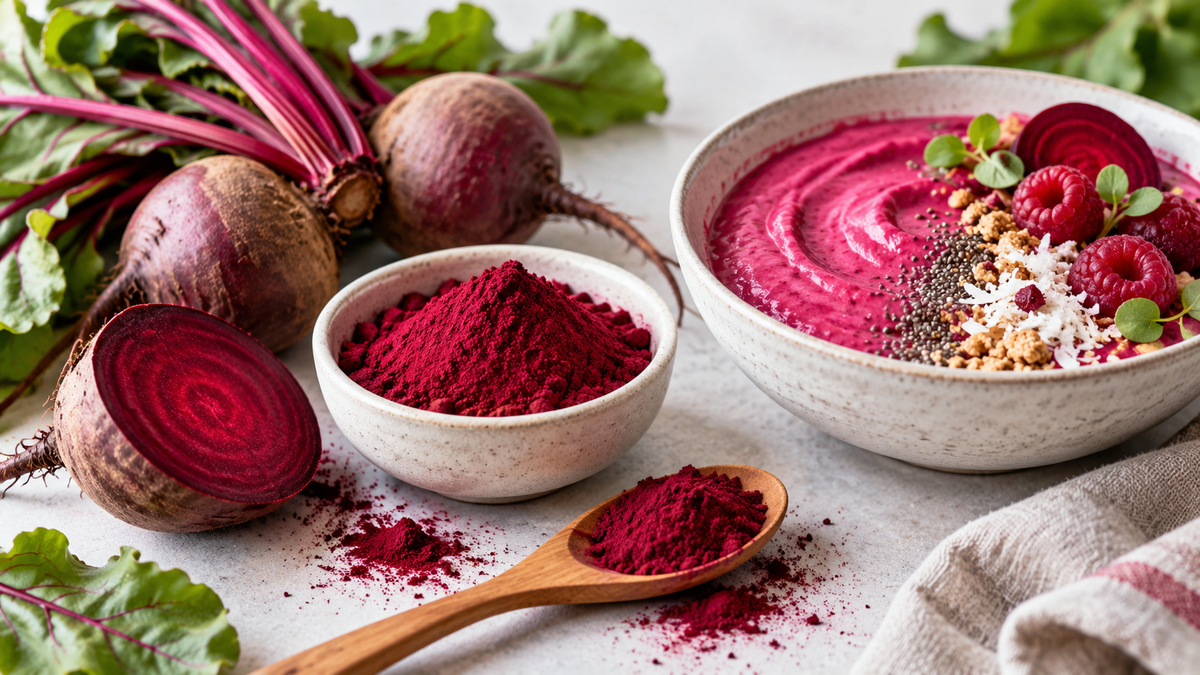
Beet root has one of the most recognizable colors in the vegetable world.
Cut one open and the deep red-purple color runs through the root itself. The cutting board turns crimson. So do your hands. And, often, so does whatever food you add the beet to.
That color is not added during manufacturing.
It begins in the plant itself, in naturally occurring pigments called betalains that beet root produces as part of its own chemistry.
When beet root is dried and ground into powder, these naturally occurring pigments can remain part of the finished ingredient, although their exact levels and color intensity depend on the raw material, processing, and storage.
Understanding where that color comes from — what betalains are, how they differ from other plant pigments, why beet color behaves differently in recipes, and what the root contains beyond its color — is what this article explores.
Quick Answer: Why Is Beet Root Powder Red?
Beet root powder is red-purple because beet roots naturally contain pigments called betalains.
Within the betalain family, betacyanins contribute the familiar red-to-violet tones associated with red beet root, while betaxanthins contribute yellow-to-orange tones.
When beet root vegetable material is dried and ground into powder, these naturally occurring pigments can remain part of the ingredient and contribute to its characteristic color.
The exact shade may vary depending on beet variety, growing conditions, processing, and storage.
Beet root gets its characteristic red-purple color from naturally occurring betalain pigments, especially red-violet betacyanins.
What Is Beet Root Powder?
Beet root powder is a dried food ingredient made from beet root (Beta vulgaris).
Beet root vegetable material is dried to reduce moisture and then ground into a fine powder, creating a shelf-stable and convenient ingredient for everyday food use.
It is useful to distinguish beet root powder from more specialized ingredient formats.
Beet root powder is a beet root food ingredient rather than a standardized betalain extract.
It can contain characteristics naturally associated with beet root, including:
- Naturally occurring betalain pigments
- Plant fiber and structural material
- Naturally occurring carbohydrates
- Other plant constituents
- Beet root’s characteristic color and flavor
Drying is not a neutral process.
Heat, moisture, drying conditions, storage, and other factors may influence the final composition of any plant powder.
Beet root powder is therefore not chemically identical to fresh beet root, and specific nutrient or pigment levels in a finished product should come from product-specific information rather than assumptions based on fresh beets.
What Are Betalains?
Betalains are a family of naturally occurring plant pigments found in a relatively limited group of plants.
Beet root is one of the best-known examples, but betalain pigments are also associated with plants such as dragon fruit, amaranth, cactus pear, and certain varieties of chard.
These pigments can produce vivid:
- Red
- Violet
- Purple
- Yellow
- Orange
The name betalain is connected to the genus Beta, the botanical genus that includes beet.
Betalains are chemically distinct from several other familiar plant pigment families.
They are nitrogen-containing plant pigments with their own natural chemistry and color behavior.
Within the betalain family are two major groups:
Betacyanins
Primarily associated with red-to-violet tones.
Betaxanthins
Primarily associated with yellow-to-orange tones.
Together, these two pigment groups contribute to the wide range of colors seen in betalain-containing plants.
Betacyanins vs. Betaxanthins
| Betalain Group | Typical Color Range | Examples | Example Plants |
|---|---|---|---|
| Betacyanins | Red to violet | Betanin, isobetanin | Beet root, dragon fruit, amaranth |
| Betaxanthins | Yellow to orange | Vulgaxanthins, indicaxanthin | Yellow beet varieties, cactus pear, chard |
Betacyanins
Betacyanins are the red-to-violet pigments within the betalain family.
They are strongly associated with the characteristic red-purple appearance of red beet root.
One of the best-known betacyanins in beet root is betanin, a pigment that has been widely studied in food science and is also used as a natural food colorant.
Other betacyanins may also occur in beet root.
The exact pigment profile can vary depending on plant variety, growing conditions, maturity, processing, and other factors.
Betaxanthins
Betaxanthins are the yellow-to-orange pigments within the betalain family.
They can occur alongside betacyanins in beet root, although betacyanins visually dominate in typical red beet varieties.
In golden or yellow beet varieties, yellow-orange pigment expression is more prominent.
A simple way to remember the distinction is:
Betacyanins contribute red-purple tones, while betaxanthins contribute yellow-orange tones.
The visible color of a beet depends on the natural pigment composition of that particular plant.
Are Betalains the Same as Anthocyanins?
No.
Betalains and anthocyanins are chemically distinct plant pigment families produced through different plant pathways.
They can sometimes create visually similar red or purple colors, but the pigments themselves are different.
For example:
- Blueberries are commonly associated with anthocyanins.
- Purple sweet potatoes are commonly associated with anthocyanins.
- Red cabbage is commonly associated with anthocyanins.
- Beet root is associated with betalains.
This means two plants can look similarly red or purple while getting their color from entirely different pigment systems.
In plants, betalains and anthocyanins generally do not occur together as the dominant pigment systems.
Another important difference is their color behavior.
Anthocyanins are especially well known for dramatic pH-dependent color changes.
Betalains can also be affected by their food environment, but their pH-related visual changes are generally less dramatic.
| Feature | Betalains | Anthocyanins |
|---|---|---|
| Pigment family | Betalains | Anthocyanins |
| Main subtypes | Betacyanins, betaxanthins | Many anthocyanin subclasses |
| Chemical class | Nitrogen-containing plant pigments | Flavonoid pigments |
| Typical colors | Red, violet, purple, yellow, orange | Red, purple, blue, violet |
| Example plants | Beet root, dragon fruit, amaranth, cactus pear | Blueberry, purple sweet potato, red cabbage |
| pH behavior | Can be influenced by pH; generally less dramatic shifts | Strong pH-dependent color shifts |
| Heat sensitivity | Can be affected by heat | Can be affected by heat |
Understanding this distinction helps explain why beet root behaves differently from blueberry powder or purple sweet potato powder in foods, even though all three can produce vivid red-purple colors.
What Naturally Occurs in Beet Root?
The interesting part of beet root powder begins with what the root naturally contains before it becomes a powder.
Beet root is more than a source of red pigment.
It is a root vegetable with a broader natural plant composition.
Betalain Pigments
Betalains are among the most visually distinctive components naturally associated with beet root.
These pigments are produced by the plant itself.
They are not added simply to make beet root appear red.
How much betalain pigment remains in a finished powder depends on the original plant material, processing, and storage.
Exact amounts should not be assumed without product-specific testing.
Plant Fiber and Root Material
Beet root naturally contains dietary fiber and structural plant material.
A dried beet root powder can retain plant material associated with the vegetable, giving it a different composition and physical character from a purified pigment extract.
Naturally Occurring Carbohydrates
Like other root vegetables, beet root naturally contains carbohydrates, including naturally occurring sugars.
These are part of the root’s broader natural composition and contribute to its characteristic mild sweetness.
Vitamins and Minerals
Beet root naturally contains various vitamins and minerals as part of its plant composition.
However, the amount of any individual micronutrient in a finished powder depends on the raw material, processing, and storage conditions.
Specific amounts should therefore be taken from the finished product’s own Nutrition Facts or analytical information rather than assumed from fresh-beet data.
Other Naturally Occurring Plant Constituents
Beet root also contains naturally occurring phenolic compounds and other plant constituents.
These are simply part of the vegetable’s broader natural chemistry.
The key idea is:
Beet root’s color is visually striking, but the ingredient is more than its color. It begins with a real root vegetable that has its own broader natural plant composition.
Why Does Beet Root Powder Change Color in Recipes?
Natural plant pigments are not completely inert.
Their visible color can be influenced by the food environment around them.
With beet root powder, several factors may affect the final color:
- Heat
- Light
- Oxygen
- Moisture
- pH
- Processing
- Storage
- Other ingredients in the recipe
This is normal behavior for naturally occurring plant pigments.
It does not automatically indicate a problem with the ingredient.
Heat
Sustained heat can affect betalain pigments and may cause beet color to become lighter, more muted, or different from the original powder.
Light and Oxygen
Extended exposure to light and oxygen may influence pigment stability.
Moisture
The amount of water in a food system may affect how the pigments appear.
pH
Betalains are generally less dramatically pH-sensitive than anthocyanins, but acidity and alkalinity can still influence the final color environment.
Other Ingredients
Proteins, fats, sugars, acids, and other ingredients may influence how natural beet color appears in a finished recipe.
The important point is:
The color of beet root powder in a finished food does not always look exactly like the dry powder itself.
In some baked foods, the color may become more muted or brownish.
In cold foods and drinks, the original red-purple character may sometimes be easier to maintain.
Does Heat Affect Beet Root Powder Color?
Yes, it can.
Betalain pigments can be sensitive to heat, especially when exposed to higher temperatures for longer periods of time.
Natural beet color is not standardized in the same way as a synthetic colorant, so the final shade depends on the particular food system.
Factors include:
- Temperature
- Heating duration
- Moisture
- Other ingredients
- Processing conditions
Cold applications such as smoothies and yogurt may preserve a more vivid beet-like color than some heated or baked applications.
That does not mean beet root powder cannot be used in baking.
It simply means the final shade may differ from the dry powder, which is normal for a real plant-derived color ingredient.
Does pH Affect Beet Root Powder Color?
It can.
Betalain pigments generally show less dramatic pH-dependent color changes than anthocyanins, but the surrounding food environment still matters.
Ingredients such as:
- Citrus juice
- Other acidic fruits
- Baking soda
- Dairy ingredients
- Plant-based milks
can all contribute to the chemistry of the recipe and influence the final appearance.
When color consistency is especially important, testing the actual recipe is more useful than relying on one general rule.
Can Beet Root Powder Be Used as Natural Food Coloring?
Yes — as a food ingredient that naturally contributes red-purple plant color.
Beet root powder can be used in foods such as:
- Smoothies
- Smoothie bowls
- Yogurt
- Oatmeal
- Pancake batter
- Muffins
- Frostings
- Glazes
- Drinks
- Doughs
- Sauces
However, beet root powder should not be thought of as identical to a standardized synthetic food dye.
It is a plant-derived food ingredient.
That means:
- Its exact shade can vary.
- Heat may affect the color.
- Recipe chemistry matters.
- The amount used affects intensity.
- Beet flavor and plant material come along with the color.
That natural variation is part of working with a real vegetable ingredient.
Beet Root Powder vs. Artificial Red Food Coloring
| Feature | Beet Root Powder | Artificial Red Food Coloring |
|---|---|---|
| Source | Beet root vegetable material | Manufactured color additive |
| Color source | Naturally occurring betalain pigments | Standardized color compounds |
| Color consistency | May vary with amount, heat, pH, and processing | Designed for greater consistency |
| Flavor | Contributes beet/root-vegetable character | Generally designed primarily for color |
| Plant material | Contains plant-derived food material | Not a vegetable food ingredient |
| Shade variation | Can vary between batches and recipes | Generally more predictable |
| Best understood as | Beet root food ingredient | Color additive |
These are different types of ingredients designed for different purposes.
Artificial coloring is generally selected when consistent color control is the primary goal.
Beet root powder is a vegetable-derived food ingredient that naturally contributes color along with other characteristics of the root.
Neither needs to be framed as universally better.
What Does Beet Root Powder Taste Like?
Beet root powder has a recognizable root-vegetable flavor with mildly sweet, vegetal, and earthy notes.
The exact intensity can vary depending on the amount used and the surrounding ingredients.
It is not a completely neutral ingredient.
In simple preparations, the beet character may be easier to notice.
In recipes containing berries, cacao, vanilla, citrus, or other noticeable flavors, the beet character may become less prominent.
One useful thing to remember is:
The color can sometimes appear more intense than the flavor itself.
A smoothie may look deeply red while its overall flavor is still shaped mostly by the fruit and other ingredients around it.
Why Can Beet Root Powder Vary in Color?
Natural agricultural ingredients can vary, and beet root powder is no exception.
Several factors may contribute to color differences:
- Beet variety
- Growing region
- Soil and climate
- Harvest conditions
- Maturity
- Processing
- Drying conditions
- Storage
- Light, heat, and humidity exposure
Because these are real agricultural ingredients, two batches do not necessarily have to look perfectly identical.
Natural color variation does not automatically indicate a quality problem.
A darker shade also should not automatically be interpreted as having more betalains or being “better.”
Color alone is not a reliable measure of pigment content or overall product quality.
How to Use Beet Root Powder in Everyday Food
Beet root powder can bring both natural plant color and beet-root character into everyday recipes.
Start with a small amount and adjust based on the color and flavor you prefer.
Smoothies and Drinks
Blend with:
- Berries
- Banana
- Cacao
- Oat milk
- Plant-based milk
- Juice
Its natural red-purple color can make smoothies especially visually distinctive.
Smoothie Bowls
Blend into a thicker base and pair with fruit, granola, seeds, or coconut.
Oatmeal
Stir into warm oatmeal for natural beet color and root-vegetable flavor.
Yogurt
Mix into yogurt to create a naturally pink-red appearance.
Pancakes and Baking
Add to pancake batter, muffins, breads, or other baked recipes.
Keep in mind that heat may affect the final color.
Frostings and Glazes
Mix into frostings or glazes where naturally derived pink-red coloring is desired.
Doughs
Incorporate into pasta or other dough-based recipes where beet color and flavor fit.
Savory Foods
Use in sauces, dips, vegetable blends, or recipes where the natural beet character works with the other ingredients.
Where Unleash’d Organic Beet Root Powder Fits In
Unleash’d Organic Beet Root Powder is a USDA certified organic plant powder made from real beet root.
It brings the root’s natural color, characteristic flavor, plant material, and naturally occurring pigments into a convenient dried food format for everyday use.
The story begins with the root itself and the plant compounds naturally responsible for its distinctive color.
That makes beet root powder useful not only for understanding where natural plant color comes from, but also for bringing a real root-vegetable ingredient into smoothies, yogurt, oatmeal, baking, drinks, and everyday recipes.
Final Thoughts
Beet root does not need added coloring to become vivid.
Its distinctive color begins in the plant itself, with naturally occurring betalain pigments.
Betacyanins contribute the familiar red-violet tones.
Betaxanthins contribute yellow-orange tones.
Together, they help create the recognizable color range associated with beet plants.
When beet root is dried and ground into powder, its naturally occurring betalain pigments can remain part of the finished ingredient, although the exact amount and color intensity depend on processing and storage.
The color may be the first thing people notice.
But it is not the only part of the story.
Beet root is still a real root-vegetable ingredient with its own flavor, plant material, natural carbohydrates, pigments, and broader plant composition.
Understanding where the color comes from — why betalains are different from anthocyanins, why betacyanins and betaxanthins play different roles, and why color can change with heat or vary between batches — turns beet root powder from something that simply looks interesting into an ingredient you actually understand.
Real beet root. Naturally occurring betalains. Natural color. Everyday possibilities.
Frequently Asked Questions
What is beet root powder?
Beet root powder is a dried food ingredient made from beet root vegetable material.
The beet root is dried to reduce moisture and then ground into a powder that retains characteristics associated with the plant, including its natural color, root-vegetable flavor, plant material, and naturally occurring pigments.
It is a beet root food ingredient rather than an isolated standardized pigment extract.
Why is beet root powder red?
Beet root powder is red-purple because beet root naturally contains pigments called betalains.
Red beet varieties contain betacyanins, which contribute red-to-violet tones.
Betaxanthins contribute yellow-to-orange tones.
These pigments are naturally produced by the plant itself.
What are betalains?
Betalains are naturally occurring plant pigments responsible for red, violet, yellow, and orange colors in certain plants, including beet root.
They consist primarily of two groups:
- Betacyanins — red to violet
- Betaxanthins — yellow to orange
They are chemically distinct from anthocyanins.
What are betacyanins?
Betacyanins are the red-to-violet pigments within the betalain family.
They are strongly associated with the characteristic red-purple color of red beet root.
Betanin is one well-known betacyanin naturally associated with beet root.
What are betaxanthins?
Betaxanthins are the yellow-to-orange pigments within the betalain family.
They may occur alongside betacyanins in beet root and are particularly noticeable in yellow or golden beet varieties.
Are betalains the same as anthocyanins?
No.
Betalains and anthocyanins are chemically distinct plant pigment families.
Anthocyanins are commonly associated with foods such as blueberries and purple sweet potatoes.
Beet root is associated with betalains.
Both pigment families can produce red-purple plant colors, but they are different compounds with different chemical structures and color behavior.
In plants, they generally do not occur together as the dominant pigment systems.
Does beet root naturally contain betalains?
Yes.
Betalains are naturally produced by beet plants and are part of the plant’s own pigment chemistry.
The exact pigment profile in a finished powder can vary depending on the raw material, processing, and storage.
Does beet root powder contain betanin?
Beet root naturally contains betanin, a well-known red-violet betacyanin pigment.
A finished beet root powder may retain naturally occurring betanin, but the exact amount should not be assumed without product-specific analytical testing.
Can beet root powder be used as natural food coloring?
Yes.
Beet root powder can naturally contribute red-purple plant color to foods such as smoothies, yogurt, oatmeal, pancakes, baked goods, frostings, drinks, and doughs.
Because it is a plant-derived food ingredient rather than a standardized synthetic dye, the exact shade can vary depending on amount, heat, pH, processing, and surrounding ingredients.
Does beet root powder change color when heated?
It can.
Betalain pigments may be affected by sustained heat, which can make the final color lighter, more muted, or different from the dry powder.
The amount of change depends on temperature, time, moisture, and the surrounding ingredients.
Why can beet root powder vary in color?
Natural plant ingredients vary because of factors such as:
- Beet variety
- Growing conditions
- Harvest timing
- Processing
- Drying
- Storage
Natural color differences do not automatically indicate a quality problem, and a darker color does not necessarily mean higher pigment content.
What does beet root powder taste like?
Beet root powder generally has a recognizable root-vegetable flavor with mildly sweet, vegetal, and earthy notes.
The intensity depends on how much powder is used and what other ingredients are present.
How do you use beet root powder?
Beet root powder can be blended into smoothies, stirred into yogurt or oatmeal, mixed into pancake or baking recipes, whisked into drinks, incorporated into frostings and glazes, or used in savory foods where beet color and flavor fit.
Start with a small amount and adjust according to color and flavor preference.
Is beet root powder a whole-food ingredient?
It is a dried beet root food ingredient made from beet root vegetable material.
It represents more of the vegetable’s broader plant characteristics than a purified pigment extract would.
However, drying and grinding can affect the finished composition compared with fresh beet root.
It is therefore more accurate to describe it as a dried beet root food ingredient rather than claiming that it is nutritionally identical to fresh beet.


Leave a comment
This site is protected by hCaptcha and the hCaptcha Privacy Policy and Terms of Service apply.