Not every purple food gets its color from the ingredient itself. Purple candy often gets its color from added dyes. Purple frosting usually starts with a neutral base and gets its color from food coloring. Even some purple-tinted drinks rely more on added pigment than on the ingredient itself.
Purple sweet potato is different.
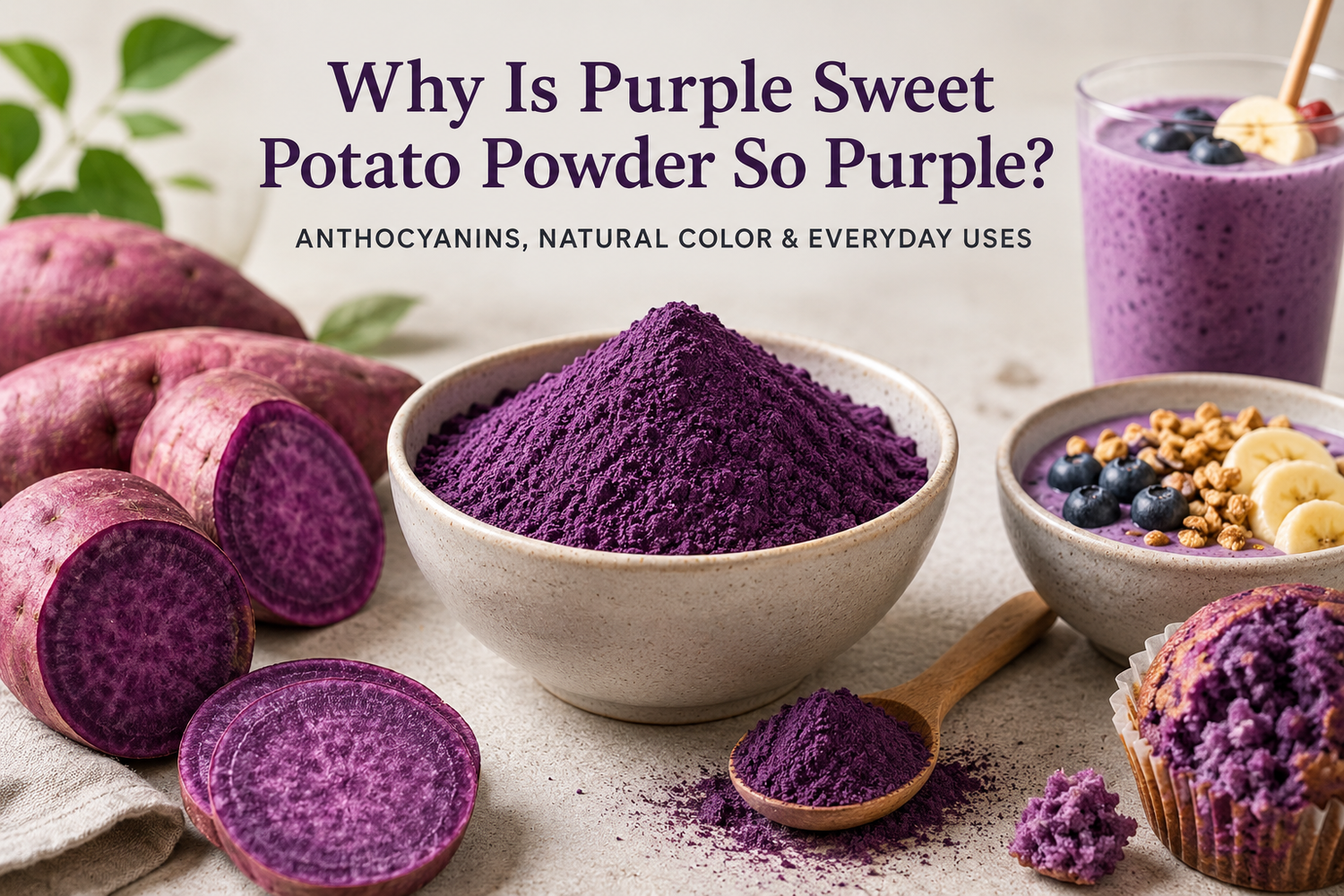
Cut one open and the color runs all the way through — deep violet flesh from the outside toward the center, with no added coloring needed to create that distinctive shade. That intensity comes from the plant itself.
When that same vegetable is dried and ground into powder, its naturally occurring pigments remain part of the ingredient. So when you see purple sweet potato powder that looks strikingly, almost improbably purple, the color begins with the root itself.
What is actually behind that color? What makes purple sweet potato different from other colorful plant foods? And what does that mean when you use the powder as a food ingredient?
Those are the questions this article answers.
Quick Answer: Why Is Purple Sweet Potato Powder Purple?
Purple sweet potato powder is purple because of naturally occurring plant pigments called anthocyanins.
These pigments are found throughout the flesh of purple sweet potatoes and contribute to the deep violet-purple color the root vegetable is known for.
Purple sweet potatoes are particularly distinctive for containing many acylated anthocyanins, including forms related to cyanidin and peonidin.
When the sweet potato is dried and ground into powder, those naturally occurring pigments remain part of the ingredient.
Organic Purple Sweet Potato Powder
What Is Purple Sweet Potato Powder?
Purple sweet potato powder is a finely ground food ingredient made from real purple sweet potatoes.
The result is a smooth, deep-purple powder that can be stirred, blended, or mixed into a wide range of foods and drinks.
It is not an artificial food coloring. It is not an isolated pigment or standardized extract. It is a real root vegetable transformed into a convenient powder form that is easy to measure, store, and use.
Unleash’d Organic Purple Sweet Potato Powder is USDA certified organic and made from real purple sweet potatoes. It brings the vegetable’s natural purple color, mild root-vegetable flavor, and naturally occurring plant compounds into everyday food.
What Gives Purple Sweet Potatoes Their Color?
The short answer is anthocyanins.
But it is worth understanding what that means in plain language.
Anthocyanins are naturally occurring plant pigments responsible for many of the red, blue, purple, and deep violet colors found throughout the plant kingdom.
When you see the deep indigo of a blueberry, the dark color of a blackberry, the magenta-red tones of some cherries, or the blue-purple shades of red cabbage, anthocyanins are part of what you are seeing.
These pigments naturally occur within plant tissues and serve different functions for the plant itself, including interactions with light and environmental conditions.
Purple sweet potatoes are especially visually distinctive because their pigments are found throughout the flesh rather than being limited to the outer skin.
Cut through the root and the purple color continues through the interior.
That is one of the reasons purple sweet potato looks so dramatically different from an ordinary orange or white sweet potato.
What Makes Purple Sweet Potato Anthocyanins Distinctive?
Not every anthocyanin-containing plant has the same anthocyanin profile.
A blueberry does not contain exactly the same mixture of anthocyanins as red cabbage, and neither has the same profile as purple sweet potato.
The types and proportions found in a plant can vary according to botanical variety, genetics, growing conditions, and other natural factors.
Purple-fleshed sweet potatoes are particularly known for containing a high proportion of acylated anthocyanins, including forms related to cyanidin and peonidin.
What does “acylated” mean?
An acylated anthocyanin is an anthocyanin molecule with an additional organic acid group attached to its structure.
This happens naturally within the plant. It is not something added during manufacturing.
Acylated anthocyanins are of particular interest in food science because of their distinctive color characteristics. Compared with some non-acylated anthocyanins, they are often noted for relatively good color stability, although the final color in a recipe can still vary substantially depending on heat, pH, moisture, and surrounding ingredients.
Research on purple-fleshed sweet potatoes has identified numerous cyanidin- and peonidin-related anthocyanins, including various acylated forms.
The exact anthocyanin profile can vary from one purple sweet potato variety to another.
This does not mean purple sweet potato powder behaves exactly like artificial food dye.
It means the color comes from real plant pigments — and real plant pigments naturally interact with the food environment around them.
Purple Sweet Potato Powder Is More Than a Natural Color
The color is usually the first thing people notice.
It is vivid enough that it can easily dominate the conversation around purple sweet potato powder.
But the color is only part of the story.
Purple sweet potato powder is a whole root-vegetable ingredient. Along with its natural color, it brings mild flavor, plant material, and naturally occurring plant compounds that are already part of the vegetable.
When you use it in food, you are adding more than a color signal.
You are adding a real plant ingredient.
That distinction matters.
A conventional food dye is primarily intended to add color. Purple sweet potato powder contributes color as part of a whole-food ingredient that naturally contains anthocyanins and other plant components.
Some people may be drawn to it because of the color.
Others may be interested in the naturally occurring plant compounds.
Others simply want an easy way to include more real plant ingredients in the foods they already eat.
All three are reasonable ways to think about this ingredient.
What Does Purple Sweet Potato Powder Taste Like?
This is worth answering directly because the dramatic color often makes people expect an equally dramatic flavor.
Purple sweet potato powder has a mild, lightly earthy, gently sweet flavor.
It tastes like what it is: a dried root vegetable.
The flavor is subtle and slightly starchy, with a natural sweetness that is much gentler than refined sugar.
Think of the familiar character of sweet potato, but lighter and easier to blend into other foods.
It is not grape-flavored.
It is not berry-like.
And it does not taste as intense as it looks.
The deep purple color can make people expect something strongly fruity or sweet, but the actual flavor is much quieter.
That mildness is part of what makes the powder versatile.
It can blend into smoothies, oatmeal, yogurt, baked goods, and drinks without overpowering the other ingredients.
The color announces itself; the flavor does not have to.
Purple Sweet Potato Powder vs. Ube Powder
Purple sweet potato and ube are not the same ingredient.
That distinction is worth understanding before buying either one.
Purple sweet potato is Ipomoea batatas, a sweet potato with naturally purple flesh.
Ube is Dioscorea alata, a species of purple yam with an especially strong association with Filipino culinary traditions.
They are botanically different plants.
Purple sweet potato typically has a mild, earthy, gently sweet root-vegetable flavor.
Ube is also mildly sweet and earthy, and in desserts it is commonly paired with vanilla, coconut, dairy, and other flavors that have become strongly associated with ube desserts.
Both can create beautifully purple foods, but they are not interchangeable ingredients.
Purple Sweet Potato
Plant type: Sweet potato (Ipomoea batatas)
Flavor: Mild, earthy, gently sweet, root-like
Color source: Anthocyanins, including many acylated forms
Uses: Sweet and savory foods, drinks, baking, bowls and everyday recipes
Ube
Plant type: Yam (Dioscorea alata)
Flavor: Mildly sweet and earthy; commonly paired with vanilla and coconut flavors in desserts
Color source: Naturally occurring purple plant pigments with a different profile
Uses: Strongly associated with Filipino desserts, halaya, ice cream and baked goods
Are they interchangeable?
Not exactly. They are different plants with different flavor characteristics and culinary traditions.
Unleash’d Organic Purple Sweet Potato Powder is purple sweet potato powder — not ube powder.
Can Purple Sweet Potato Powder Be Used as Natural Food Coloring?
Yes — as long as you understand what “natural food coloring” means when the color is coming from a real plant ingredient.
Purple sweet potato powder can contribute naturally derived purple color to foods such as:
- Smoothies
- Yogurt bowls
- Oatmeal
- Pancake batter
- Muffins
- Quick breads
- Frostings
- Glazes
- Drinks
- Doughs
- Desserts
In these applications, purple sweet potato powder acts as both a food ingredient and a source of natural plant color.
It is not equivalent to artificial food dye.
Synthetic colors are designed to produce highly controlled, repeatable color results.
Natural plant pigments behave differently because they interact with the chemistry of the surrounding food.
Your final color can depend on:
- How much powder you use — more powder usually creates a deeper color
- Other ingredients in the recipe
- pH — acidic and alkaline environments can shift anthocyanin colors
- Heat
- Moisture
- Cooking or baking time
That variation is not unusual.
It is part of working with natural plant pigments rather than standardized synthetic coloring.
How Heat and Acidity Affect the Color
Anthocyanins are pH-sensitive plant pigments.
That means their visible color can change depending on whether the surrounding environment is more acidic or more alkaline.
You may have seen a similar effect with red cabbage.
The same basic principle helps explain why purple sweet potato powder does not always remain exactly the same shade of purple in every recipe.
Acidity
More acidic conditions may shift the color toward brighter pink, magenta, or reddish-purple tones.
Alkalinity
More alkaline conditions may shift the color toward blue, blue-green, grey, or muted tones.
Heat
Baking and cooking may alter color intensity or tone.
Dairy and other ingredients
Different ingredients can affect the overall pH and appearance of the finished recipe.
Amount used
Using more powder generally creates a stronger baseline color, while using less may result in softer lavender or pink-purple shades.
So if purple batter comes out of the oven looking slightly more blue-grey than expected, or yogurt turns pink-purple rather than violet, that does not necessarily mean anything is wrong with the ingredient.
You are seeing the natural behavior of plant pigments.
That variability is one of the differences between cooking with real plant color and working with standardized artificial dye.
How to Use Purple Sweet Potato Powder in Everyday Food
Purple sweet potato powder works across both sweet and savory recipes.
Because the flavor is relatively mild, it can fit into many foods without dominating the overall taste.
Start with a small amount and adjust according to the color depth and flavor you want.
Drinks and Smoothies
Smoothies
Blend purple sweet potato powder with banana, oat milk, coconut milk, vanilla, or other favorite smoothie ingredients.
The mild root flavor blends easily while the natural purple color remains visually distinctive.
Smoothie Bowls
Mix the powder into a thicker smoothie base and finish with fruit, seeds, granola, or coconut.
The contrast between the purple base and lighter toppings can be especially striking.
Warm Milk Drinks
Whisk a small amount into warm oat milk or coconut milk with cinnamon or another favorite spice for a naturally colorful warm drink.
Breakfast
Oatmeal
Stir purple sweet potato powder into warm oats.
Banana, cinnamon, maple syrup, and plant milk all pair naturally with its mild root-vegetable character.
Yogurt
Mix it into plain yogurt, Greek yogurt, or coconut yogurt.
Add granola, fruit, seeds, or other toppings.
Pancakes
Blend it into pancake batter to create naturally colorful pancakes without relying on artificial purple dye.
Vanilla, coconut milk, cinnamon, and maple syrup all work well alongside it.
Baking
Muffins and Quick Breads
Purple sweet potato powder works especially well in banana, oat, vanilla, or coconut-based batters.
Keep in mind that baking can change the final purple tone depending on heat and the chemistry of the other ingredients.
Cookies and Doughs
Add a small amount to cookie or shortbread dough to introduce naturally occurring plant color.
Frostings and Glazes
Mix the powder into cream cheese frosting or a simple glaze for a naturally purple finish.
Because it is a real plant ingredient rather than standardized dye, the exact tone may vary.
Savory and Other Uses
Soups and Sauces
A small amount can introduce natural color and mild root-vegetable character to creamy soups, puréed vegetable sauces, grain bowls, and similar foods.
Coconut Milk Drinks
Purple sweet potato and coconut naturally complement one another.
Mixing the powder with coconut milk creates a mild, naturally colorful beverage that can be enjoyed warm or cold.
Pairing Purple Sweet Potato Powder
Because the flavor is mild, earthy-sweet, and root-like, purple sweet potato powder pairs easily with ingredients that complement its natural sweetness or provide gentle contrast.
Banana
Banana adds natural sweetness and creaminess while allowing the purple color to remain prominent.
Oat Milk, Coconut Milk and Almond Milk
All three work well as neutral or mildly flavored bases.
Coconut milk adds richness.
Oat milk keeps the flavor especially gentle.
Almond milk gives the result a lighter character.
Vanilla
Vanilla softens the earthy root note and works especially well in drinks, smoothies, pancakes, and desserts.
Cinnamon and Baking Spices
Warm spices provide contrast to the naturally mild sweetness of purple sweet potato.
Maple Syrup and Honey
Both pair naturally with the root-like flavor without overwhelming it.
Yogurt
The slight tartness of yogurt contrasts nicely with purple sweet potato's mild sweetness and creates a visually striking base for breakfast or snack bowls.
Cacao
Cacao provides deeper flavor and bitterness that contrasts with the gentler sweet potato character.
The pairing works particularly well in smoothies and warm drinks.
Cream Cheese
Cream cheese can work as a base for naturally colorful frostings and spreads.
Coconut
Coconut milk, coconut cream, and shredded coconut all pair naturally with purple sweet potato, particularly in dessert-style recipes.
Where Unleash’d Organic Purple Sweet Potato Powder Fits In
Unleash’d Organic Purple Sweet Potato Powder is a USDA certified organic plant powder made from real purple sweet potatoes.
It is designed as a whole-food plant ingredient rather than an isolated pigment or standardized extract.
Keep it in the pantry alongside other plant powders and reach for it when you want to bring real plant color, mild root-vegetable flavor, and naturally occurring plant compounds into the foods you already make.
If you are building a more plant-forward routine, purple sweet potato powder provides a convenient way to include a distinctive root vegetable in smoothies, breakfast foods, baking, drinks, and other everyday recipes.
Organic Purple Sweet Potato Powder
Final Thoughts
The color catches your eye first.
That makes sense. Purple sweet potato contains naturally occurring pigments vivid enough to make the root look almost unusually colorful.
But behind that color is a real vegetable with its own natural plant composition.
Purple sweet potatoes naturally contain anthocyanins, including distinctive acylated forms related to cyanidin and peonidin.
Those pigments are already part of the plant.
When purple sweet potato is transformed into powder, its naturally occurring anthocyanins remain part of the ingredient along with the mild flavor and other plant components that give the root its character.
That is what makes purple sweet potato powder interesting.
It does not need an artificial color story added to it.
It starts with a real root vegetable, its naturally occurring pigments, and the plant character already present in the ingredient.
And in powder form, it becomes easier to bring that real plant color and real plant composition into everyday food.
FAQ
1. What is purple sweet potato powder?
Purple sweet potato powder is a finely ground food ingredient made from real purple sweet potatoes.
It is naturally purple because of anthocyanins — plant pigments found throughout the flesh of the vegetable.
The powder can be used in smoothies, oatmeal, yogurt, baked goods, frostings, drinks, and other everyday foods.
2. Why is purple sweet potato powder purple?
The purple color comes from naturally occurring plant pigments called anthocyanins.
Purple sweet potatoes naturally contain anthocyanins, including many acylated forms related to cyanidin and peonidin.
These pigments occur throughout the purple flesh of the vegetable rather than only in the skin.
When the sweet potato is dried and ground into powder, those pigments remain part of the ingredient.
3. What are anthocyanins?
Anthocyanins are naturally occurring plant pigments that contribute to red, blue, purple, and deep violet colors in many plant foods.
They can be found in foods such as blueberries, blackberries, red cabbage, tart cherries, mulberries, and purple sweet potatoes.
Different plants naturally contain different anthocyanin profiles.
4. Does purple sweet potato powder naturally contain anthocyanins?
Yes.
Anthocyanins naturally occur in purple sweet potatoes and remain part of the whole plant ingredient when the vegetable is dried and ground into powder.
Purple-fleshed sweet potatoes are especially known for containing many acylated anthocyanins, including cyanidin- and peonidin-related forms.
The exact anthocyanin profile can naturally vary between different varieties and growing conditions.
5. What does purple sweet potato powder taste like?
Purple sweet potato powder has a mild, lightly earthy, gently sweet flavor.
It has the familiar character of a sweet potato, but in a subtler form.
It is not grape-flavored or strongly fruity, and its flavor is much gentler than its dramatic purple appearance might suggest.
6. Can purple sweet potato powder be used as natural food coloring?
Yes.
Purple sweet potato powder can bring naturally occurring purple plant color to smoothies, yogurt, oatmeal, pancake batter, muffins, frostings, glazes, doughs, and drinks.
Because it is a whole-food plant ingredient rather than standardized artificial dye, the final color can vary depending on the amount used, other ingredients, pH, heat, and moisture.
7. Does purple sweet potato powder change color when heated?
It can.
Anthocyanins are sensitive to factors such as pH and heat, so their visible color may shift during baking or cooking.
Depending on the recipe, the final color may appear more pink-purple, muted purple, blue-purple, or greyish.
Natural color variation is normal when working with plant pigments.
8. Is purple sweet potato powder the same as ube powder?
No.
Purple sweet potato is Ipomoea batatas, while ube is Dioscorea alata.
They are different plants.
Purple sweet potato has a mild, earthy-sweet root-vegetable flavor.
Ube is also mildly sweet and earthy and is strongly associated with Filipino desserts, where it is commonly paired with coconut, vanilla, and dairy flavors.
Unleash’d Organic Purple Sweet Potato Powder is purple sweet potato powder, not ube powder.
9. How do you use purple sweet potato powder?
Purple sweet potato powder can be blended into smoothies and smoothie bowls, stirred into oatmeal or yogurt, mixed into pancake or muffin batter, whisked into warm drinks, or incorporated into frostings, glazes, and doughs.
Start with a small amount and adjust according to the color depth and flavor you prefer.
10. Is purple sweet potato powder a supplement?
Unleash’d Organic Purple Sweet Potato Powder is sold as a food ingredient.
It is made from purple sweet potatoes in powder form and is intended for everyday food use.

Leave a comment
This site is protected by hCaptcha and the hCaptcha Privacy Policy and Terms of Service apply.