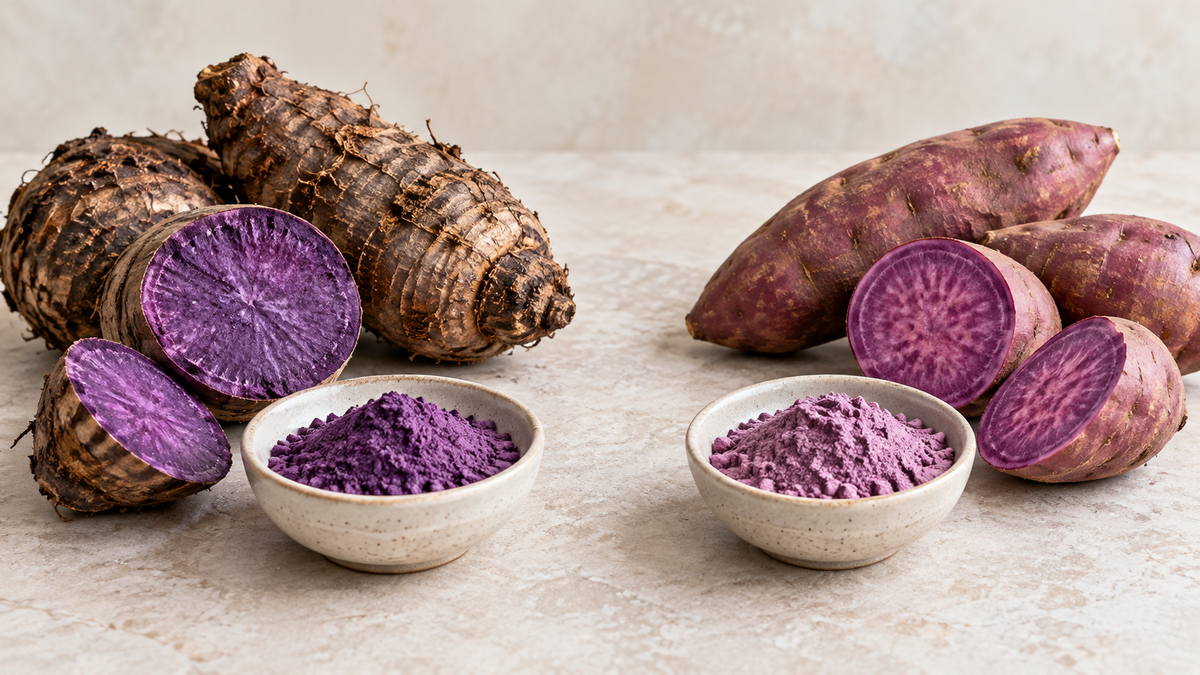
They're both purple, both naturally sweet, and both appear in everything from traditional desserts to modern smoothies and food powders. With their similar appearance—and the way their names are sometimes used interchangeably—it's easy to assume that ube and purple sweet potato are the same ingredient.
They aren't. The difference begins with the plants themselves and extends to their flavor, natural pigment composition, and the ingredients sold under their names.
If you're choosing a plant powder, understanding that distinction helps you know what you're actually buying.
The Short Answer: Is Ube the Same as Purple Sweet Potato?
No. Ube is a purple yam, commonly identified as Dioscorea alata, while purple sweet potato is a purple-fleshed variety of Ipomoea batatas. They belong to different botanical families.
Both can have striking purple flesh, and both naturally contain anthocyanins—the plant pigments associated with their color. But their botanical identities, pigment profiles, and culinary characteristics are not identical.
Unleash’d Organic Purple Sweet Potato Powder is made from purple sweet potato, not ube. That distinction matters whether you're interested in the ingredient's natural plant composition or how it fits into everyday food.
Same Color, Different Plants
The confusion between ube and purple sweet potato is understandable.
Both can produce vivid purple foods. Both have a mild, earthy sweetness. And as purple desserts and drinks have become more familiar, their names have sometimes been used loosely in recipes, product descriptions, and social media.
But a shared color does not establish a shared botanical identity.
Ube belongs to the Dioscoreaceae family, which includes yams. Purple sweet potato belongs to the Convolvulaceae family, also known as the morning glory family. They are different plants, even when their prepared forms look remarkably similar.
The distinction becomes especially important when buying powders. A purple powder is not automatically ube powder, and a product labeled purple sweet potato should not be understood as a yam ingredient.
The ingredient name—not color alone—is the better starting point.
What Is Ube?
Ube is a yam commonly associated with Dioscorea alata. It is particularly well known in Filipino cuisine, where it has been used in traditional foods for generations.
Its flesh can range from pale lavender to deeper purple, depending on the variety. When cooked, ube typically has a starchy texture and a sweet, earthy flavor. It is often described as having subtle nutty or vanilla-like notes.
Those flavor descriptions are useful, but they are not universal. The variety, preparation method, and other ingredients in an ube dish all affect the final taste. Commercial ube desserts may also contain added flavorings, so the flavor of a finished dessert should not be treated as a precise description of the original yam.
Ube is familiar in preparations such as ube halaya, rice cakes, ice cream, and baked goods.
Botanically, however, it is a yam—not a sweet potato or taro.
What Is Purple Sweet Potato?
Purple sweet potato is a purple-fleshed form of the sweet potato, Ipomoea batatas.
Sweet potatoes can have orange, white, cream, or purple flesh. Purple-fleshed varieties contain naturally occurring pigments that give the interior its characteristic color.
Purple sweet potato generally has a mild sweetness and an earthy, familiar sweet-potato character. Its exact flavor and texture vary with the variety and preparation.
Beyond its appearance, purple sweet potato is a plant food with its own natural composition. Its anthocyanins are part of that composition, rather than pigments added to the vegetable to create its color.
Purple sweet potato is also the source ingredient for purple sweet potato powder. The powder provides another food format for people who want to incorporate this particular plant ingredient into their diets.
For a deeper explanation of purple sweet potato's natural pigments and ingredient characteristics, see our Purple Sweet Potato Powder — Anthocyanins, Color & Uses.
Why Are Ube and Purple Sweet Potato Both Purple?
Their similar color comes largely from anthocyanins, a group of naturally occurring plant pigments also found in foods such as blueberries, red cabbage, and black rice.
Anthocyanins belong to a broader family of plant compounds called flavonoids. They are part of the natural chemical composition of certain fruits, vegetables, and other plant foods.
But the fact that two plants contain anthocyanins does not mean they contain the same combination of compounds.
Purple-fleshed sweet potatoes are particularly associated with anthocyanins derived from cyanidin and peonidin. Many of these occur in acylated forms, meaning their molecular structures include additional chemical groups that can influence pigment behavior and stability.
Ube also contains anthocyanins, but its specific pigment composition varies by cultivar and is not identical to that of purple sweet potato.
This is one reason the two ingredients should not be treated as interchangeable sources of a single, uniform purple pigment.
Does a Deeper Purple Color Mean More Anthocyanins?
Not necessarily.
The visible color of a plant ingredient can be influenced by its pigment composition, variety, growing conditions, processing, and the surrounding food environment.
Acidity and temperature, for example, can affect the appearance of anthocyanin-containing ingredients. Processing can also influence how much of the original pigment composition remains in a finished food.
A deeper purple shade is therefore not a reliable substitute for measuring anthocyanin content.
For anyone interested in naturally occurring plant compounds, botanical identity and verified composition are more informative than appearance alone.
Ube vs. Purple Sweet Potato: Side-by-Side Comparison
The table below summarizes the main differences between the two ingredients.
| Feature | Ube | Purple Sweet Potato |
|---|---|---|
| Botanical identity | Dioscorea alata | Ipomoea batatas |
| Plant group | Yam | Sweet potato |
| Plant family | Dioscoreaceae | Convolvulaceae |
| Flesh color | Often lavender to deep purple in commonly used varieties | Purple in purple-fleshed varieties |
| Natural purple pigments | Anthocyanins; composition varies by variety | Anthocyanins, including cyanidin- and peonidin-related compounds |
| Typical flavor | Sweet and earthy; may have nutty or vanilla-like notes | Mildly sweet, earthy, and characteristic of sweet potato |
| Texture when cooked | Generally starchy; varies by preparation | Can range from soft to dense depending on variety and preparation |
| Common food applications | Traditional desserts, sweet preparations, drinks, and powders | Whole-food dishes, smoothies, baked goods, and powders |
| Same as taro? | No | No |
These are general ingredient characteristics, not fixed rules for every variety or finished product. Processing and added ingredients can change the appearance and flavor of foods made from either plant.
Do Ube and Purple Sweet Potato Taste the Same?
They can share a broad earthy sweetness, but their flavor profiles are not necessarily identical.
Ube is often described as having a more distinctive sweet, nutty character. Some preparations also bring out notes that people associate with vanilla.
Purple sweet potato tends to retain a more familiar sweet-potato flavor: gently sweet and earthy, with a character that can work in both sweet and savory foods.
The differences are often easier to notice when comparing simply prepared versions of the plants. Once sugar, dairy, spices, or flavorings are added, the final dishes may taste quite different from the original ingredients.
For food powders, the exact flavor also depends on the source material and finished formulation.
If you're choosing a powder for a particular recipe, use the actual ingredient description rather than assuming that ube and purple sweet potato will produce identical results.
Is Ube the Same as Taro?
No. Taro is another distinct plant, commonly identified as Colocasia esculenta.
Unlike ube, which is a yam, and purple sweet potato, which is a sweet potato, taro belongs to the Araceae family. The edible part is a corm, an underground plant structure.
Taro generally has a starchy texture and a relatively mild, earthy flavor. Its flesh is often pale, sometimes with purple or pinkish flecks, rather than consistently deep purple.
The three ingredients may appear in similar desserts, drinks, and powdered products, which contributes to the confusion.
But ube, purple sweet potato, and taro are three different plants. Their names should not be used as botanical synonyms.
What Is Purple Sweet Potato Powder?
Purple sweet potato powder is a food ingredient derived from purple sweet potato.
Its identity comes from the original plant: Ipomoea batatas. It is not ube powder simply because it has a similar color.
This distinction matters beyond labeling.
Purple sweet potato naturally contains anthocyanins as part of its broader plant composition. A powder made from purple sweet potato represents a plant-derived food ingredient rather than an isolated, standardized anthocyanin extract.
However, that does not mean every purple sweet potato powder has the same nutritional composition as the fresh vegetable, or that every powder retains identical amounts of anthocyanins.
The finished composition can depend on the starting material and processing conditions. Without product-specific testing, the powder's exact anthocyanin content cannot be determined from its appearance alone.
Why Might Purple Sweet Potato Powder Vary in Color?
Natural plant ingredients are not always identical from one source or batch to another.
Purple sweet potato powders may show differences in shade due to the original plant material, its pigment composition, processing, and storage conditions.
These variations do not automatically establish a difference in nutritional value or product quality. Nor should every visible color change be assumed to be harmless or unrelated to the ingredient.
The appropriate way to understand a finished powder is through its ingredient identity, product specifications, and relevant quality information—not color alone.
For consumers looking specifically for this plant ingredient, Unleash’d Organic Purple Sweet Potato Powder provides an option derived from purple sweet potato rather than ube.
How to Use Purple Sweet Potato Powder in Everyday Food
Purple sweet potato powder offers a practical way to incorporate a different plant ingredient into foods you already prepare.
Its natural color and mild flavor can be useful in recipes, but these characteristics are not the only reasons someone may choose it. For people interested in the variety of naturally occurring plant compounds found in different foods, the ingredient's botanical source matters too.
A few everyday applications include:
Smoothies: Blend the powder with fruit and a liquid base. The final shade and texture will depend on the other ingredients and the amount used.
Oatmeal and yogurt: Stir it into prepared oats or yogurt for another way to include a purple sweet potato ingredient in breakfast.
Pancakes and baked goods: Incorporate it into a suitable batter or dough, adjusting the recipe as needed.
Other food preparations: Depending on the recipe, it may also be used in drinks or selected savory dishes.
As with many plant powders, purple sweet potato powder disperses through mixtures rather than necessarily dissolving completely in water. A whisk or blender may help distribute it more evenly.
The best preparation method depends on the recipe and the desired result.
Choosing the Right Purple Ingredient
If you are buying a purple food ingredient, start by identifying the plant you actually want.
Choose ube when you specifically want a yam ingredient associated with ube-based foods. Choose purple sweet potato when you want an ingredient derived from Ipomoea batatas.
If a product is a powder, check the full ingredient description. A powder's appearance alone cannot establish whether it comes from ube, purple sweet potato, taro, or a blend containing other ingredients.
It is also useful to distinguish a plant-derived food powder from a purified pigment or standardized extract. These are different ingredient formats, and their nutritional compositions should not be assumed to be equivalent.
For readers interested in exploring purple sweet potato alongside other vegetable-derived food powders, visit our Vegetable Powders collection.
Final Thoughts
Ube and purple sweet potato may share a vivid purple appearance, but they begin with different plants.
Ube is a yam, Dioscorea alata. Purple sweet potato is a sweet potato, Ipomoea batatas. Their flavors, culinary traditions, and natural pigment compositions are related in some ways, but they are not identical.
Understanding the distinction helps you choose an ingredient for what it actually is—not simply how it looks.
For anyone specifically interested in purple sweet potato, a powder derived from the plant offers another way to incorporate that ingredient into everyday food. Its botanical identity and naturally occurring composition are the starting points for understanding its value.

Leave a comment
This site is protected by hCaptcha and the hCaptcha Privacy Policy and Terms of Service apply.