Compare a few greens powders online and you'll quickly notice something interesting.
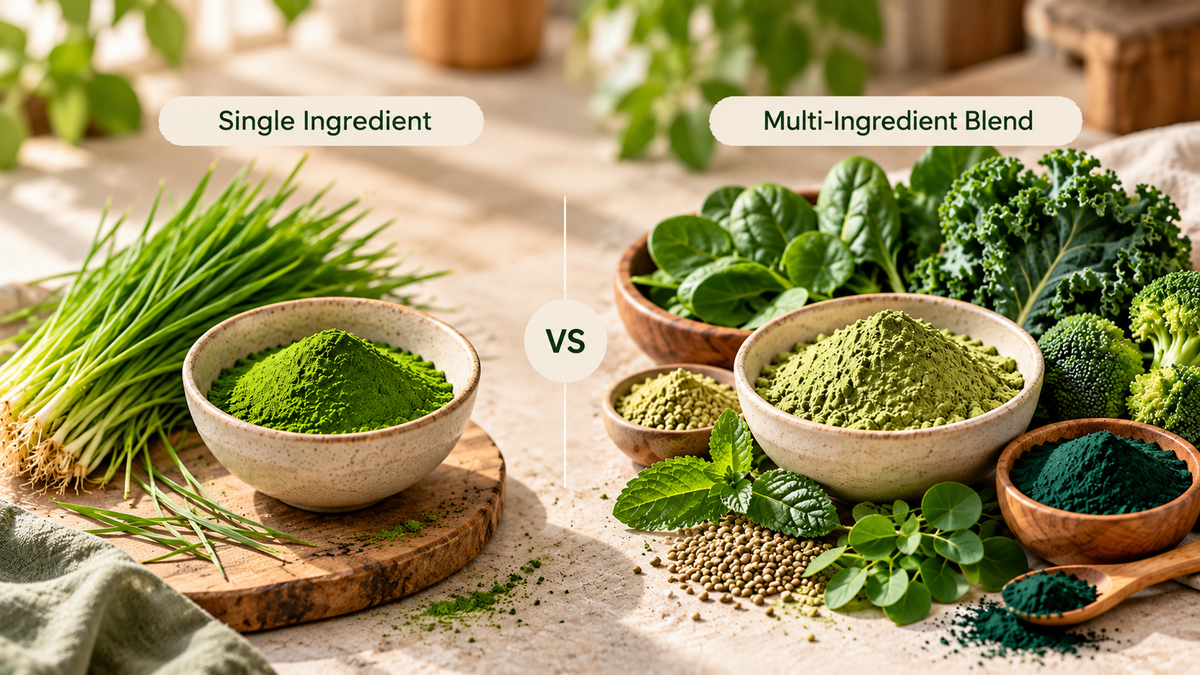
One product contains wheatgrass and nothing else. Another advertises 20 botanical ingredients. A third promises more than 40 ingredients, combining greens, algae, fruits, mushrooms, probiotics, and other additions into a single formula.
Looking at those products side by side, it's tempting to assume that the one with the longest ingredient list must be the most nutritious.
After all, if one plant ingredient is useful, wouldn't 20 or 40 be even better?
Not necessarily.
More ingredients don't automatically mean more nutrition. What matters is what the finished product actually provides per serving — and whether that matches what you're looking for.
A thoughtfully formulated greens blend can be a convenient and useful choice. A single-ingredient powder can be equally practical for someone who wants a particular botanical ingredient without a pre-mixed formula.
Understanding the difference starts with looking beyond the ingredient count printed on the front of the package.
Do More Ingredients Automatically Mean More Nutrition?
The short answer is no.
A product containing 20 botanical ingredients may offer a wider range of plant sources than one containing only wheatgrass. But that doesn't automatically tell you how much dietary fiber, protein, iron, or other nutrients it provides.
There are three important distinctions:
Ingredient diversity describes how many different ingredients are included.
Ingredient quantity describes how much of each ingredient is present.
Nutritional composition describes the nutrients and other constituents found in the finished product.
These are related, but they aren't interchangeable.
Consider a hypothetical greens powder containing 20 ingredients in a 10 g serving.
All 20 ingredients must collectively fit within those 10 grams. If they were present in equal amounts, each would contribute an average of 0.5 g.
In practice, they may be present in very different proportions. Some ingredients could make up much of the formula, while others contribute considerably less.
This simple calculation does not tell us whether the blend is good or bad. It illustrates why the number of ingredients alone cannot establish how much of any individual component the consumer receives.
It also raises another question: are those 20 ingredients actually 20 different plants?
Not necessarily. A formulation may include botanical ingredients alongside added vitamins, minerals, flavorings, probiotics, or other components. The number advertised on the package should not automatically be interpreted as the number of distinct plants included.
A well-designed multi-ingredient powder may provide a useful combination of ingredients. But its value comes from the actual formulation and nutritional composition, not simply the length of its ingredient list.
How Much of Each Ingredient Are You Actually Getting?
Imagine you're comparing two greens powders.
The first contains a single ingredient: organic barley grass.
The second lists wheatgrass, barley grass, spirulina, chlorella, spinach, kale, broccoli, and several additional ingredients.
You can identify the plants in both products. But can you tell exactly how much barley grass appears in the second formula?
That depends on what the manufacturer discloses.
What the ingredient list tells you
For conventional foods sold in the United States, ingredients are generally listed in descending order of predominance by weight, subject to certain labeling exceptions.
That means ingredients appearing earlier on the list generally represent larger amounts than ingredients appearing later.
However, the ingredient list does not ordinarily tell you the exact number of grams of each component.
Knowing that barley grass appears before spinach is useful. It does not establish how many grams of either ingredient are included in one serving.
What about proprietary blends?
Some greens powders are marketed as conventional food products, while others are sold as dietary supplements.
Those categories follow different U.S. labeling requirements.
Under the dietary supplement labeling framework, certain formulations may be declared as proprietary blends. The label identifies the dietary ingredients in the blend and provides the total blend weight, while individual amounts of certain ingredients may not be disclosed.
A proprietary blend is not automatically deceptive or poorly formulated.
It simply means that a consumer may have less information about the quantity of each component than they would with a fully itemized formula.
Other manufacturers voluntarily disclose more detailed ingredient quantities.
When comparing products, it's useful to recognize the difference between knowing that an ingredient is present and knowing how much is present.
Why serving size matters
Serving size provides another piece of context.
A 5 g serving and a 12 g serving are not directly comparable simply because both products are described as greens powders.
The larger serving does not automatically offer better nutrition, but it provides a different total amount of material in which nutrients and ingredients may be present.
To evaluate a greens powder, look at the ingredient list, the labeled serving size, and the declared nutritional composition together.
Each answers a different question.
Single-Ingredient vs. Multi-Ingredient Greens Powders
Single-ingredient powders and multi-ingredient blends represent two different approaches to using plant-derived food ingredients.
Neither format is inherently superior.
The more useful question is what each format allows you to do.
| Consideration | Single-Ingredient Greens Powder | Multi-Ingredient Greens Blend |
|---|---|---|
| Ingredient identity | One identifiable botanical source | Multiple ingredients combined in a formulation |
| Plant variety | One primary source per product | May contain several different plant sources |
| Flexibility | Consumers choose which ingredients to combine | Ingredient combination is predetermined |
| Convenience | Simple when using one ingredient; more preparation if combining several | Convenient for those wanting a ready-made combination |
| Quantity transparency | Amount of the primary ingredient is generally clear from serving size | Individual ingredient amounts may or may not be disclosed |
| Nutritional information | Nutrition Facts describe the finished single-ingredient product | Nutrition Facts or Supplement Facts describe the finished blend, as applicable |
| Flavor | Reflects the character of the individual ingredient | Depends on the combination and proportions of ingredients |
| Best suited for | Those who prefer ingredient simplicity or more control | Those who prefer a prepared combination of ingredients |
Why choose a single-ingredient powder?
A single-ingredient greens powder offers a straightforward experience.
If you choose wheatgrass powder, you know the botanical source you are adding to your food. If you choose barley grass, you're working with a different grass-derived ingredient and its own characteristic flavor.
This simplicity can be useful for people who enjoy experimenting with particular ingredients.
For example, someone might prefer the bold, grassy character of Unleash'd Organic Wheatgrass Powder in a smoothie, while using the milder flavor of Unleash'd Organic Barley Grass Powder in yogurt, dressings, or savory sauces.
Using separate powders gives the consumer control over which ingredient to use and how much to add to a particular recipe.
That control is an advantage of the format.
It doesn't mean the product automatically contains more vitamins, minerals, or other nutrients than a blend. Those characteristics still depend on the finished product.
Why choose a multi-ingredient blend?
A multi-ingredient blend offers a different kind of convenience.
Instead of purchasing several individual powders and deciding how to combine them, a consumer can choose a prepared formulation.
A thoughtfully designed blend may combine ingredients for flavor, variety, or a particular nutritional profile.
It may also be easier to incorporate into a routine for someone who prefers a consistent combination rather than mixing individual ingredients.
For example, Unleash'd Organic Ultimate Superfood Powder combines ingredients including alfalfa, barley grass, broccoli, chlorella, kale, spinach, spirulina, and wheatgrass.
Those ingredients provide an example of a multi-ingredient approach rather than an individual green powder.
The presence of several plant sources, however, should not be confused with a guarantee about specific nutrient quantities. As with any blend, the finished product's label remains the appropriate starting point for understanding what a serving provides.
The difference is not necessarily quality. It's how the ingredients are selected, combined, and used.
Does a Greens Powder with 30 Plants Replace Eating 30 Different Plants?
No.
A greens powder containing ingredients from 30 different plants is not nutritionally equivalent to eating substantial portions of 30 different plant foods.
That distinction matters because ingredient variety and food quantity are two different things.
Whole vegetables and fruits provide water, natural food structure, dietary fiber, and a range of nutrients and plant compounds in amounts that depend on the food and portion consumed.
Turning plant materials into powders changes their physical form. Depending on the ingredients and processing methods, their nutritional composition may also change.
A small amount of spinach powder, for example, cannot automatically be treated as equivalent to a full serving of cooked spinach. Nor does including broccoli on an ingredient list establish that a finished product provides a particular amount of broccoli's naturally occurring compounds.
A greens blend may still contribute useful plant-derived ingredients and nutrients.
But a list of 30 plants is not the same thing as consuming meaningful portions of 30 different foods.
The Dietary Guidelines for Americans, 2025–2030 continue to emphasize eating a varied diet built around nutritious foods, including vegetables and fruits.
Greens powders can fit alongside that kind of eating pattern. They should not be presented as a complete replacement for it.
Ingredient Lists vs. Nutrition Facts: What Should You Actually Read?
When evaluating greens powders, neither the ingredient list nor the Nutrition Facts panel tells the entire story.
They provide different information.
The ingredient list tells you what is included in the formula.
Nutrition Facts tells you about declared nutrients per serving.
For products regulated as dietary supplements, the Supplement Facts panel follows a different format and may provide additional information about dietary ingredients.
Together, these labels can help you understand a product more completely.
A practical example: Two greens powders, two different labels
Consider two hypothetical products:
| Label Information | Powder A | Powder B |
|---|---|---|
| Ingredients | 1 botanical ingredient | 20 ingredients |
| Serving size | 5 g | 10 g |
| Dietary fiber | 2 g | 3 g |
| Individual ingredient amounts | Single primary ingredient | Not individually disclosed |
These are fictional examples used only to demonstrate label comparison. They do not represent specific products.
Which powder provides more fiber?
Powder B provides more dietary fiber per labeled serving: 3 g compared with 2 g.
But Powder A has a higher proportion of fiber relative to its serving weight.
Does that make Powder A better?
Not necessarily.
Powder B may provide other nutrients or ingredients that the consumer values. Powder A may be a better fit for someone specifically looking for that one botanical ingredient.
Neither ingredient count nor fiber amount alone establishes overall superiority.
The example demonstrates why the comparison depends on what the consumer wants to understand.
If dietary fiber is the priority, compare declared fiber amounts and serving sizes.
If you want a particular botanical ingredient, read the ingredient list and check whether its amount is disclosed.
If sodium, added sugars, protein, or a specific mineral matters to you, look at the corresponding declared values.
And remember that a Nutrition Facts panel does not necessarily quantify every naturally occurring botanical compound in the product.
For example, seeing spirulina or wheatgrass listed as an ingredient does not establish how much chlorophyll or another plant-derived constituent the finished serving contains.
Likewise, the presence of many green ingredients does not automatically make a product high in dietary fiber or protein.
The relevant information must come from the finished product and its substantiated composition.
What to check when comparing labels
A useful label comparison should consider:
-
Serving size: How much powder does one labeled serving contain?
-
Dietary fiber: How much does that serving contribute?
-
Protein: Is protein a meaningful part of the product's nutritional profile?
-
Vitamins and minerals: Which nutrients are declared, and in what amounts?
-
Sodium and added sugars: Are these relevant to the way the product is formulated?
-
Ingredient disclosure: Can you identify the main ingredients and, where disclosed, their quantities?
The goal is not to find a powder with the highest number in every category.
It's to understand what the product actually offers.
What About Organic Certification, Testing, and Quality?
Ingredient count and nutritional composition are not the only considerations when choosing a greens powder.
Product quality also matters.
Organic certification is one useful piece of information.
For example, USDA organic certification indicates that the product has been produced and handled according to applicable organic standards.
That is a meaningful distinction related to agricultural production and handling practices.
However, organic certification does not automatically establish that a powder contains more iron, fiber, vitamins, or other nutrients than a comparable non-organic product.
Those are separate questions.
Testing is another area where consumers benefit from understanding what a claim actually means.
A product may be tested for heavy metals, microbial contamination, ingredient identity, or nutritional composition.
These are different types of tests, each addressing different characteristics.
A statement that a product has been "third-party tested" is more informative when the brand explains what was tested and what the results support.
The same principle applies to ingredient sourcing and traceability.
Clear identification of ingredients, appropriate labeling, credible certifications, and relevant testing information can help consumers evaluate product quality.
None of these factors should be assumed solely from whether a formula contains one ingredient or forty.
Who Should Choose a Single Ingredient — and Who Might Prefer a Blend?
The answer depends more on how you want to use the product than on which format sounds more impressive.
A single-ingredient powder may suit you if...
You have a particular ingredient in mind.
Perhaps you enjoy the taste of barley grass and want to incorporate it into savory preparations. Or you prefer using a single green ingredient in smoothies instead of working with a pre-mixed combination.
You might also want to experiment with different ingredients individually before deciding whether to combine them.
Spirulina Powder, for example, represents a very different ingredient from wheatgrass or barley grass.
Spirulina is a cyanobacterium commonly grouped with algae in commercial food categories. It is not botanically a leafy green vegetable.
Its distinctive identity, flavor, and composition are reasons to evaluate it as its own ingredient rather than treating every green-colored powder as nutritionally equivalent.
Choosing individual ingredients can make it easier to understand their characteristics and decide where each belongs in your everyday food preparation.
A multi-ingredient blend may suit you if...
You prefer a ready-made formulation.
Instead of choosing and measuring several individual powders, you may want a single product containing a preselected combination.
A blend can also be useful when you like the taste, convenience, and nutritional characteristics of that specific formulation.
The important consideration is whether you understand what you're purchasing.
Does the ingredient list make sense to you?
Does the label provide useful nutritional information?
Does the formulation contain ingredients you actually want?
And does it fit comfortably into foods or drinks you already enjoy?
A blend containing 20 ingredients can be a reasonable choice.
So can a powder containing just one.
Neither format automatically wins. The more useful comparison is between the actual products and your priorities.
How to Choose a Greens Powder That Fits Your Everyday Routine
Before buying a greens powder, consider what you're trying to add to your diet.
If your main interest is a particular botanical ingredient, a single-ingredient powder may be the most straightforward starting point.
If you want a ready-made combination of several plant ingredients, a multi-ingredient blend may be more convenient.
If you are comparing products for a specific nutrient such as fiber or iron, look at the finished product's declared nutritional information rather than assuming that a longer ingredient list delivers more.
Taste and food compatibility matter too.
A powder with a strong earthy or grassy flavor may work well in certain smoothies, sauces, or savory dishes but be less appealing in other preparations.
A prepared blend may have a more complex flavor because of the ingredients and their proportions.
Think about how you will realistically use the product.
Will you blend it into fruit smoothies? Stir it into yogurt? Mix it into a sauce or soup?
A product that suits your preferences and everyday meals may be more useful to you than one with an impressive ingredient count that you rarely enjoy using.
Finally, consider how the powder fits into your broader diet.
Greens powders are food ingredients or dietary supplements, depending on the product's formulation and intended use. Neither category should be treated as a shortcut to complete nutrition.
A varied diet built around ordinary foods remains the foundation.
A greens powder can be an additional option within that diet, rather than something expected to do everything on its own.
So, Do You Really Need 20 Ingredients?
Not necessarily.
A greens powder with 20 ingredients may be a good choice if you want that particular formulation and its nutritional composition fits your needs.
A single-ingredient powder may be equally appropriate if you prefer simplicity, flexibility, or a specific botanical source.
What matters is the relationship between the ingredients, the serving size, the finished nutritional composition, and how you intend to use the product.
Ingredient count can tell you something about a formula's complexity.
It cannot tell you everything about its nutritional value.
The better greens powder isn't necessarily the one with the longest ingredient list. It's the one whose ingredients, nutritional composition, and purpose make sense for you.
Explore Unleash'd Organic Greens & Algae Powders to see different plant-derived ingredients and find the format that fits your everyday routine.

Leave a comment
This site is protected by hCaptcha and the hCaptcha Privacy Policy and Terms of Service apply.