
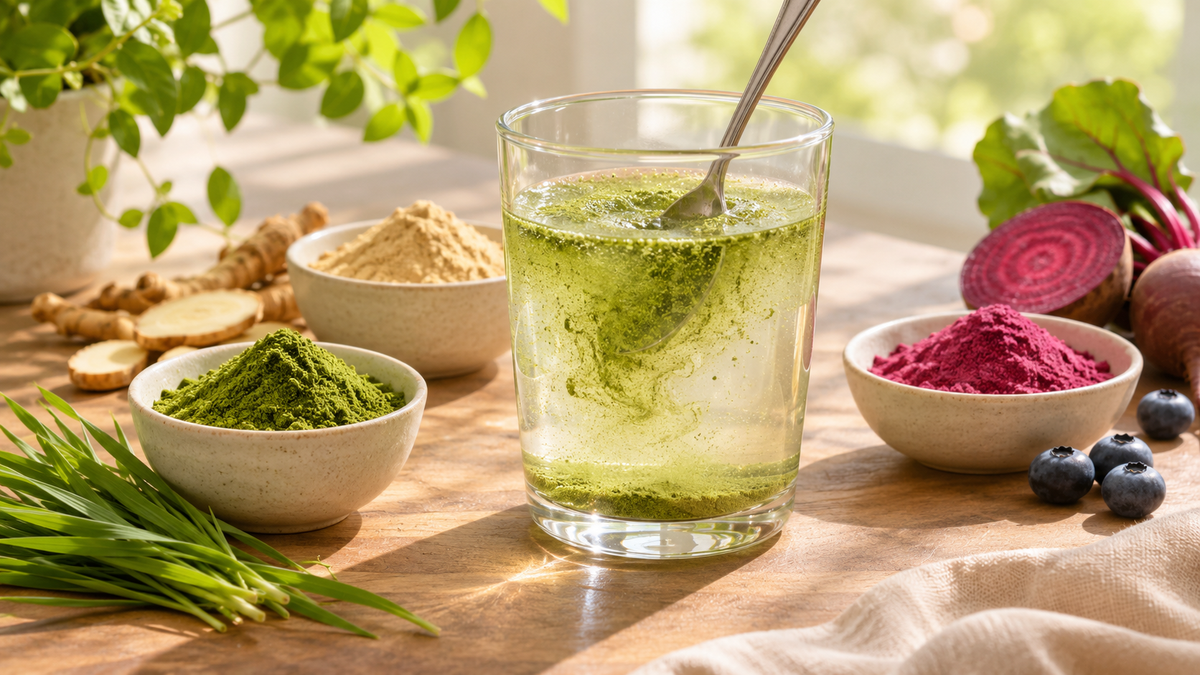
You add a spoonful of plant powder to a glass of water and start stirring.
Some of the powder floats on the surface. A few small clumps form around the spoon. After mixing, the drink looks fairly uniform, but when you leave it on the counter for a few minutes, a thin layer of particles collects at the bottom.
Now you're wondering: Is something wrong with the powder?
Not necessarily. Many plant powders mix into water without completely dissolving, and some visible particles or sediment are a normal part of how these ingredients behave.
The reason is surprisingly simple: mixing and dissolving are not the same thing.
Plant powders are made from complex ingredients. Depending on the source, they may contain soluble compounds, insoluble plant material, starches, proteins, or a combination of these components.
Some dissolve in water. Others disperse, absorb water, or remain suspended before gradually settling.
Understanding these differences can help you get a better texture, avoid frustrating clumps, and choose the preparation method that works best for your powder.
Why Doesn't Plant Powder Fully Dissolve in Water?
Think about what happens when you stir sugar into water.
Sugar dissolves because its molecules separate and become distributed throughout the liquid. Once dissolved, you no longer see individual sugar particles.
Plant powders often behave differently.
They contain a variety of substances, and not all of them are water-soluble.
A vegetable powder, for example, may contain material from plant cell walls. A root powder may contain a combination of structural carbohydrates and soluble compounds. A plant protein powder may contain protein particles whose ability to dissolve depends on how the ingredient was processed.
When these ingredients meet water, several things can happen simultaneously.
Some substances dissolve. Others absorb water and swell. Still others become suspended as tiny particles.
This is why a drink can look thoroughly mixed while still containing material that has not actually dissolved.
Dissolving vs. dispersing: What's the difference?
The distinction matters more than you might expect.
Dissolving happens when a soluble substance becomes incorporated into a liquid at the molecular or ionic level, forming a solution.
Dispersing happens when particles spread throughout a liquid without necessarily dissolving.
Suspending describes particles remaining distributed in the liquid for a period of time.
Settling occurs when some of those undissolved particles gradually collect at the bottom of the container.
Imagine stirring a fine plant powder into water. At first, it may create a smooth-looking drink. But if some particles remain insoluble, they can eventually separate from the liquid.
How quickly that happens depends on particle size, density, liquid thickness, and other physical properties.
Some preparations stay fairly uniform for a long time. Others begin showing sediment soon after mixing.
A powder can mix well without ever becoming completely water-soluble.
That is one of the most useful things to understand about preparing plant-derived powders.
Why Does Plant Powder Float, Clump, or Settle?
Floating, clumping, and settling may look like variations of the same problem, but they happen for different reasons.
Why does powder float on the surface?
Some dry powders do not become wet immediately when they touch water.
Food scientists call this property wettability.
Fine particles can trap small pockets of air, and certain particle surfaces are slower to absorb or interact with water.
As a result, some powder may temporarily sit on the surface rather than sinking immediately.
Stirring, whisking, or shaking helps bring the powder into contact with the liquid.
A little initial floating does not mean the powder is defective. It often means the particles need more time or movement to become properly wetted.
Why does powder form clumps?
Clumps commonly form when a large amount of dry powder comes into contact with water all at once.
The outer layer becomes wet first, while some powder inside the clump remains dry.
Depending on the ingredient, this outer layer may become sticky or swell, making it harder for water to reach the center.
The result is a small lump that seems determined to survive every turn of your spoon.
This is especially noticeable with powders that absorb water quickly.
The solution is often straightforward: change how you combine the powder and liquid.
Adding powder gradually, preparing a small slurry first, or using a shaker can make a noticeable difference.
Clumps that form during mixing are different from hard clumps already present in the unopened or dry product. The latter may deserve a closer look for possible moisture exposure.
Why does powder settle after mixing?
When undissolved particles are dispersed throughout water, some may gradually sink as gravity acts on them.
Particle size and density influence this behavior, along with the viscosity of the surrounding liquid.
A thicker smoothie, for example, may keep particles distributed differently from a glass of plain water.
This explains why the same powder can appear more evenly blended in one preparation than another.
If a drink develops a little sediment while standing, stirring it again often redistributes the particles.
Settling is a physical behavior, not a nutritional score.
A powder that leaves sediment is not automatically worse, better, more natural, or more nutritious than one that mixes smoothly.
Why Different Plant Powders Mix Differently
One of the biggest mistakes consumers make is expecting every plant powder to behave like an instant drink mix.
But different plants contain different combinations of fiber, starches, proteins, soluble compounds, and structural materials.
Processing also changes how these components interact with water.
Consider how five common types of plant powders may behave.
| Powder Type | Why Mixing Behavior Can Differ | Practical Mixing Approach |
|---|---|---|
| Wheatgrass / Barley Grass | Grass-derived material may contain insoluble plant particles that remain suspended or settle | Stir or blend thoroughly; use in smoothies or mixed drinks |
| Dandelion Root Powder | Contains both soluble compounds, including inulin-type fructans, and plant material that may remain insoluble | Prepare a slurry first; gradually add liquid; use in suitable warm drinks |
| Purple Sweet Potato Powder | Starch and other root-vegetable components can absorb water and influence thickness or texture | Mix into oatmeal, yogurt, smoothies, or blended preparations |
| Plant Protein Powder | Protein solubility varies with source, processing, temperature, and other conditions | Use a shaker or blender; incorporate into smoothies or recipes |
| Fruit Juice Powder | Soluble fruit-derived solids and any other formulation components influence dissolution and dispersion | Stir into suitable liquids; use a shaker if needed; follow product directions |
These descriptions explain general ingredient behavior rather than laboratory-tested solubility results for specific Unleash'd Organic products.
Dandelion root: Why doesn't it dissolve completely?
Dandelion root is a particularly interesting example because it contains more than one type of carbohydrate.
The root naturally contains inulin-type fructans, which are soluble carbohydrates, as well as other plant-derived material.
That means some components of dandelion root may dissolve or interact with water differently from others.
A powdered root is not the same as a purified inulin ingredient.
When the root is dried and ground, the powder can still contain structural material that does not completely dissolve.
As a result, part of the powder may mix into the liquid while other particles remain visible or eventually settle.
If you're preparing Unleash'd Organic Dandelion Root Powder, try combining the powder with a small amount of liquid first, then gradually adding the rest while stirring.
Its earthy, roasted flavor also makes it a natural fit for warm botanical drinks, lattes, and other recipes where a perfectly clear liquid is not necessary.
Purple sweet potato: Why does the texture change?
Purple sweet potato powder behaves differently because sweet potatoes naturally contain starch alongside other plant components.
Starch does not behave like sugar when added to water.
Depending on the starch's condition and the preparation temperature, it can absorb water, swell, and influence the thickness of the mixture.
This helps explain why some root-vegetable powders create a fuller or thicker texture rather than a perfectly clear drink.
For Unleash'd Organic Purple Sweet Potato Powder, oatmeal, yogurt, smoothies, and pancake batter are practical ways to use its natural color and flavor while allowing the powder to become part of the food.
Plant proteins: Why doesn't a shaker always solve everything?
Plant protein powders have their own mixing characteristics.
Protein solubility depends on several factors, including the protein source, manufacturing process, temperature, and the conditions of the liquid.
A shaker bottle can distribute protein powder more evenly and reduce visible lumps.
But it cannot guarantee that every protein component dissolves.
For example, Unleash'd Organic Mung Bean Protein Powder can also be incorporated into smoothies, oatmeal, pancakes, and baking rather than being limited to plain-water preparations.
The important distinction is between achieving a pleasant, uniform mixture and expecting a transparent solution.
Those are not the same goal.
What Role Does Dietary Fiber Play?
Many plant-derived powders contain some combination of soluble and insoluble plant components.
Dietary fiber is one part of that picture.
Insoluble fiber includes structural materials such as cellulose, which does not dissolve in water.
Soluble fiber can interact with water differently. Depending on the specific fiber, it may dissolve, increase viscosity, or contribute to gel formation.
Some plant ingredients contain both.
This helps explain why certain powders produce suspended particles while others change the texture of the liquid.
However, you cannot determine a powder's dietary fiber content simply by looking at the amount of sediment it produces.
A visible layer at the bottom of a glass is not a fiber measurement.
If dietary fiber is important to your food choices, the product's Nutrition Facts panel is the appropriate place to check its declared amount.
Is Sediment Normal, or Does It Mean Poor Quality?
For many plant powders, some visible sediment after mixing is an ordinary physical characteristic.
The important question is whether the powder is behaving as expected for that ingredient.
A drink that becomes slightly cloudy or develops fine particles at the bottom after standing may simply contain plant material that has dispersed without completely dissolving.
This is especially understandable with powders derived from grasses, roots, vegetables, and certain plant proteins.
However, not every unexpected change should be dismissed as normal.
What usually isn't surprising
Fine particles that settle after stirring, temporary floating before the powder becomes wet, or small lumps that break apart during mixing can all reflect ordinary powder behavior.
What deserves attention
An unexpected odor, visible mold, foreign material, damaged packaging, or unusual hard clumps in the dry powder may indicate a problem that requires further investigation.
If a product appears spoiled, contaminated, or substantially different from its expected condition, do not consume it. Contact the seller for clarification.
Appearance alone cannot establish microbial safety, and sediment by itself cannot confirm product quality.
The useful rule is simple:
A little settling in a prepared drink is very different from signs that the dry product itself may have deteriorated.
How to Mix Plant Powders More Easily
Now for the practical part.
You don't need to force every plant powder to dissolve completely. But you can often make it mix more evenly and improve the drinking experience.
1. Start with a small amount of liquid
For powders that form lumps easily, try mixing the powder with a little liquid before adding the full amount.
Stir until it forms a relatively smooth paste or slurry.
Then gradually add the remaining liquid while continuing to stir.
This gives the powder more opportunity to become wetted and reduces dry pockets inside larger clumps.
It can be especially useful for certain root and vegetable powders.
2. Add powder gradually
Instead of dropping a large scoop onto the water surface all at once, add it in smaller portions while stirring.
This prevents a large pile of dry material from forming in one place.
The result is often easier to mix with an ordinary spoon or whisk.
3. Use a shaker bottle
A shaker bottle can help distribute powder more evenly than gentle spoon-stirring.
It is particularly convenient for plant protein powders and green drink preparations.
Shaking may reduce clumps and create a more consistent mixture.
If undissolved particles remain, they may still settle when the drink is left standing.
4. Try a blender
A blender is useful when you're combining plant powder with fruit, yogurt, milk alternatives, or other ingredients.
The additional mixing action can distribute powder more thoroughly throughout the preparation.
This can create a smoother, more consistent texture, especially in thicker drinks.
But remember: blending improves dispersion. It doesn't magically turn every insoluble plant component into a dissolved substance.
5. Choose the right liquid temperature
Water temperature can affect how a powder behaves.
Warm liquid may help certain ingredients become wetted and mixed, while starch-containing powders may change texture as temperature increases.
Heat can also affect protein behavior and some heat-sensitive plant compounds.
There is no universal rule that hotter water produces a better result.
Use a temperature that suits the ingredient, the recipe, and the product's preparation instructions.
6. Stir again before drinking
Sometimes the simplest method is the best one.
If a plant powder forms a suspension and some particles collect at the bottom after standing, give the drink another stir or gentle shake before drinking.
You may not eliminate settling completely, but you can redistribute the particles and enjoy a more consistent mixture.
Better mixing is about improving texture and distribution, not forcing every ingredient to become water-soluble.
Beyond Water: Plant Powders Can Be Easier to Enjoy in Food
Plain water is only one way to prepare plant powders.
In fact, some ingredients offer a more enjoyable flavor and texture when incorporated into foods that already have body, thickness, or complementary flavors.
Rather than treating incomplete dissolution as a problem you must solve, it can be helpful to consider whether a different preparation would suit the ingredient better.
Purple sweet potato in breakfast foods
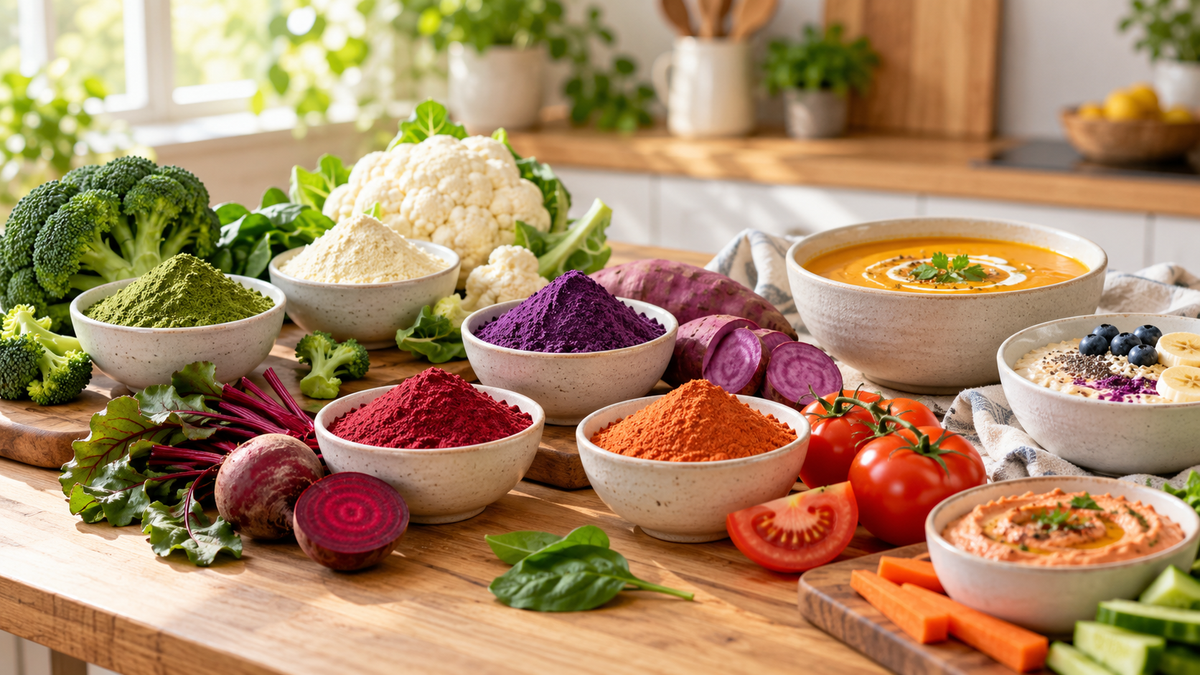
Purple sweet potato powder can be mixed into oatmeal, yogurt, smoothie bowls, or pancake batter.
Its natural purple color and mildly sweet, earthy flavor can become part of the finished dish without requiring a transparent liquid.
Broccoli and tomato in savory recipes
Broccoli powder fits naturally into suitable vegetable soups, sauces, and dips.
Tomato powder works well in pasta sauces, soup bases, savory seasoning mixtures, and marinades.
In these preparations, the powder becomes part of the food itself.
Wheatgrass and barley grass in blended drinks
Grass-derived powders can be incorporated into smoothies and other blended preparations.
Other ingredients provide flavor and texture, while blending helps distribute the green powder throughout the drink.
Plant proteins in everyday recipes
Mung bean protein and pumpkin seed protein can be incorporated into smoothies, oatmeal, suitable batters, and other recipes.
A pleasant food texture may be easier to achieve when the powder is combined with ingredients that naturally provide structure and consistency.
A plant powder doesn't have to disappear into a glass of water to be useful in your kitchen.
For more ideas on incorporating vegetable-derived ingredients into meals, see Can Vegetable Powders Help When You Don't Eat Enough Vegetables?.
Frequently Asked Questions
Is it normal for plant powder to settle at the bottom of a glass?
Yes, it can be. Many plant powders contain particles that disperse into water without completely dissolving. Those particles may settle after the drink stands. Stirring or shaking again often redistributes them.
Does more sediment mean the powder contains more fiber or nutrients?
No. Sediment reflects how particles behave in liquid. It doesn't measure dietary fiber, vitamin content, mineral concentration, or overall nutritional value. Use the product's Nutrition Facts and verified product information for nutritional comparisons.
Why does my plant powder clump when I add water?
Water may wet the outside of a powder cluster before it reaches the dry center. Adding the powder gradually or mixing it into a small amount of liquid first can help reduce these lumps.
Does warm water dissolve plant powders better?
Sometimes warm water helps with mixing, but it depends on the ingredient. Heat may also change starch texture or protein behavior. Follow the product's preparation guidance rather than assuming hotter water is always better.
Can a blender make plant powder dissolve completely?
A blender can make the mixture more uniform, but it doesn't guarantee complete dissolution. Some plant particles remain insoluble even when they are well dispersed throughout a drink.
Final Thoughts: Understanding What Happens in Your Glass
If your plant powder doesn't disappear completely into water, that doesn't automatically mean there's something wrong with it.
Plants contain a combination of soluble and insoluble materials. When those materials are dried and made into powders, they retain different physical characteristics.
Some dissolve. Others absorb water, disperse, or settle.
Once you understand that difference, a little cloudiness or sediment becomes easier to interpret.
You can also improve the experience by changing how you prepare the powder: mix gradually, use a slurry when needed, try a shaker or blender, and stir again if particles settle.
And if plain water doesn't give you the texture you want, consider using the ingredient in a smoothie, oatmeal, yogurt, soup, or another food where its natural character fits.
The goal isn't always a perfectly clear glass of water.
It's understanding how your plant powder behaves and finding a preparation method that makes it easy to enjoy.
Explore the Unleash'd Organic Vegetable Powders Collection for more ways to use real plant-derived ingredients in everyday cooking.

Leave a comment
This site is protected by hCaptcha and the hCaptcha Privacy Policy and Terms of Service apply.