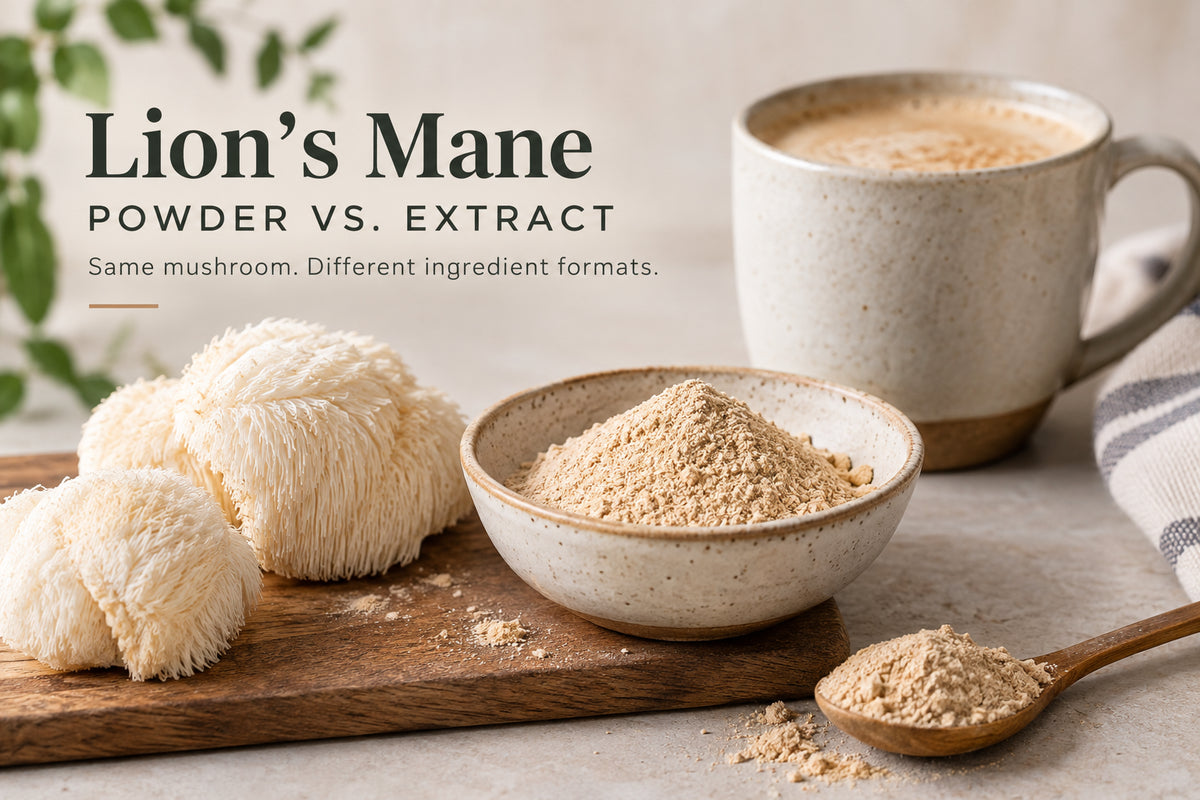
Search for Lion’s Mane and you’ll quickly run into two words: powder and extract.
They can look surprisingly similar sitting side by side on a shelf, and both may begin with the same mushroom. But they are not simply two names for the same ingredient.
The difference is less about what the mushroom is—and more about what happens to it before it becomes the ingredient you buy.
The Short Answer
Lion’s Mane mushroom powder and Lion’s Mane extract may begin with the same mushroom, but they represent different ingredient formats.
A simple mushroom powder generally represents more of the original physical mushroom material in dried, powdered form.
An extract takes a different route. An extraction step separates certain extractable components from the original mushroom material before the finished ingredient is produced.
Here is where the terminology can become confusing: the word “powder” describes physical form, not necessarily processing history.
A mushroom extract can also be dried and sold as a powder.
So seeing “powder” on the front of a package does not automatically tell you whether the ingredient is a simple mushroom powder or a dried mushroom extract.
Unleash’d Organic Lion’s Mane Mushroom Powder
Same Mushroom, Different Ingredient Format
Think of the difference in terms of what the finished ingredient represents.
A simple mushroom powder stays relatively close to the physical mushroom itself. Mushroom material is dried and milled into a usable powder, so a broader portion of the original mushroom material remains represented in the finished ingredient.
An extract changes that relationship.
During extraction, certain components move from the original mushroom material into the extraction medium. The finished extract therefore represents an extracted fraction of the starting material rather than the broader physical mushroom itself.
Both finished ingredients may eventually appear as fine powders.
That is why appearance alone cannot tell you which format you are looking at.
This is not really a question of which format is “better.”
It is a question of what the finished ingredient represents and how it was produced.
Once that distinction is clear, mushroom labels become much easier to understand.
What Is a Simple Lion’s Mane Mushroom Powder?
When we refer to a simple mushroom powder here, we mean mushroom material that has been dried and milled without a separate extraction step.
The exact drying and milling methods can vary between manufacturers, so it is better not to assume a specific process unless that process has been confirmed.
What matters for ingredient understanding is that the finished powder generally represents a broader portion of the original physical mushroom material.
That can include mushroom structure, fiber, protein, carbohydrates, polysaccharides, and other naturally occurring components present in the source material.
Drying and milling are still processing steps, and the finished composition depends on the original material and how it was handled.
So “mushroom powder” should not be interpreted as a guarantee that every compound found in a fresh mushroom remains in exactly the same amount.
It simply describes a different ingredient format from an extract.
What Is Lion’s Mane Extract?
Extraction is a process used to separate certain extractable components from a raw material.
In mushroom processing, water and alcohol are among the extraction media commonly used in the industry, although methods vary between manufacturers.
The important point is not the specific solvent—it is that an extraction step takes place before the finished ingredient is produced.
After extraction, the resulting material may be further processed and dried into a powder.
That is why products described as Lion’s Mane extract powder can look physically similar to ordinary mushroom powder even though they represent different ingredient formats.
Extract products can also differ considerably from one another.
Some may identify an extraction method. Others may include a ratio such as 8:1 or 10:1, or provide information about particular measured compounds.
Those details describe specific products and should not be assumed to apply to every Lion’s Mane extract.
Lion’s Mane Powder vs. Extract — Side by Side
| Feature | Lion’s Mane Mushroom Powder | Lion’s Mane Extract |
|---|---|---|
| Starting material | Lion’s Mane mushroom | Lion’s Mane mushroom |
| Ingredient format | Broader mushroom material | Extracted mushroom fraction |
| Processing concept | Mushroom material is dried and powdered | Extraction occurs before the finished ingredient is produced |
| Physical mushroom structure | More broadly represented | Less representative of the full original physical material |
| Can the finished product be a powder? | Yes | Yes |
| Same ingredient format? | No | No |
| Best understood as | Mushroom-derived food ingredient | Extracted mushroom ingredient |
The biggest source of confusion is that both columns can end with the word powder.
That word tells you what the finished ingredient looks like. It does not necessarily tell you what happened before it reached that form.
Does “Powder” Mean It Is Not an Extract?
No.
This is one of the most useful things to understand when reading mushroom product labels.
A mushroom extract can be dried after extraction and sold as a fine powder.
So a powdered Lion’s Mane product could represent a simple mushroom powder, or it could be a dried extract.
The word powder tells you about physical form.
It does not, by itself, tell you whether an extraction step occurred.
If the distinction matters, read the full ingredient description and product information rather than relying only on the front label.
Words such as extract, a stated extraction method, or an extraction ratio may indicate an extract format.
If the ingredient format is not clearly identified, the manufacturer’s detailed product information is the better place to confirm it.
What Naturally Occurs in Lion’s Mane Mushroom?
Lion’s Mane (Hericium erinaceus) is an edible mushroom with a distinctive white, cascading appearance.
Like other mushrooms, it contains a naturally complex mixture of structural and nutritional components.
Among these are polysaccharides, including beta-glucans—naturally occurring polysaccharides found in mushroom cell walls.
Lion’s Mane also contains varying amounts of fiber, protein, carbohydrates, and other naturally occurring mushroom compounds.
Research on Lion’s Mane has also identified distinctive compounds in different fungal tissues.
Hericenones are primarily associated with the fruiting body, while erinacines are predominantly associated with the mycelium.
That distinction is useful from an ingredient-education standpoint because not every Lion’s Mane ingredient begins with exactly the same source material.
The amount and profile of naturally occurring compounds in a finished product depend on the source material and how the ingredient was produced.
The goal here is not to suggest that one ingredient format is inherently superior.
The more useful takeaway is that Lion’s Mane is a naturally complex mushroom, and processing determines which parts of that original material are represented in the finished ingredient.
What About Taste, Color, and Texture?
Lion’s Mane mushroom powder can have a mild earthy and lightly savory mushroom character.
The exact flavor depends on the source material, the amount used, and the finished ingredient.
In foods with stronger surrounding flavors, the mushroom character often becomes part of the background rather than the dominant taste.
Color can vary naturally as well.
Lion’s Mane powders are often found in light cream, off-white, beige, or tan tones, but appearance can vary depending on the source material and processing.
Texture is also important.
Mushroom powder does not necessarily dissolve in liquid the way sugar or a completely soluble ingredient does.
It is better described as mixing, blending, whisking, or dispersing into foods and drinks.
A blender, whisk, or shaker can help produce a more even texture.
How Can Lion’s Mane Mushroom Powder Be Used in Everyday Food?
Lion’s Mane mushroom powder can fit into a variety of everyday foods without needing to become the main flavor.
It can be blended into smoothies, whisked into warm drinks, stirred into oatmeal, or mixed into soups, broths, sauces, and other savory dishes.
Its mild mushroom character can also work in food blends where other ingredients provide most of the flavor.
Because it is a powdered mushroom ingredient, it is best incorporated through mixing, whisking, or blending rather than expecting it to disappear completely into liquid.
The amount used can be adjusted depending on the recipe and the flavor balance you want.
Where Unleash’d Organic Lion’s Mane Fits In
Unleash’d Organic Lion’s Mane Mushroom Powder is a mushroom-derived food ingredient intended for everyday use in foods and drinks.
The broader Unleash’d Organic philosophy starts with real plant and mushroom ingredients and the naturally occurring nutrients, fibers, colors, flavors, and compounds already present within them.
With Lion’s Mane, the focus is not on presenting the ingredient as a clinical or therapeutic product.
It is about making a real mushroom-derived ingredient easier to incorporate into everyday food.
The exact ingredient format and processing details should always be described according to the confirmed product information rather than assumptions based on the word “powder” alone.
Unleash’d Organic Lion’s Mane Mushroom Powder
Final Thoughts
Two Lion’s Mane ingredients can begin with the same mushroom and still arrive at very different forms.
The most useful question is not which one is “better.”
It is simpler:
What does this finished ingredient actually represent, and how was it made?
Once you understand that powder describes a physical form, while extraction describes a processing step, the category becomes much easier to navigate.
The label starts to tell a clearer story.
And that is really the point—not to decide for you, but to help you understand what you are looking at.
Frequently Asked Questions
1. What is Lion’s Mane mushroom powder?
A simple Lion’s Mane mushroom powder generally refers to mushroom material that has been dried and milled into a fine powder without a separate extraction step. It represents a broader portion of the original physical mushroom material than an extract.
2. What is Lion’s Mane extract?
Lion’s Mane extract is produced through an extraction step that separates certain extractable components from the original mushroom material. The resulting ingredient may later be dried and sold in powder form.
3. Is Lion’s Mane powder the same as extract?
No. A simple mushroom powder and a mushroom extract are different ingredient formats. Mushroom powder generally represents more of the broader physical mushroom material, while an extract represents material obtained through an extraction step.
4. Can Lion’s Mane extract come in powder form?
Yes. An extract can be dried after processing and sold as a fine powder. This is why the word “powder” alone does not tell you whether a Lion’s Mane ingredient is a simple mushroom powder or an extract.
5. How can I tell whether a Lion’s Mane product is a powder or an extract?
Read the full ingredient description and product information rather than relying only on the word “powder.” Terms such as “extract,” an extraction ratio, or a stated extraction method may indicate an extract format. If the format is not clearly identified, check the manufacturer’s detailed product information.
6. What naturally occurs in Lion’s Mane mushroom?
Lion’s Mane naturally contains mushroom polysaccharides, including beta-glucans, along with fiber, protein, carbohydrates, and other naturally occurring mushroom compounds. Its exact composition varies with the source material and finished ingredient.
7. What does Lion’s Mane mushroom powder taste like?
Lion’s Mane mushroom powder can have a mild earthy and lightly savory mushroom character. The exact flavor depends on the particular ingredient, the amount used, and the foods or drinks it is mixed with.
8. How do you use Lion’s Mane mushroom powder?
It can be blended into smoothies, whisked into warm drinks, stirred into oatmeal, mixed into soups and broths, or incorporated into other everyday foods. It disperses into foods and liquids rather than necessarily dissolving completely.

Leave a comment
This site is protected by hCaptcha and the hCaptcha Privacy Policy and Terms of Service apply.