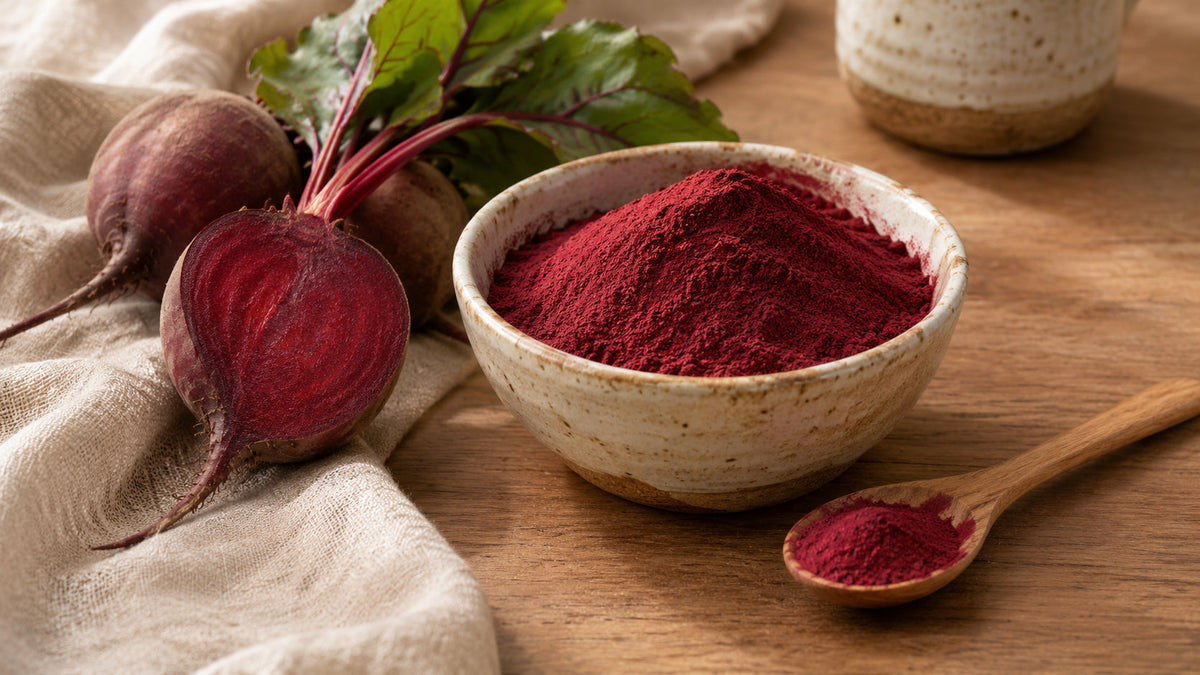
Beet root powder has a way of making itself noticed. Stir it into a smoothie, and an ordinary breakfast drink turns a remarkable shade of red. Mix it into hummus, and suddenly a familiar dip looks like something from a modern food magazine.
But the conversation around beets goes well beyond their color. They come up in discussions about circulation, sports nutrition, and the naturally occurring compounds found in vegetables.
So what exactly makes this earthy, slightly sweet root vegetable so interesting? And what does it offer beyond making your breakfast look a little more colorful?
The answer begins with something you might not expect: nitrate.
More Than Just a Pretty Red Powder
Beet root powder is made by drying and grinding the edible root of the beet plant (Beta vulgaris). Removing moisture transforms a familiar vegetable into a convenient ingredient that can be added to drinks, soups, dips, sauces, and baked goods.
What makes beets particularly interesting from a nutritional perspective is their combination of naturally occurring compounds. These include dietary nitrates, betalains, betaine, and nutrients such as folate, potassium, and dietary fiber.
Each has a different role. Some contribute to the plant's appearance, some are involved in normal human metabolism, and others have become subjects of nutritional research.
Among them, dietary nitrate has attracted particular attention because of what can happen to it after we eat it.
Wait, Aren't Nitrates Supposed to Be Bad?
If the word nitrate sounds familiar, it may be because you've heard it in conversations about processed meats and food preservatives.
But nitrate isn't unique to processed foods. It also occurs naturally in many vegetables, including spinach, arugula, lettuce, celery, and beetroot.
Plants absorb nitrogen from the soil as part of their normal growth. Some of that nitrogen is present in the form of nitrate.
The scientific conversation about dietary nitrate is more complicated than labeling the compound as either good or bad. The food it comes from, other compounds present in that food, and the conditions under which it is metabolized all matter.
Vegetables are particularly interesting because nitrate exists alongside a variety of naturally occurring nutrients and plant compounds.
And once vegetable-derived nitrate enters the human body, an unexpected biological process can begin.
What Happens to Dietary Nitrate Inside Your Body?
One of the most fascinating things about dietary nitrate is that its metabolism involves not only our own cells but also the microorganisms living in our mouths.
After nitrate is consumed and absorbed, some of it circulates back into the saliva. Certain oral bacteria can convert nitrate into nitrite. Through further biological and chemical reactions, nitrite can contribute to the formation of nitric oxide.
The simplified pathway looks like this:
Dietary nitrate (NO₃⁻) → Nitrite (NO₂⁻) → Nitric oxide (NO)
Scientists call this part of the enterosalivary nitrate–nitrite–nitric oxide pathway.
Nitric oxide is a signaling molecule that the human body produces naturally. Among its many physiological functions, it helps regulate the relaxation of smooth muscle surrounding blood vessels.
When these muscles relax, blood vessels can widen, a process known as vasodilation. This is one of the mechanisms the body uses to regulate circulation.
What makes dietary nitrate scientifically interesting is that it provides an additional pathway through which nitric oxide can be formed.
A 2026 scientific review of dietary nitrate metabolism describes how this process connects food composition, oral microorganisms, and normal human physiology.
It is a remarkable example of how the relationship between food and the human body can be far more complex than a list of vitamins on a nutrition label.
What's the Connection Between Beets and Circulation?
This nitrate-to-nitric-oxide pathway helps explain why researchers have spent years investigating beetroot in relation to blood pressure and vascular function.
The connection isn't based solely on traditional beliefs or laboratory experiments. It has also been explored in controlled human studies.
A Review of 11 Clinical Trials
A 2024 systematic review and meta-analysis brought together 11 clinical trials involving 349 people with hypertension.
Across the studies, nitrate-rich beetroot juice was associated with an average reduction of approximately 5.3 mmHg in systolic blood pressure measured in clinical settings compared with control conditions.
However, the researchers rated the certainty of that evidence as low. Results also varied across studies and measurement methods.
The findings were interesting enough to warrant continued investigation, but they did not establish that all beetroot foods produce the same response.
When the Biological Mechanism Doesn't Tell the Whole Story
Another randomized crossover study published in 2024 examined 15 adults between the ages of 56 and 71 who were receiving treatment for hypertension.
After four weeks of consuming nitrate-rich beetroot juice, participants had higher nitrate and nitrite concentrations in their blood and saliva.
The expected metabolic pathway was active.
Yet the researchers did not observe sustained improvements in the vascular-function or blood-pressure outcomes they measured.
This distinction is important. Demonstrating that a biological pathway is working is not the same as demonstrating that every anticipated health outcome will follow.
What About Beet Root Powder Itself?
A 2026 randomized, double-blind crossover trial published in Food & Function investigated a nitrate-rich beetroot powder with measured nitrate concentrations.
The researchers examined several aspects of cardiovascular physiology, including blood pressure, arterial stiffness, and endothelial function—the function of the cells lining blood vessels.
They observed changes in certain measurements under specific experimental conditions. However, the findings differed depending on the outcome being measured and the nitrate quantity used.
This study is particularly relevant because it demonstrates that beetroot powder, as a food-derived preparation, is also being investigated in human nutrition research.
It was a short-term experiment using a characterized research preparation, rather than evidence of a long-term effect from ordinary commercial beet root powder.
What Can We Take From These Studies?
| Research | What researchers studied | Main finding |
|---|---|---|
| 2024 systematic review | Beetroot juice across 11 clinical trials | Encouraging findings for clinical systolic blood pressure, with low-certainty evidence |
| 2024 crossover trial | Nitrate-rich beetroot juice over four weeks | Changes in nitrate metabolism without sustained improvements in the measured vascular outcomes |
| 2026 randomized crossover trial | Beetroot powder with measured nitrate content | Short-term changes in selected cardiovascular measurements under particular study conditions |
Together, these studies show why beetroot continues to be a subject of scientific interest. They also illustrate why the composition of the studied ingredient and the characteristics of the participants matter.
These are findings about specific research preparations. They do not establish that a serving of Unleash'd Organic Beet Root Powder lowers blood pressure or produces a clinically measured circulatory effect.
Why Do Athletes Talk About Beets?
If you've encountered beetroot in conversations about running, cycling, or endurance sports, you've probably come across another area of dietary nitrate research.
Scientists have investigated whether nitrate metabolism influences the amount of oxygen muscles require during physical activity, as well as other aspects of exercise physiology.
A 2022 systematic review and meta-analysis examined 123 studies involving 1,705 adult participants. The researchers found a small average effect on exercise performance across the nitrate interventions studied, although results varied according to the participants and experimental conditions.
The interesting point is that a compound naturally present in vegetables has become a subject of research into how the human body uses oxygen.
That doesn't make every beetroot ingredient a sports-performance product. Nor does it mean that everyone who enjoys a beetroot smoothie should expect a measurable change in athletic performance.
It does, however, help explain why this familiar vegetable has attracted attention far beyond the kitchen.
There's More to Beets Than Nitrates
Dietary nitrate may receive much of the attention, but focusing on it alone would overlook several other interesting aspects of beetroot nutrition.
Betalains: The Reason Beets Are So Colorful
That unmistakable red-purple color comes primarily from a family of plant pigments known as betalains.
Betalains include red-violet pigments called betacyanins and yellow-orange pigments called betaxanthins. Betanin, one of the best-known betacyanins, contributes to the appearance of red beetroot.
These pigments have also been studied for their chemical behavior and antioxidant activity in laboratory settings.
Their presence reminds us that the natural colors of plant foods often come from chemically interesting compounds rather than simply being decorative features.
If you're curious about these pigments, explore our article on Beet Root Powder, Betalains, Natural Color & Uses.
Betaine: A Compound Named After the Beet
Here's a little piece of food trivia: betaine takes its name from Beta vulgaris, the beet plant.
Betaine, also known as trimethylglycine, occurs naturally in foods including beets, spinach, and whole grains.
Within the human body, it participates in two important biological processes. It acts as an osmolyte, helping cells manage changes in their water environment, and as a methyl donor, contributing to reactions involved in normal cellular metabolism.
A scientific review of betaine in human nutrition explains these physiological roles and the relationship between dietary betaine and human metabolism.
It is another example of a naturally occurring beet compound with a story that extends well beyond flavor and color.
Folate, Potassium, and Dietary Fiber
Fresh beets also naturally contain several familiar nutrients.
Folate is a B vitamin needed for processes including DNA synthesis and normal cell division. The National Institutes of Health provides an overview of its role in human nutrition.
Potassium is an essential mineral involved in muscle contraction, nerve signaling, and normal heart function. Its established physiological roles are explained in the NIH potassium fact sheet.
Dietary fiber is part of the natural structure of the beet root. Fiber contributes to normal digestive function and is one reason the distinction between whole-vegetable ingredients and clarified juices can matter.
These nutrients help explain why beets are worth appreciating as a vegetable rather than solely as a source of one fashionable compound.
The precise amounts in a finished powder depend on the original vegetable, processing conditions, and serving size.
Beet Root Powder vs. Beet Juice vs. Fresh Beets
They all begin with the same vegetable, but the format changes how the ingredient can be used.
| Food format | What it is | Where it fits naturally |
|---|---|---|
| Fresh beetroot | The intact root vegetable | Roasting, salads, soups, and cooked dishes |
| Beetroot juice | Liquid extracted from the root | Drinks and juice-based recipes |
| Whole beet root powder | Dried and ground root material | Smoothies, dips, sauces, soups, and baking |
| Beetroot extract | A selectively processed beet-derived ingredient | Formulations designed around particular constituents |
Whole-root powder is especially interesting as a culinary ingredient because it retains the ground root material rather than being produced by separating juice from the vegetable.
Its dry format also means you can introduce beet flavor and color into a recipe without significantly changing its liquid content.
That is useful when making foods such as hummus, pancake batter, salad dressing, or pasta sauce.
The powder's composition is not necessarily identical to fresh beetroot on a gram-for-gram basis. Removing water changes the relationship between weight and nutrient concentration, while processing can affect individual compounds differently.
A 2026 study examining fresh beetroots and commercial beetroot powders found variations in the nutritional and phytochemical profiles of different products. Growing conditions, sourcing, and post-harvest processing were among the factors relevant to those differences.
No single format is automatically superior. Fresh beets have their place, and so do juices and powders. The right choice depends on the food you want to prepare and the qualities you're looking for in that ingredient.
What Makes a Good Beet Root Powder?
Start with the ingredient list.
A whole-root beet powder and a beet-flavored drink mix are not necessarily the same thing. Some commercial formulations may contain sweeteners, flavoring agents, carriers, or additional ingredients.
Unleash'd Organic Beet Root Powder is made from one ingredient: USDA Certified Organic beet root. It contains no fillers, added sugar, artificial colors, or artificial flavors.
Its naturally earthy flavor, subtle sweetness, and distinctive red-purple appearance come from the vegetable itself.
It is a straightforward food ingredient rather than a nitrate-standardized sports supplement or concentrated beetroot extract.
The appeal is simple: you get real beetroot in a convenient pantry format, ready to use in foods you're already making.
Everyday Ways to Enjoy Beet Root Powder
Beet root powder doesn't have to be reserved for a particular type of drink or routine.
Its earthy sweetness works surprisingly well in both sweet and savory recipes.
Here are a few ways to explore it:
-
Berry smoothies: Combine beetroot with strawberries, blueberries, banana, and yogurt for a fruit-forward flavor.
-
Homemade hummus: Mix beet root powder into chickpeas, tahini, lemon, and olive oil for a colorful, earthy dip.
-
Salad dressings: Pair it with olive oil, lemon juice, and balsamic vinegar.
-
Pancakes and muffins: Stir it into batter for a natural pink or red hue.
-
Soups and sauces: Use it where a little earthy vegetable flavor would complement the other ingredients.
-
Fruit drinks: Blend it with apple, citrus, or berries to balance the characteristic beet flavor.
If you're unfamiliar with the taste of beetroot, pairing it with citrus or fruit is a good place to begin.
And because whole-root powder contains plant material, blending or whisking it into a recipe may provide a more even texture than simply stirring it into cold water.
So, What's All the Hype Really About?
Beetroot has an unusual combination of characteristics for such a familiar vegetable.
Its red-purple color comes from distinctive plant pigments. Its natural nitrate content has opened up fascinating questions about food, oral microorganisms, and nitric oxide metabolism. It also contains betaine and other nutrients with established roles in human biology.
Those characteristics help explain why beetroot has become a recurring subject in food and nutrition research.
But perhaps the most approachable thing about beet root powder is that you don't need a complicated routine to enjoy it.
It can be part of a homemade dip, a colorful breakfast, a fruit smoothie, or an ordinary evening meal.
The research gives us more reasons to be curious about beets. The powder gives us another way to enjoy them.
And sometimes, discovering something interesting about a familiar vegetable is all it takes to look at an everyday ingredient a little differently.
Frequently Asked Questions
What is beet root powder made from?
Whole beet root powder is made from dried and ground beet roots. It differs from juice-derived powder and extracts, which begin with different food materials or undergo different processing.
What are the nutritional benefits of beetroot?
Beetroot naturally contains dietary nitrate, betalains, betaine, folate, potassium, and fiber. These compounds and nutrients contribute to its food composition and scientific interest. Finished powder composition varies.
Does beetroot naturally contain nitrates?
Yes. Dietary nitrate occurs naturally in beetroot and many other vegetables. The amount varies with growing conditions, variety, and processing.
What is the relationship between beetroot and nitric oxide?
Nitrate from foods can undergo metabolic conversion into nitrite and subsequently contribute to nitric oxide formation. Nitric oxide participates in several physiological processes, including regulation of blood-vessel relaxation.
Can beet root powder lower blood pressure?
Human research involving specific beetroot preparations has produced mixed results. Those studies do not establish that an ordinary serving of every beet root powder lowers blood pressure. Beetroot foods are not substitutes for prescribed treatment.
Is beet root powder the same as beet juice powder?
No. Whole-root powder uses dried root material, while beet juice powder starts from extracted juice. They may differ in fiber content, composition, texture, and culinary applications.
Why is beet root powder naturally red?
Its characteristic color comes primarily from betalains, a family of naturally occurring plant pigments that includes red-violet betacyanins.
Is beet root powder only used in smoothies?
Not at all. It is also suitable for dips, salad dressings, soups, sauces, pancakes, muffins, and other everyday recipes.
Scientific References
-
Dietary nitrate metabolism, oral microbiota, and nitric oxide formation — 2026 review.
-
Four-week beetroot juice intervention and vascular-function outcomes — Fejes et al., 2024. DOI: 10.1039/D3FO03749E.
-
Nitrate-rich beetroot powder and cardiovascular function — McLellan et al., Food & Function, 2026. DOI: 10.1039/D5FO05298J.
-
Dietary nitrate and exercise performance in adults — 2022 systematic review and meta-analysis.
-
Betaine in human nutrition — American Journal of Clinical Nutrition, 2004.

Leave a comment
This site is protected by hCaptcha and the hCaptcha Privacy Policy and Terms of Service apply.