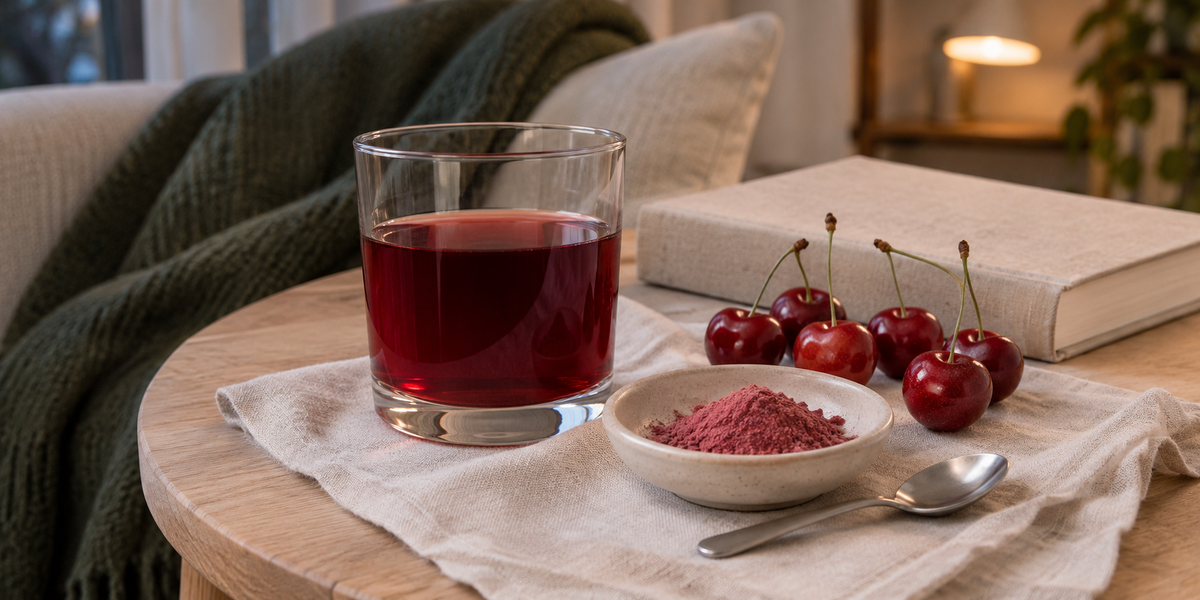
Could a tart cherry drink really help you sleep better?
It's an intriguing question, especially for something as familiar as fruit.
In a small clinical trial involving older adults with insomnia, researchers found that drinking tart cherry juice was associated with approximately 84 additional minutes of sleep compared with a placebo. Another study involving physically active adults reported improvements in sleep duration and sleep efficiency.
Those findings helped turn tart cherries into an unexpected subject of sleep research.
And there's an interesting reason scientists began looking at this fruit: tart cherries naturally contain melatonin, a hormone involved in regulating the body's sleep–wake cycle, along with anthocyanins and other plant compounds.
But the story doesn't end with a couple of positive studies.
In September 2026, researchers published a systematic review and meta-analysis of 10 randomized controlled trials involving 294 participants. Their findings offered a broader perspective: while certain studies reported improvements, the combined evidence did not demonstrate a statistically significant overall improvement in sleep quality across the different populations studied.
So what should we make of all this?
Tart cherries have shown promising sleep-related effects in some human studies, particularly small trials involving people with insomnia. But the overall evidence is mixed, and the effects of ordinary tart cherry juice powder have not been established in the same way.
Understanding why makes this fruit even more interesting.
Why Have Tart Cherries Become Associated With Better Sleep?
Tart cherries belong to the species Prunus cerasus, commonly called sour cherries.
They're different from the sweet cherries typically eaten fresh during summer. Tart cherries have a sharper, more acidic flavor and are frequently used in juices, concentrates, dried fruit products, and other food preparations.
One variety in particular, Montmorency tart cherry, appears frequently in published sleep research.
Montmorency cherries are widely grown in the United States and have attracted scientific interest because of their naturally occurring plant compounds.
Two groups of substances are especially relevant to the sleep conversation:
-
Melatonin, a naturally occurring compound involved in sleep–wake regulation.
-
Polyphenols, including anthocyanins, which have been studied for their biological activity.
Together, these have given researchers several reasons to investigate whether tart cherry consumption might influence sleep.
But the most compelling part of the story comes from actual human experiments.
What Have Human Studies Found About Tart Cherries and Sleep?
Unlike many food trends built mainly around laboratory experiments, tart cherry has been tested in randomized controlled trials.
The results are worth examining individually because different researchers have studied different people, different preparations, and different aspects of sleep.
The 2012 Study: Improvements in Sleep Duration and Efficiency
In 2012, researchers led by Glyn Howatson published a study in the European Journal of Nutrition.
The trial involved 20 healthy, physically active adults.
Participants consumed Montmorency tart cherry juice concentrate or a placebo during separate seven-day periods in a randomized crossover design.
The tart cherry protocol involved 30 mL of concentrate twice daily, diluted with water.
Researchers used actigraphy, a method of estimating sleep and wake patterns through movement monitoring, to evaluate sleep-related outcomes.
The study reported improvements in several measures, including total sleep time, time in bed, and sleep efficiency.
Total sleep time increased by approximately 34 minutes in the tart cherry condition compared with placebo.
Researchers also observed an increase in urinary measurements of a melatonin metabolite.
These findings were exciting because they suggested that tart cherry consumption might influence both measurable sleep patterns and markers associated with melatonin metabolism.
It was a small study involving healthy, active adults rather than people with diagnosed sleep disorders. Nevertheless, it helped establish tart cherry as a legitimate subject for further sleep research.
Read the 2012 study on PubMed.
The 2018 Study: An Additional 84 Minutes of Sleep
One of the most frequently discussed tart cherry sleep studies was published by Jack Losso and colleagues in the American Journal of Therapeutics.
The researchers investigated Montmorency tart cherry juice in older adults experiencing insomnia.
Eleven participants were initially randomized, but three were excluded after sleep testing identified sleep apnea. Eight participants completed the trial.
During the tart cherry condition, participants drank approximately 240 mL of tart cherry juice twice daily for two weeks.
One serving was consumed in the morning, and another in the evening.
Sleep was evaluated using polysomnography, a laboratory-based method that measures physiological signals during sleep.
The researchers found that sleep time increased by approximately 84 minutes during the tart cherry condition compared with placebo.
They also reported an improvement in habitual sleep efficiency measured through the Pittsburgh Sleep Quality Index.
That's a striking result for a food-based intervention.
However, the study involved only eight completers. It provides an interesting experimental finding, not a reliable estimate of what an average consumer should expect from drinking tart cherry juice.
The study also explored a possible explanation involving tryptophan metabolism, which we'll examine shortly.
The 2024 Study: A Different Result From Tart Cherry Powder
Not every tart cherry trial has produced positive findings.
In a randomized crossover study published in Nutrients in 2024, researchers investigated Montmorency tart cherry powder capsules in 34 adults with sleep concerns and overweight or obesity.
Participants received a 500 mg dose of tart cherry powder or placebo before bedtime for 14 days.
Unlike the earlier juice studies, this trial did not demonstrate significant improvements in the measured sleep outcomes compared with placebo.
The researchers also did not observe meaningful differences in the inflammatory markers they evaluated.
Why is this study important?
Because it illustrates how results can differ when researchers change the preparation, participants, or experimental design.
The study tested a particular powder capsule preparation, not a reconstituted tart cherry juice powder used as an everyday food ingredient.
It also doesn't cancel out the earlier findings.
Instead, it adds another important piece to a growing body of research.
The 2026 Meta-Analysis: Putting the Results Together
Individual studies can produce intriguing results, but scientists also want to understand what happens when the available evidence is examined collectively.
In September 2026, Jonathan Sinclair, Lauren Baker, and Lindsay Bottoms published a systematic review and meta-analysis in Recent Progress in Nutrition.
The researchers examined 10 randomized controlled trials involving 294 enrolled or randomized participants.
The studies involved different groups, including healthy adults, athletes, and people experiencing insomnia. They also used different tart cherry products, from juice and concentrates to capsules and powders.
Across the combined evidence, the researchers found no statistically significant overall improvement in sleep quality.
However, a subgroup analysis involving two small trials of participants with insomnia showed a statistically significant improvement.
This distinction is important.
The overall finding suggests that tart cherry supplementation has not consistently improved sleep quality across the different groups studied.
The insomnia subgroup suggests that certain populations may be worth investigating more closely.
It is an interesting signal, although the small number of studies means it remains preliminary.
Tart Cherry Sleep Research at a Glance
| Study | Participants and Preparation | Main Finding | What Makes It Important |
|---|---|---|---|
| Howatson et al., 2012 | 20 healthy, active adults; Montmorency concentrate for 7 days | Improved total sleep time, sleep efficiency, and urinary melatonin metabolite measures | Demonstrated measurable sleep-related changes in a small controlled trial |
| Losso et al., 2018 | 8 completers with insomnia; tart cherry juice for 14 days | Approximately 84 additional minutes of sleep in the cherry condition versus placebo | Provided an intriguing result in people experiencing insomnia |
| Tucker et al., 2024 | 34 adults with sleep concerns; 500 mg tart cherry powder capsules for 14 days | No significant improvement in measured sleep outcomes versus placebo | Showed that results are not consistently positive across preparations and populations |
| Sinclair et al., 2026 | Systematic review and meta-analysis of 10 RCTs involving 294 participants | No significant overall sleep-quality improvement; positive signal in a two-trial insomnia subgroup | Offers the broadest quantitative perspective on the available evidence |
The collective research tells us something more useful than a simple yes-or-no answer.
Tart cherry is a fruit with measurable biological properties and intriguing findings in specific human trials. Whether those findings translate into consistent sleep benefits depends on questions researchers are still investigating.
Why Did the 2026 Review Find Mixed Results?
At first glance, the findings might seem contradictory.
How could one study report an additional 84 minutes of sleep while a later meta-analysis finds no significant overall benefit?
There are several explanations.
The participants were different
Some studies recruited healthy adults who were already sleeping reasonably well.
Others investigated recreational athletes or people with specific sleep complaints.
Two small studies involved participants with insomnia.
A food intervention might produce different measurable effects depending on the population being studied.
Researchers used different tart cherry preparations
Some trials used tart cherry concentrate.
Others used full juice, freeze-dried products, or powder capsules.
Even when the starting fruit is the same, these preparations can differ in their composition and concentration.
Sleep was measured in different ways
Sleep researchers use several methods.
Actigraphy estimates sleep and wake patterns from movement.
Polysomnography measures physiological signals during sleep.
Sleep questionnaires capture a person's perception of sleep quality, difficulty falling asleep, or nighttime waking.
These methods provide different types of information, and they don't always produce identical results.
Most studies were relatively small
Small trials can help identify promising effects.
But their results can also be sensitive to participant characteristics, study design, and measurement differences.
The 2026 meta-analysis helped put these individual findings into context.
The researchers reported a pooled effect for overall sleep quality of Hedges' g = 0.064 (95% CI −0.147 to 0.275; P = 0.552).
That result was not statistically significant.
In the insomnia subgroup, however, the pooled effect was Hedges' g = 0.732 (95% CI 0.051 to 1.412; P = 0.035).
This result was statistically significant, but it came from only two small trials.
In other words, the overall findings are mixed, but the research has identified specific questions worth exploring further.
Read the September 2026 meta-analysis.
Does Tart Cherry Really Contain Melatonin?
Yes. Tart cherries have been documented to contain naturally occurring melatonin.
This is one of the main reasons scientists became interested in studying them in relation to sleep.
Melatonin is a hormone involved in communicating information about the body's day–night cycle.
Its production is closely associated with darkness, and it plays an important role in the timing of sleep and wakefulness.
Naturally occurring melatonin has been identified in several foods, including tart cherries.
But there's a difference between discovering melatonin in fruit and demonstrating that eating that fruit produces a specific sleep effect.
How Much Melatonin Is in Tart Cherry?
The amount varies.
Different cultivars, growing conditions, harvest periods, and processing methods can influence the measured composition of cherry products.
In the 2012 Howatson study, researchers reported approximately 1.42 micrograms of melatonin per milliliter of the specific tart cherry concentrate used.
At the study's intake of 30 mL twice daily, that represented approximately 85 micrograms of melatonin per day.
For perspective, 85 micrograms equals 0.085 milligrams.
This is substantially less than the milligram-level doses commonly studied in melatonin supplement research.
That comparison highlights a useful distinction:
Tart cherry is a food containing naturally occurring melatonin, not a standardized melatonin supplement.
The amount present in a particular finished tart cherry juice powder also cannot be determined simply from the fruit's reputation.
It depends on the specific ingredient and how it was produced.
Is Melatonin the Whole Explanation?
Probably not.
The 2026 meta-analysis examined melatonin-related measurements across the studies that reported them.
The combined analysis did not find a statistically significant increase in melatonin markers compared with placebo.
That does not rule out melatonin-related effects in individual settings.
But it suggests that the relationship between tart cherries and sleep may be more complicated than the simple idea that consuming cherries delivers enough melatonin to make someone sleepy.
Scientists have therefore investigated other compounds and pathways.
What About Anthocyanins and Other Cherry Polyphenols?
Tart cherries are rich in color, and that color tells us something about their plant chemistry.
Their deep red appearance comes partly from anthocyanins, a family of naturally occurring pigments belonging to the flavonoid group of polyphenols.
Anthocyanins are also found in other colorful plant foods, including blueberries, blackberries, and purple sweet potatoes.
Tart cherries contain additional phenolic compounds, including certain flavanols and phenolic acids.
Researchers have investigated these substances in connection with antioxidant activity, inflammatory signaling, and other biological processes.
An Interesting Connection to Tryptophan
The 2018 Losso trial explored a mechanism involving tryptophan.
Tryptophan is an amino acid used by the body in several metabolic pathways, including pathways involved in serotonin and melatonin production.
One pathway converts tryptophan into kynurenine.
Researchers have investigated how enzymes involved in this conversion respond to inflammatory signaling and other physiological conditions.
In the Losso study, participants showed changes in the ratio of kynurenine to tryptophan after consuming tart cherry juice.
The researchers also investigated whether a cherry compound called procyanidin B-2 could influence an enzyme involved in tryptophan metabolism.
Their laboratory findings suggested a possible mechanism deserving further research.
This doesn't establish that tart cherry juice reliably raises melatonin or serotonin levels in consumers.
But it offers another scientifically interesting explanation for why researchers are studying the fruit.
Why This Matters
Tart cherry is not simply a source of one isolated compound.
It's a complex fruit containing naturally occurring melatonin, anthocyanins, and other plant constituents.
These compounds may help researchers understand how tart cherry preparations interact with biological systems.
The challenge is identifying which compounds matter, in what amounts, and under which conditions.
That is a much more interesting scientific question than simply asking whether cherries contain melatonin.
Tart Cherry Juice vs. Concentrate vs. Powder: Does the Form Matter?
Imagine reading that a tart cherry concentrate improved sleep duration in a clinical trial.
You then discover tart cherry juice powder online.
Both come from tart cherries.
Does that mean they are equivalent?
Not necessarily.
The starting material, processing method, concentration, and finished composition can vary considerably.
Understanding the differences helps consumers interpret the research more accurately.
| Product Form | How It's Made | Key Characteristics | Relationship to Sleep Research |
|---|---|---|---|
| Tart Cherry Juice | Juice obtained from tart cherries | Liquid preparation; composition varies with fruit, processing, and formulation | Used in certain human sleep studies, including the 2018 Losso trial |
| Tart Cherry Juice Concentrate | Tart cherry juice with some water removed | More concentrated than ordinary juice by volume; composition depends on the specific preparation | Used in the 2012 Howatson trial and other studies |
| Tart Cherry Juice Powder | Tart cherry juice processed into a dried powder | Convenient food format; composition depends on the starting juice and drying process | Research on juice and concentrate provides context, but not direct evidence for every finished juice powder |
| Tart Cherry Fruit Powder or Capsules | Fruit-derived powder or another specific powdered preparation | May contain different fruit components depending on how it is produced | Some sleep trials used powder capsules, including the 2024 Tucker study |
Why Processing Makes a Difference
Fruit contains different types of substances.
Some are concentrated in the juice.
Others are associated with the skin, pulp, or other parts of the fruit.
When cherries are juiced, concentrated, dried, or processed into an extract, the resulting ingredient may contain different proportions of those constituents.
Drying conditions can also influence the retention of certain compounds, including anthocyanins.
That's why studies conducted using a particular concentrate don't automatically establish the same effects for a powder made through a different process.
However, those studies remain useful for understanding the broader science of tart cherries.
What About Tart Cherry Juice Powder?
Tart cherry juice powder offers a different way to use the fruit.
Instead of pouring liquid juice, consumers can incorporate a juice-derived powder into drinks and recipes.
Its practical appeal comes from its fruit flavor, versatility, and shelf-stable format.
When considering any specific product, the most informative details are its ingredient form, actual composition, and available product-specific information.
For compounds such as melatonin and anthocyanins, measured amounts in the finished product are more meaningful than general figures drawn from unrelated cherry studies.
Is There a Best Time to Enjoy Tart Cherry Juice Powder?
Tart cherry drinks frequently appear in discussions about evening routines.
That makes sense given the fruit's association with sleep research.
But is there a scientifically established best time to drink tart cherry juice powder?
Not at present.
Published studies have used different schedules.
In the 2018 Losso trial, participants consumed tart cherry juice in the morning and again approximately one to two hours before bedtime.
In the 2012 Howatson study, participants consumed concentrate twice daily.
The 2024 Tucker trial involved capsules taken approximately one hour before bedtime.
These schedules were part of the respective study designs.
They were not direct comparisons designed to identify the best drinking time for ordinary tart cherry juice powder.
For everyday culinary use, tart cherry powder can be enjoyed whenever its flavor fits your routine.
Some people may prefer a tart cherry drink in the evening, while others may enjoy it in smoothies, breakfast bowls, or other recipes during the day.
The important distinction is between a personal food preference and a clinically established sleep schedule.
Can Tart Cherry Juice Powder Replace Melatonin Supplements?
Tart cherry juice powder and melatonin supplements are different types of products.
Melatonin supplements provide specific labeled doses of melatonin.
Tart cherry juice powder is a fruit-derived ingredient containing a mixture of naturally occurring plant compounds.
Although melatonin has been identified in tart cherries, no reliable dose equivalence has been established between ordinary tart cherry juice powder and melatonin supplements.
The fruit's broader phytochemical composition is part of what makes tart cherry research interesting.
But its natural melatonin content should not be treated as interchangeable with a measured supplement dose.
Why Tart Cherry Juice Powder Is Also Worth Exploring in the Kitchen
There's another reason tart cherry deserves attention, and it has nothing to do with sleep research.
Its flavor is distinctive.
Compared with sweet cherries, tart cherries have a brighter, sharper taste that can bring contrast to drinks and food.
That combination of fruitiness and acidity makes tart cherry juice powder useful in a surprising variety of everyday recipes.
Tart Cherry Sparkling Water
Mix tart cherry juice powder with a little water to disperse it, then add sparkling water for a refreshing fruit drink.
Its naturally tart character pairs well with citrus or other fruit flavors.
Tart Cherry Smoothies
Tart cherry works well alongside banana, berries, yogurt, and preferred milk alternatives.
The tartness can provide contrast to sweeter ingredients.
Yogurt and Overnight Oats
Stir tart cherry juice powder into plain yogurt or overnight oats for fruit flavor and a red berry color.
It can also be paired with granola, fresh fruit, or nuts.
Sauces and Dressings
The tart character of cherry makes it an interesting ingredient in fruit-based sauces, vinaigrettes, and selected savory preparations.
It pairs especially well with ingredients that balance acidity with warmth or sweetness.
Everyday Baking
Tart cherry juice powder can also be incorporated into suitable baked goods for a fruity, slightly tangy flavor.
As with other fruit-derived powders, its behavior depends on the recipe and how the powder is incorporated.
These applications offer plenty of reasons to explore tart cherry as a food ingredient, whether or not you're particularly interested in its connection to sleep.
You can also explore the wider Unleash'd Organic Fruit & Juice Powders Collection for other fruit-derived ingredients.
How to Evaluate a Tart Cherry Juice Powder
If you're comparing tart cherry products, a few details are especially useful.
Check the ingredient form. Is it juice powder, whole-fruit powder, concentrate, or an extract?
Read the ingredient list. Products with similar names may have different formulations.
Review the Nutrition Facts. The finished product's declared nutritional values are more relevant to your everyday food choices than general information about fresh tart cherries.
Look for measured compounds when relevant. If a brand makes a specific claim about melatonin or anthocyanin content, product-specific testing provides more useful information than broad claims about the fruit.
Understand what organic certification means. Organic certification relates to applicable production and handling standards. It doesn't establish a specific melatonin concentration or sleep benefit.
Knowing these differences makes it easier to compare products based on what they actually contain and how you intend to use them.
Frequently Asked Questions
Can tart cherry juice powder really help you sleep?
Some human trials involving tart cherry juice or concentrate have reported improvements in sleep duration or other sleep measures. However, a 2026 meta-analysis of 10 randomized trials did not find a statistically significant overall improvement in sleep quality across mixed populations. A subgroup involving two small insomnia trials showed a promising signal. Ordinary tart cherry juice powder has not been established to produce the same outcomes.
Does tart cherry naturally contain melatonin?
Yes. Certain tart cherry varieties contain naturally occurring melatonin. The amount varies with the cultivar, growing conditions, and processing. A specific finished juice powder's melatonin content would need to be measured rather than assumed from studies involving other preparations.
Why are Montmorency cherries frequently mentioned in sleep research?
Montmorency is a widely grown tart cherry variety used in several published clinical studies. Its natural compounds have been investigated in relation to sleep and other biological outcomes. Not every tart cherry product is necessarily made from Montmorency cherries.
Is tart cherry juice powder the same as tart cherry juice concentrate?
No. Concentrate is a juice product with some water removed, while juice powder is a dried product made from juice. Their composition, concentration, and preparation can differ. Clinical research involving one form does not automatically establish identical results for another.
Should tart cherry juice powder be consumed before bedtime?
There is no established optimal bedtime schedule for ordinary tart cherry juice powder. Clinical studies have used different timing protocols, but those protocols were not designed to establish one universally effective schedule. For everyday food use, timing can be based on personal preference.
Can tart cherry juice powder replace a melatonin supplement?
No clinical equivalence has been established. Tart cherry juice powder is a fruit-derived food ingredient, while melatonin supplements contain specified doses of the hormone. Their composition and supporting research differ.
Final Thoughts: What Makes Tart Cherry So Interesting?
Tart cherry has become an interesting subject in modern food and sleep research.
Scientists have identified naturally occurring melatonin and several groups of polyphenols in the fruit.
Small human trials have reported improvements in certain sleep outcomes, including sleep duration and efficiency.
At the same time, a broader 2026 analysis found that the available studies do not yet demonstrate a consistent overall sleep-quality benefit across different populations.
Both findings are part of the same scientific story.
The positive studies tell us why researchers became interested.
The larger evidence review helps us understand how much confidence to place in those individual results.
And the differences among juices, concentrates, and powders remind us that the particular preparation matters.
For consumers, tart cherry offers more than a simple sleep-related claim.
It's a flavorful, colorful fruit with a distinctive natural composition and a growing body of research behind it.
Whether you're interested in the science of sleep or simply enjoy exploring plant-based ingredients, tart cherry is a fruit worth getting to know.
Discover more colorful fruit ingredients in the Unleash'd Organic Fruit & Juice Powders Collection.
Scientific References
-
Sinclair JK, Baker L, Bottoms LM. (2026). Effects of Tart Cherry (Prunus cerasus) Supplementation on Overall Sleep Quality, Melatonin, and Inflammatory Biomarkers: A Systematic Review and Meta-Analysis. Recent Progress in Nutrition, 6(3), 024. Read the study.
-
Howatson G, et al. (2012). Effect of tart cherry juice (Prunus cerasus) on melatonin levels and enhanced sleep quality. European Journal of Nutrition, 51, 909–916. PubMed.
-
Losso JN, et al. (2018). Pilot Study of the Tart Cherry Juice for the Treatment of Insomnia and Investigation of Mechanisms. American Journal of Therapeutics. Full text.
-
Tucker RM, et al. (2024). Commonly Used Dose of Montmorency Tart Cherry Powder Does Not Improve Sleep or Inflammation Outcomes in Individuals with Overweight or Obesity. Nutrients, 16(23), 4125. PubMed.

Leave a comment
This site is protected by hCaptcha and the hCaptcha Privacy Policy and Terms of Service apply.